Updated Updated August 28, 2026
Table of Contents
- United Airlines Infant Policy Overview
- Lap Infant vs Seat With Car Seat vs Bassinet
- How to Get a Bassinet on United
- Stroller, Car Seat, and Diaper Bag Allowance
- TSA Rules for Formula, Breast Milk, and Baby Food
- Family Seating: Sitting Together for Free
- Onboard: Bottles, Changing Tables, Boarding
- Domestic vs International Cost Breakdown
- Quick Checklist
- FAQ
Yes, you can fly United Airlines with a baby starting at 7 days old. Babies under 2 travel free as a lap infant on US domestic flights, or you can book a separate seat and bring an FAA-approved car seat. Bassinets exist on select international widebody flights but are limited and never guaranteed, so it’s worth understanding all three options before you book.
I haven’t personally flown United with my daughter, our own flights together have been on European carriers, so everything airline-specific in this guide is carefully researched and sourced rather than lived. That said, the general realities of flying with a baby, the aisle seat that becomes non-negotiable, the ear pressure question, the liquids rule at security, apply no matter which airline you’re on, and I’ll flag clearly which parts come from my own experience versus research.
United Airlines Infant Policy Overview
United defines an infant as a child between 7 days and 2 years old. Under that age range, your baby can travel on your lap at no cost on US domestic flights, including Puerto Rico and the US Virgin Islands. Once your child turns 2, they need their own paid seat, even on the return leg of a trip booked while they were still under 2.
The essentials at a glance:
- Minimum age: 7 days old. A newborn younger than that may need a physician’s note.
- Documents: a birth certificate to prove your baby’s age, plus a passport for any international itinerary.
- Lap infant, US domestic: free, no ticket required, just add the infant when booking.
- Lap infant, international: a ticket is required and taxed, usually around 10% of the adult fare.
- One lap infant per adult. Traveling solo with twins under 2 means buying a second seat.
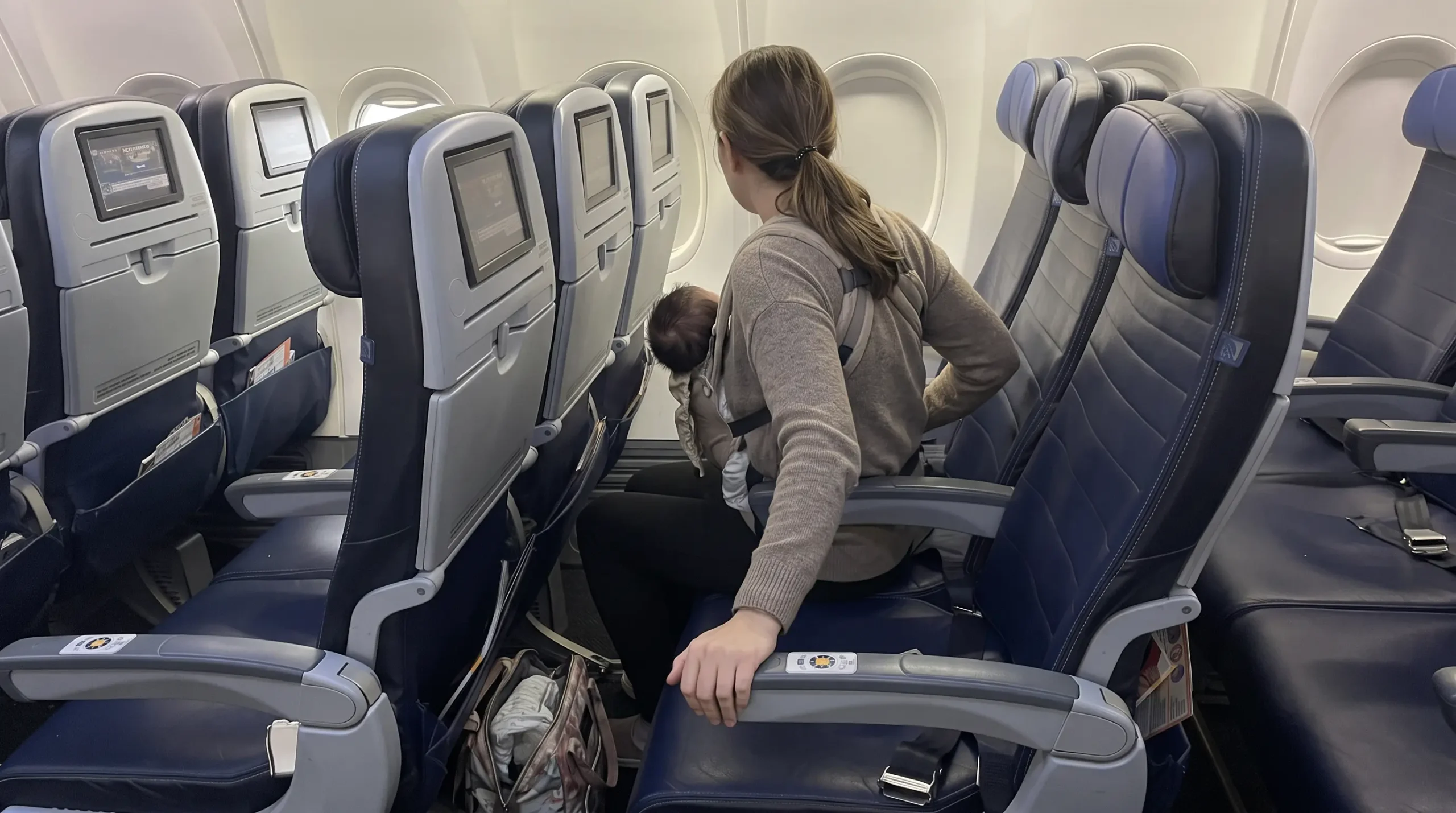
Key term: Lap infant. A lap infant is a baby under 2 who travels held on an adult’s lap rather than in their own seat. It’s the free option on US domestic United flights, but it means no separate seat, no bassinet guarantee, and no car seat use unless you’ve also purchased a seat for your baby.
If you didn’t add your baby when you first booked, don’t worry, you can still add an infant to an existing United reservation through “Manage my booking” online, at check-in, or by calling United directly. It’s a quick fix, not a reason to panic if it slipped your mind during a sleep-deprived booking session.
Sources: United Airlines flight reservations FAQ, NerdWallet (guide to United Airlines infant policy), Velivolo (United Airlines child travel policy, published policy summary).
Lap Infant vs Seat With Car Seat vs Bassinet: Which Should You Choose?
United gives you three ways to fly with a baby under 2: free on your lap, in a purchased seat with an FAA-approved car seat, or in a bassinet on select international widebody flights. Each comes with a different tradeoff between cost, comfort, and how much you can actually count on it before departure.
Which one fits your situation:
- Short domestic flight, tight budget: lap infant is the practical default.
- Long-haul or overnight flight, budget allows it: a seat with a car seat gives your baby a real place to sleep and you a bit of your lap back.
- International widebound route, flexible expectations: request a bassinet as a bonus, but plan as if you won’t get one.
Key term: FAA-approved car seat. Only car seats labeled for use on aircraft are allowed during takeoff, landing, and taxi. Check the label on your seat before travel, standard car seats without this certification will be turned away at boarding, even if you’ve paid for the extra seat.
My honest take, from flying with my own daughter on other airlines: a purchased seat with a car seat is the most comfortable option by far, but it’s also the most expensive, and for a short flight it rarely feels worth it. On longer or overnight flights, the extra space and the ability to let your baby sleep somewhere other than your arms changes the whole experience.
Sources: United Airlines flight reservations FAQ, Velivolo (United Airlines child travel policy), NerdWallet (guide to United Airlines infant policy).
How to Get a Bassinet on United
To get a bassinet on United, call the airline directly after booking to request a bulkhead seat, then confirm the request again at check-in and at the gate, since bassinets are assigned on a first-come basis and are never guaranteed no matter how early you ask. They’re only available on select international widebody aircraft, not on domestic flights.
Where bassinets exist on United’s fleet:
- 757-200 and 757-300
- 767-300ER and 767-400
- 777-200 and 777-300ER
- 787-8, 787-9, and 787-10
All of these are used on United’s international routes. If your domestic itinerary connects through one of these aircraft on an international leg, the bassinet only applies to that leg.
Why this matters: United’s economy bassinet weight cap beats Singapore Airlines (14 kg) and Emirates (11 kg), so if your baby is on the larger side, United’s bassinet stays usable for longer than on many other international carriers.
The realistic step-by-step
- Call after booking. Contact United’s Customer Contact Center to request the bulkhead bassinet seat, this can’t always be done through the standard online booking flow.
- Confirm again at check-in. Bassinet requests noted at booking can still fall through if the aircraft changes.
- Ask again at the gate. Being among the first at the gate to ask genuinely improves your odds, since assignment is largely first-come.
- Bring your own sleep sack or swaddle. A blanket isn’t always provided for the bassinet itself.
- Have a backup plan. A carrier or baby wrap that lets your baby sleep against you is your fallback if the bassinet doesn’t come through.
A note on expectations: even families who do everything right, book early, call ahead, arrive first at the gate, sometimes still don’t get a bassinet if the aircraft is swapped or the bulkhead rows fill with elite-status upgrades. Treat it as a genuine bonus if it happens, not a guaranteed part of your plan.
Sources: Velivolo (United Airlines child travel policy, published bassinet specifications), Flying With A Baby (United Airlines bassinet request process).
United Baby Baggage Policy: Stroller, Car Seat, and Diaper Bag Allowance
United lets you check one stroller and one car seat per child completely free, on top of your regular baggage allowance, and your diaper bag doesn’t count against your carry-on limit either. This is one of the more generous parts of flying with a baby on United, and it’s worth knowing exactly how it works so you’re not caught paying for something that should be free.
What’s free, per child:
- One stroller or folding wagon, checked at no additional cost
- One car seat, checked at no additional cost
- One diaper bag, carried on in addition to your normal carry-on and personal item allowance
- Formula, breast milk, and baby food, don’t count toward your liquids limit either, more on that in the TSA section
Where to check the stroller
Small, compact strollers, the kind designed to fold down to carry-on size like a Doona, can often be gate-checked, meaning you use it right up to the jet bridge and hand it off just before boarding. Larger strollers or wagon-style strollers like a Wonderfold typically need to be checked at the counter during check-in instead, since they won’t fit through the gate-check process the same way.
Practical tip: gate-checking your stroller means you keep it through security and the entire terminal, which is genuinely one of the best conveniences of flying with a baby. Only larger models force the earlier counter check, so if stroller size is flexible for your trip, a compact fold-down model buys you more mobility at the airport.
What to bring in the diaper bag
Since your diaper bag rides free alongside your regular carry-on, use it fully: diapers for the whole trip plus a buffer, wipes, a change of clothes for your baby, formula or pumped milk, snacks, and a couple of small toys. On a long-haul or delayed flight, this bag is what stands between a manageable day and a genuinely hard one, so don’t try to minimize it just because it’s “extra” weight to carry.
Sources: Expedition Parenthood (flying United with a baby or toddler, baggage allowance experience), Kids On A Plane (United Airlines flying with kids policy), Velivolo (United Airlines child travel policy, stroller gate-check details).
TSA Rules for Formula, Breast Milk, and Baby Food When Flying United
Baby formula, breast milk, and baby food are exempt from the standard 3.4-ounce liquid limit at every US security checkpoint, including the ones you’ll pass through for a United flight, in any reasonable quantity, without needing to fit in your quart-sized bag. You don’t even need to be traveling with your baby to carry breast milk through security.
What’s exempt from the standard liquid rule:
- Baby formula, prepared or powdered
- Breast milk, in any quantity, even if you’re traveling without your baby
- Baby food, including pouches and glass jars
- Toddler drinks and juice
- Ice packs, gel packs, and freezer packs used to keep any of the above cold, even if partially melted or slushy
Key term: Reasonable quantity. TSA doesn’t publish an official maximum volume for baby liquids, its policy simply says “reasonable quantities.” In practice, this means packing enough for your full travel day, including layovers and possible delays, without raising questions. Most experienced traveling parents bring one to two days’ worth without issue.
How to move through the checkpoint smoothly
- Declare it. Tell the TSA officer you’re carrying formula, breast milk, or baby food before screening starts, this is the single biggest thing that speeds things up.
- Take it out of your bag. These items should be removed from your carry-on for separate screening, just like laptops.
- Use clear, translucent bottles when you can. TSA recommends this because opaque containers or pouches sometimes can’t be read by bottle liquid scanners, which can trigger additional screening.
- Know your rights. TSA officers cannot require you to taste, open, or consume breast milk, formula, or baby food to prove it’s safe. They may test it for explosives using alternate methods like X-ray or trace detection instead.
If your cooler or bag needs additional screening, staying calm and factual helps more than anything else. A simple, “This contains breast milk and gel packs, they’re exempt from the standard liquid rule even if the ice is melted,” is usually all it takes to move things along.
Sources: TSA.gov (official baby formula screening guidance), Autopilot (TSA liquid rules 2026, exemption details), Milk & Baby (flying with breast milk, TSA rights and scripts).
Family Seating on United: How to Sit Together for Free
United uses a dynamic seat map that automatically searches for adjacent seats when you’re traveling with a child under 12, including on Basic Economy fares, and opens up free Preferred seats if standard Economy is full. If no adjacent seats exist at all, United lets you switch to another flight to the same destination with available adjacent seating, at no extra fare difference.
Worth knowing before you rely on it: reporting on this policy is mixed. Some sources describe it as a guarantee regardless of fare type, others classify United alongside Delta and Southwest as offering “best effort” seating rather than a hard guarantee, since no federal rule currently requires free family seating in the US. In practice, treat United’s tool as a strong, genuinely helpful system, but not an ironclad promise the way it is on the handful of airlines that formally guarantee it (Alaska, American, Frontier, Hawaiian, and JetBlue, as of 2026).
How United’s seat map tool actually works:
- Reviews all available free Economy seats first
- Opens up complimentary Preferred seats if standard Economy doesn’t have enough adjacent pairs
- Applies even to Basic Economy tickets, which normally don’t include free seat selection at all
- Does not apply to Polaris, First, or Economy Plus cabins
- If adjacent seats aren’t available anywhere, you can switch to a different flight to the same destination for free
How to give yourself the best odds
- Book your child on the same reservation as the accompanying adult. The tool only works within one booking.
- Book early. Adjacent seats fill up as a flight sells, so the sooner you book, the more the seat map has to work with.
- Check the seat map again after booking. Seats open up as other passengers change plans, so a quick look a few weeks and again a few days before departure can reveal better options.
- If your seats separate after an aircraft swap, contact United directly, this is exactly the scenario their free-flight-switch policy is meant to cover.
From experience flying with my own daughter, even without this specific tool: a full flight with a lap infant and separated seats is genuinely stressful, so I’d treat this feature as one more reason to book as early as your plans allow rather than leaving seat assignment for the week before departure.
Sources: United Airlines newsroom (family seating policy announcement), The Points Guy (2026 guide to airline family seating policies), GorillaFare (how airline family seating works, 2026 parent guide), DeepArrival (airline family seating rules and DOT status, 2026).
Onboard With a Baby on United: Bottles, Changing Tables, and Boarding
United flights aren’t equipped to heat baby bottles directly, but flight attendants can provide hot water or ice on request to warm or cool a bottle yourself. Changing tables exist on certain aircraft types, and United offers priority boarding for families along with a few kid-specific extras worth knowing about before you fly.
What’s available onboard:
- Hot water or ice on request to warm or cool a bottle, ask a flight attendant directly
- Changing tables in select lavatories on certain aircraft, a flight attendant can point you to the right one
- Kids amenity kits on many flights
- Pre-order kids’ meals on longer routes, typically requested ahead of time
- A dedicated kids’ content channel in United’s entertainment system for younger passengers
Practical tip, from my own flights with my daughter on other airlines: the little fold-down changing table tucked in the lavatory wall isn’t always obvious. I make a habit of locating it as soon as I board, before I actually need it in a hurry, rather than searching for the handle mid-emergency with a squirming baby.
Boarding: priority isn’t always automatic
United offers family boarding for passengers traveling with young children. On other airlines I’ve flown, I’ve noticed that priority boarding for families isn’t always offered spontaneously, some airlines apply it automatically, others only if you ask directly at the gate, so it’s worth checking your boarding group and, if in doubt, simply asking the gate agent: “I’m traveling with a baby, can I board with the family group?” It costs nothing to ask.
Board first or last? It depends on your situation
Boarding early gives you time to settle in, organize your bag, and get set up before the aisle fills with other passengers, genuinely useful if you’re traveling solo or have a lot of gear. Boarding later means less time confined to your seat with a baby who’d rather move. Neither is objectively better, it depends on whether extra settling time or extra freedom to move matters more for your specific trip.
On solo travel specifically: in my own experience, other passengers are often quick to offer help when they see you managing a baby, a stroller, and bags alone, more so than when you’re visibly traveling with a partner. Don’t hesitate to accept, or even ask, “Could you hold this for a second?” usually gets a warm yes.
Sources: Kids On A Plane (United Airlines flying with kids policy), Upgraded Points (ultimate guide to flying United Airlines with kids), Familieslovetravel (United Airlines policies for kids).
United Airlines Baby Fees: Domestic vs International Cost Breakdown
Flying with a lap infant on United costs nothing on US domestic routes, taxes only between the US, Canada, and Mexico, and roughly 10% of the adult fare on international flights. The exact amount depends entirely on your route and fare type, so here’s the full breakdown before you book.
Other cost scenarios to know:
- Booking with MileagePlus miles: a lap infant is charged 10% of the revenue fare in miles or cash, even on an award ticket.
- Front cabin upgrades: a lap infant traveling on an adult’s upgraded front cabin seat pays 10% of the applicable front cabin fare on international routes.
- A purchased seat for your baby: full child fare applies, whether you use a car seat or not, since you’re occupying a full seat either way.
Book the infant fare in advance when it’s required. Waiting until check-in to add an international lap infant is usually more expensive than adding them during the original booking, since last-minute infant fares aren’t always priced the same as advance ones.
The overall pattern is simple even if the exceptions feel fiddly: the more your itinerary crosses a border, the more likely it is that your baby needs a ticket, even as a lap infant. Domestic-only trips within the US stay free, everything else layers on some cost.
Sources: NerdWallet (guide to United Airlines infant policy), Kids On A Plane (United Airlines flying with kids policy), Flyingrules.com (United infant fare structure, cross-checked against NerdWallet).
Quick Checklist: Flying United With a Baby, Step by Step
Here’s the entire guide condensed into an order you can actually follow, from booking to boarding. Work through it in sequence and you’ll cover everything that matters.
At booking: add your infant to the reservation, choose lap infant or a paid seat with car seat, and call ahead if you want to request a bassinet on an eligible international widebody route
Documents: birth certificate for age verification, passport if traveling internationally
Pack the diaper bag as a free extra carry-on: diapers, wipes, spare outfit, formula or milk, snacks, a couple of small toys
Check in your stroller and car seat at the counter (larger models) or plan to gate-check (compact fold-down models)
At security: remove formula, breast milk, and baby food from your bag, declare them to the TSA officer, use clear bottles if possible
Check the seat map again before departure, seats open up as other passengers’ plans change
At the gate: confirm your bassinet request if applicable, ask about family boarding if it isn’t automatically offered
Once onboard: locate the changing table, and ask a flight attendant for hot water or ice if you need to warm or cool a bottle
If something doesn’t go to plan, most of what feels like a crisis at the gate, a missing bassinet, a seat that didn’t come through, a stroller question, has a workable fix. A calm, direct question to a gate agent or flight attendant solves more than it seems like it will in the moment.
Sources: compiled from United Airlines flight reservations FAQ, TSA.gov, and the airline policy sources cited throughout this guide.
What is United Airlines’ baby policy?
Babies from 7 days to 2 years old can fly as free lap infants on US domestic flights, or in a purchased seat with an FAA-approved car seat. International lap infants need a ticket, usually around 10% of the adult fare.
How old does my baby need to be to travel with United Airlines?
United accepts infants from 7 days old. A newborn younger than that may require a physician’s note before being allowed to fly.
Does my baby fly free on United Airlines?
Yes, as a lap infant on US domestic flights. On international flights, or routes to Canada or Mexico, a ticket is required, though it’s discounted compared to a full adult fare.
What is United Airlines’ baby gear and stroller policy?
United checks one stroller and one car seat per child for free, on top of your regular baggage allowance. Compact strollers can often be gate-checked, while larger models typically need to be checked at the counter.
What is United Airlines’ baby formula and baby items policy?
Formula, breast milk, and baby food are exempt from the standard TSA liquid limit in reasonable quantities. Your diaper bag doesn’t count against your regular carry-on allowance either.
Can I bring a car seat on United Airlines?
Yes, if you’ve purchased a seat for your baby. The car seat must be FAA-approved and labeled for aircraft use, standard car seats without this certification aren’t allowed during takeoff, landing, or taxi.
Does United Airlines provide bassinets for babies?
Yes, on select international widebody aircraft, at bulkhead seats. They’re free to request but never guaranteed, assignment is largely first-come at the gate.
How do I add an infant to my United Airlines reservation?
You can add an infant when you first book, or afterward through “Manage my booking” online, at check-in, or by calling United directly.
Will my family be seated together on United Airlines?
United’s dynamic seat map automatically looks for adjacent seats for children under 12, including on Basic Economy fares. It’s a strong system, though some 2026 assessments describe it as “best effort” rather than a formal guarantee.
Can I bring baby food and milk through airport security?
Yes. Formula, breast milk, and baby food are exempt from the 3.4-ounce liquid rule in reasonable quantities. Declare them to the TSA officer and remove them from your bag for separate screening.
Does United Airlines heat baby bottles?
Not directly. Flight attendants can provide hot water or ice on request so you can warm or cool a bottle yourself.
How many lap infants can I bring on United Airlines?
One lap infant per adult passenger. If you’re traveling solo with twins under 2, you’ll need to purchase a separate seat for one of them.
Sources
- United Airlines, flight reservations FAQ
- NerdWallet, guide to United Airlines infant policy
- Velivolo, United Airlines child travel policy
- Expedition Parenthood, flying United with a baby or toddler
- Kids On A Plane, United Airlines flying with kids policy
- Flying With A Baby, United Airlines bassinet guide
- TSA.gov, official baby formula screening guidance
- Autopilot, TSA liquid rules 2026
- Milk & Baby, flying with breast milk in 2026
- United Airlines Newsroom, family seating policy announcement
- The Points Guy, 2026 guide to airline family seating
- GorillaFare, how airline family seating works, 2026
- DeepArrival, airline family seating rules, 2026
- Upgraded Points, ultimate guide to flying United with kids
- Families Love Travel, United Airlines policies for kids
My Verdict
“United’s policies are genuinely generous on paper, free bags, a real family seating tool, formula rules that don’t fight you at security. The gap is always between what’s promised and what’s guaranteed, and that gap is where your own preparation matters most.”
I haven’t flown United with my own daughter, so I won’t pretend to tell you how it feels in the seat. What I can tell you, from every airline I have flown with her, is that the policies on paper rarely match the day exactly, there’s always a gate agent, a swapped aircraft, a bassinet that didn’t come through. Book early, ask directly, and keep a backup plan for the parts nobody can promise you. The rest tends to work itself out.