
Last updated: Updated August 28, 2026
Here’s the question that trips up almost every new parent googling this: “beach” actually means two very different things. Sitting on a shaded towel with your toddler-free newborn is one question. Letting them into the actual water is a completely separate one, with a completely different answer. Most articles blur the two together, which is exactly why this feels more confusing than it needs to be.
Table of Contents
- Can You Take a Newborn to the Beach? (0 to 2 Months)
- Age-by-Age Beach Readiness Table
- Why 6 Months Is the Real Beach Milestone
- Beach vs Ocean vs Lake: Why the Question Isn’t the Same
- When Can Babies Go in the Ocean or Water?
- Sun Safety by Age: Before and After 6 Months
- Do You Need a Beach Bassinet?
- Our First Beach Day: What I Learned at the Lake
- Beach Bag Checklist for Baby’s First Trip
- When to Skip the Beach Day Instead
- FAQ
Can You Take a Newborn to the Beach? (0 to 2 Months)
Yes, a healthy newborn can go to the beach itself, sitting in full shade, as early as a few weeks old, as long as you’re strict about two things: no direct sun, and no overheating. The beach as a physical place isn’t the issue. What’s actually risky at this age is unprotected sun exposure and a baby who can’t yet tell you they’re too hot.
A newborn’s skin is also thinner and more permeable than an adult’s, which is part of why sunscreen isn’t recommended under 6 months in the first place, so shade genuinely has to be your only sun protection tool at this age.
- Full, reliable shade the entire time (umbrella, tent, or beach bassinet)
- Trip timed before 10am or after 4pm, outside peak UV hours
- Short duration, an hour or so rather than a full day
- Baby dressed in light, breathable layers, not overbundled
- Flushed, very red, or unusually pale skin
- Sudden fussiness, lethargy, or floppiness
- Fewer wet diapers than usual, or refusing to feed
- Rapid breathing or a fast heartbeat
Age-by-Age Beach Readiness Table
Here’s the exact-age breakdown that’s missing from most beach guides. Use it as a quick reference, then read the sections below for the “why” behind each stage.
| Age | Sitting on the beach (shade) | Sunscreen | Going in the water |
|---|---|---|---|
| 2 weeks | Yes, short trip, full shade | Not recommended, shade only | No |
| 1 month | Yes, full shade | Not recommended, shade only | No |
| 2 months | Yes, full shade | Not recommended, shade only | Generally no |
| 3 months | Yes, shade, longer trips fine | Not recommended, shade only | Generally no |
| 4 to 6 months | Yes, more flexibility | Still avoid until 6 months | Case by case, ask your pediatrician |
| 6+ months | Yes, standard sun precautions | Yes, mineral sunscreen | Yes, shallow, calm, supervised water |
Note: there’s no single official AAP age cutoff for either beach visits or water immersion, this table reflects common pediatric guidance. Always check with your own pediatrician, especially if your baby was premature or has any health conditions.
Why 6 Months Is the Real Beach Milestone
You’ll see “6 months” repeated everywhere in baby beach advice, but almost nobody explains why. It comes down to three specific, unrelated reasons converging at the same age, not one single rule.
Beach vs Ocean vs Lake: Why the Question Isn’t the Same
For a lot of families, “the beach” actually means a lake, not the ocean, and the two aren’t interchangeable once your baby is old enough to go in the water. Salt water and fresh water carry different risks.
| Ocean beach | Lake beach | |
|---|---|---|
| Water | Salt water, harder for a baby’s kidneys to process if swallowed | Fresh water, gentler if accidentally swallowed |
| Currents and waves | Waves and undertow are common, more caution needed | Usually calmer, flat water, easier to supervise |
| Sun exposure | Open exposure, sand and water both reflect UV | Often more natural tree shade available nearby |
| Germs | Bacteria levels vary, check local water quality reports | Bacteria can accumulate in warm, still water, check advisories too |
When Can Babies Go in the Ocean or Water?
Most pediatricians recommend waiting until your baby is around 6 months old before letting them into the ocean, a lake, or a pool. The AAP doesn’t publish one official cutoff age for water immersion specifically, but the reasoning behind the common 6-month guidance is consistent: head control, temperature regulation, and immune maturity are all further along by that point.
Watch for these signs it’s time to get out of the water regardless of age: skin that’s cool to the touch, chattering teeth, or pale or blotchy, bluish-tinted skin. Any of these mean baby’s body temperature is dropping too fast, time to wrap them up and warm them gently.
Sun Safety by Age: Before and After 6 Months
Sun protection isn’t one rule for all ages, it genuinely flips at 6 months, from shade-only to sunscreen-approved.
- Full shade at all times: umbrella, pop-up tent, or beach bassinet
- Lightweight long sleeves and a wide-brim hat
- Avoid the beach entirely between 10am and 4pm if possible
- Sunscreen only as a last resort, small amount on exposed skin, if shade genuinely isn’t available
- Mineral sunscreen, SPF 30 to 50, applied 15 to 30 minutes before going outside
- Reapply every 1.5 to 2 hours, and immediately after any water time
- Still favor shade, rash guard, and a hat, sunscreen isn’t a substitute for cover
- Patch test any new sunscreen on the inner wrist 24 hours ahead
Do You Need a Beach Bassinet?
A beach bassinet is a small, enclosed, UV-blocking shade tent designed specifically to hold a baby flat and shaded on the sand, and it’s genuinely one of the most useful pieces of gear for a beach trip under 6 months, even though almost nobody talks about it.
- You beach or lake trip regularly, more than a couple times a summer
- Your baby is under 6 months and needs full, reliable shade
- You want somewhere sand-free and enclosed for naps
- This is a one-off trip, a regular beach umbrella will do the job fine
- You already have a stroller with a full UV-blocking canopy
- You’ll mostly be babywearing in the shade rather than setting baby down
Whatever you choose, check that it blocks UV specifically (not just visible shade), and always place it under an umbrella or natural shade too, direct sun can still heat up the inside of a tent even with UV fabric.
Our First Beach Day: What I Learned at Pornichet
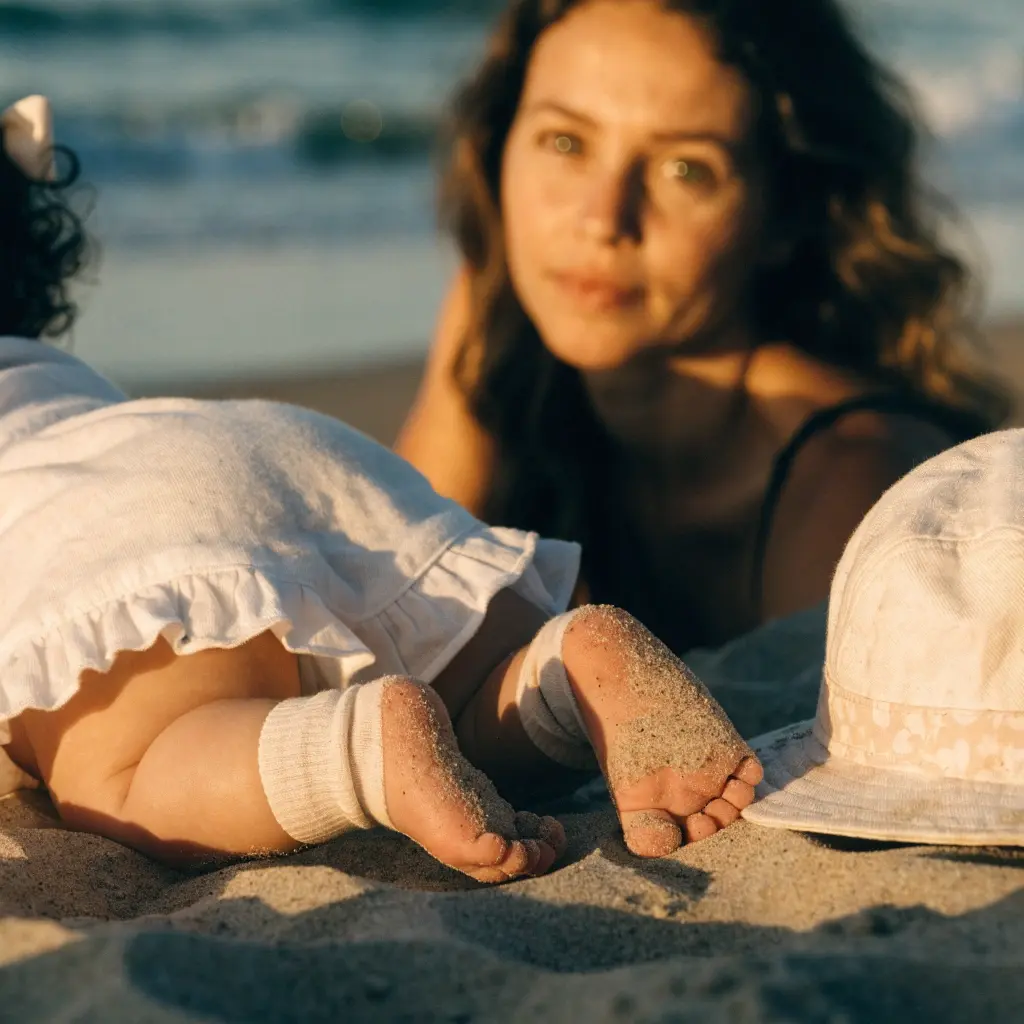
Nayeli was 5 months old for our first real beach day, at Pornichet on the French Atlantic coast. We were camping but had booked a bungalow, and honestly, she was still too young for any of the kids’ activities the campsite offered, even something as basic as a proper high chair for meals was missing. Every parent adjusts their expectations at some point on a trip, that was mine.
My real worry that day wasn’t the sun, it was the water. The Atlantic runs cold, often under 20°C in summer, and I knew babies don’t regulate body temperature well yet. So we kept it simple: just her feet, for a few seconds, and she loved it. She sat there with her eyes wide open, taking in the ocean for the first time. When she touched the sand for the first time, she had this look of pure wonder, staring at her hand, then the sand, then her hand again. We didn’t stay long. She was curious and alert, touched the sand, dipped her feet, and started showing early signs of tiredness. We left before she got to the crying point, and looking back, that timing was exactly right. Even fully shaded and well protected, the beach tires a baby out faster than you’d expect, the heat, the sound of the waves, the light, the sand, it’s a lot of sensory input all at once.
If there’s one thing I’d tell another parent packing for their baby’s first beach day at this age: don’t aim for a long, relaxed beach afternoon like you might picture. Aim for a short, well-protected outing, and leave before the first signs of fatigue, not after.
Beach Bag Checklist for Baby’s First Trip
When to Skip the Beach Day Instead
Almost nobody talks about this side of the decision, but knowing when to cancel matters just as much as knowing when it’s fine to go.
- A heat warning or extreme temperature day, even with shade, ambient heat alone can be too much for a young baby
- Baby had vaccines in the last 24 to 48 hours, they may run a low fever or feel more sensitive than usual
- Any sign of illness, even a mild cold, heat and sun exposure add stress a sick baby doesn’t need
- Baby seems off, overtired, or unusually fussy that day, trust that read over the plan you made
- A local water quality advisory is in effect, for the lake or ocean you were planning to visit
None of these mean never going, they mean today isn’t the day. The beach will still be there next week.
Frequently Asked Questions
Can you take a newborn to the beach?
Yes, a healthy newborn can go to the beach as early as a few weeks old, as long as they stay in full shade and don’t overheat. Sunscreen isn’t recommended at this age, so shade is your only real sun protection tool.
Can I take my 2 week old to the beach?
Yes, a short, shaded beach trip is generally fine at 2 weeks. Keep it brief, avoid peak sun hours between 10am and 4pm, and watch for any signs your baby is getting too hot.
Can I take my 1 month old to the beach?
Yes, the same rules apply as for a newborn: full shade, short duration, and close attention to overheating signs. Going into the water is still not recommended at this age.
Can a 2 month old go to the beach?
Yes, sitting on the beach in the shade is fine at 2 months. Sunscreen still isn’t recommended, and going into open water is generally best saved until closer to 6 months.
What age can babies go to the beach?
There’s no strict minimum age for sitting on a beach in the shade, even a newborn a few weeks old can go, as long as sun and heat exposure are carefully managed. Going into the water is a separate question, usually recommended from around 6 months.
When can babies go in the ocean?
Most pediatricians recommend waiting until around 6 months, mainly due to sunscreen restrictions, developing immunity, and a young baby’s limited ability to regulate body temperature in open water.
Is a lake beach safer than an ocean beach for a baby?
Lakes generally have calmer water and no currents, which makes supervision easier, while fresh water is also gentler than salt water if accidentally swallowed. Both still require checking local water quality before going in.
Do babies need a beach bassinet or sun tent?
Not strictly, but it’s genuinely useful for babies under 6 months who need full UV-blocking shade. A regular beach umbrella works fine too, a bassinet just adds an enclosed, sand-free space for naps.
What sunscreen can I use on a baby under 6 months?
The FDA and AAP recommend avoiding sunscreen entirely before 6 months and relying on shade instead. If shade isn’t available, a small amount of mineral sunscreen on exposed skin only is considered a better option than sunburn.
How long should a baby’s first beach trip be?
Start short, around an hour, especially for babies under 3 months. Watch how they handle the heat and stimulation, and extend future trips gradually based on how that first one goes.
Can a baby wear a regular diaper at the beach?
On the sand, yes, a regular diaper is fine. Only switch to a swim diaper once baby is actually going into the water, since regular diapers absorb water and swell up, which isn’t safe or comfortable in a pool, lake, or ocean.
Keep exploring