Updated on Updated August 28, 2026
Last updated: Updated on August 19, 2026
Here’s a number that stops most parents cold: in a review of infant deaths in sitting and carrying devices reported to the U.S. Consumer Product Safety Commission, researchers found that car seats accounted for the majority of the deaths studied, with roughly half attributed to strangulation from straps and most of the remainder linked to positional asphyxia. That’s not a reason to panic every time you buckle Lily in for a Target run. It’s the reason there’s an actual, medically backed time limit for how long a baby should stay in a car seat, and why “just let her nap in there a little longer” is one of those small decisions that deserves more thought than it gets.
I’ve done more road trips and airport runs with a baby strapped in than I can count, and the question I get asked most by other parents isn’t “which car seat should I buy,” it’s “okay but how long can she actually stay in it.” So let’s answer that clearly, right now, no fluff, and then we’ll go deeper into the age breakdown, the road trip math, and what to do when you’re the only adult in the car and baby is losing it two exits from the next rest stop.
How Long Can a Baby Really Stay in a Car Seat? The Short Answer
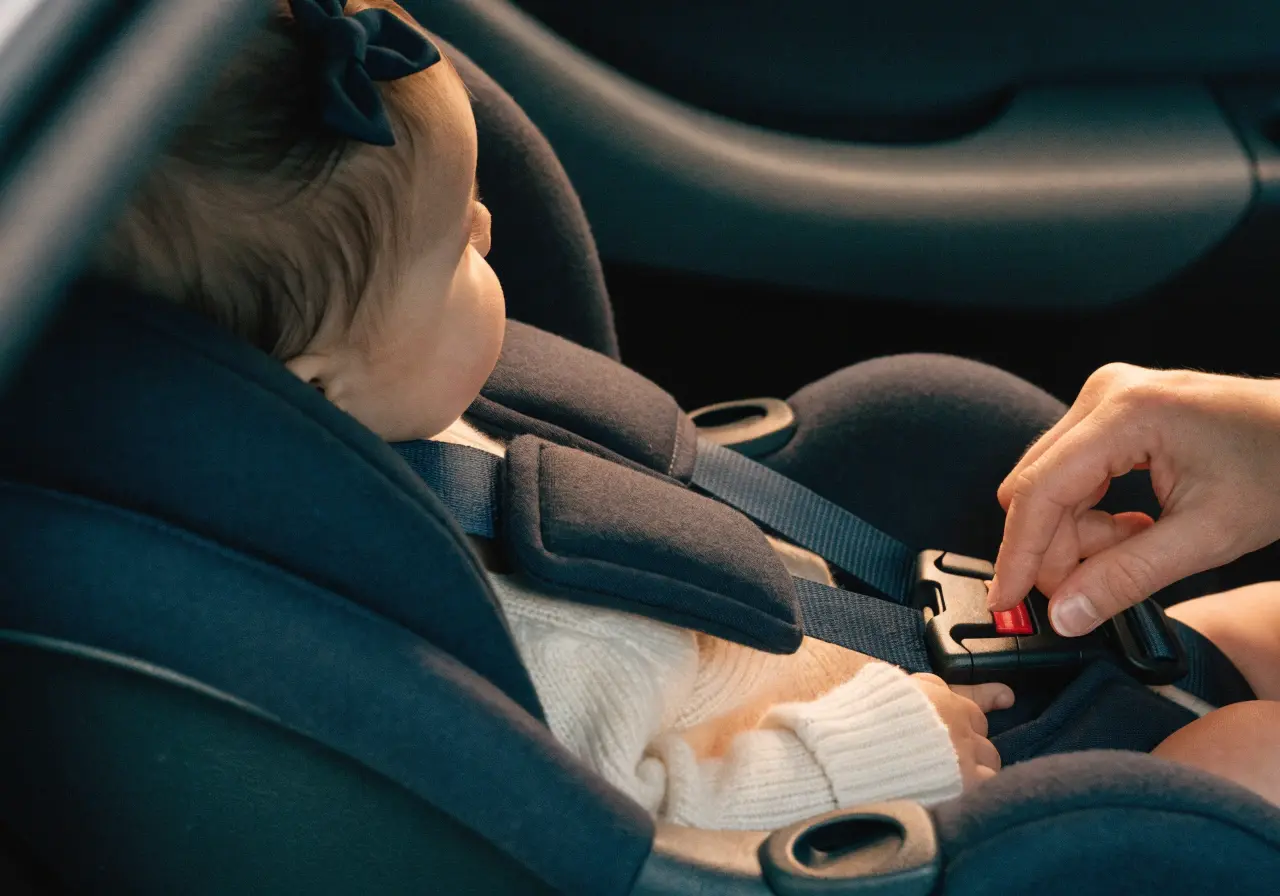
A baby should not stay in a car seat for more than 2 hours at a stretch, and newborns under 4 weeks old should be limited to about 30 minutes at a time. This is known as the “2-hour rule,” and it’s endorsed by car seat manufacturers, pediatric researchers, and safety organizations. It applies whether baby is in the car, clipped into a stroller travel system, or sitting in the seat indoors.
Here’s the thing almost every parent gets wrong about this rule: it’s not really about “the car.” A car seat’s semi-reclined, upright-ish position is the actual issue, not the vehicle itself. The American Academy of Pediatrics (AAP) and the National Highway Traffic Safety Administration (NHTSA) both recommend limiting the time infants spend in car seats when not traveling, because the concern isn’t normal car rides but extended periods in the semi-reclined position that car seats require. So a 90-minute drive followed by baby napping in the same seat for another hour on your kitchen counter? That adds up against the same 2-hour ceiling.
🚗 My honest rule of thumb: I stop treating “2 hours” as a target and start treating it as a hard ceiling I never want to touch. If Lily’s been in her seat close to 90 minutes, I’m already scanning for the next safe place to pull over, not waiting for the clock to hit zero.
Quick snapshot before we get into the full age-by-age breakdown further down:
👶 Under 4 weeks
30 min max
Per continuous stretch, per many pediatric safety guidelines for infants under 4 weeks old spending no more than 30 minutes in a car seat at a time.
🍼 1 to 12 months
2 hours max
The standard 2-hour rule, tracked across a 24-hour period, not reset with every new car trip.
🧒 Sitting unassisted
Rule relaxes
The 2-hour rule is generally followed until babies can sit up unassisted and have full control of their head and neck.
Notice what’s missing from that snapshot: an age where the answer is “unlimited.” Even once a baby ages out of the strict 2-hour rule, long stretches strapped into any seat, car or plane, aren’t great for a body that’s still learning to move. We’ll get into exactly why in the next section, plus the full breakdown by age, what changes on a real travel day with flights involved, and how to read your own baby’s signals instead of just watching a clock.
Table of Contents
- How Long Can a Baby Really Stay in a Car Seat? The Short Answer
- Why Time Limits Exist: The Real Risk Behind the Rule
- Age-by-Age Car Seat Duration Table
- Does the Rule Change From Country to Country?
- The Hidden Math: Car Seat + Plane + Car Seat Again
- Traveling Solo With Baby: What to Do When You Can’t Just ‘Pull Over’
- Signs Your Baby Needs a Break Before the Clock Says So
- Common Mistakes That Make Car Seat Time Riskier Than It Needs to Be
Why Time Limits Exist: The Real Risk Behind the Rule
The 2-hour rule exists because a car seat’s semi-upright, reclined angle can partially compress a baby’s chest and narrow their airway, lowering oxygen levels the longer they stay in that position. In one commonly cited study, published in Pediatrics, healthy term infants properly positioned in rear-facing car seats saw average oxygen saturation drop from 97% to 94% after just 60 minutes. This isn’t a theoretical worry parents made up online. It’s measurable, and it’s the reason every pediatric safety group treats “how long” as a real question with a real answer, not a suggestion.
The technical term for what’s happening is positional asphyxia: when a baby’s head slumps forward because their neck muscles aren’t strong enough yet to hold it up, their chin presses into their chest and partially blocks the airway. It sounds dramatic written out like that, and honestly, it should. This is the single biggest reason newborns and young infants get a much stricter time limit than a 9-month-old who can already hold their own head up and shift position on their own.
What actually happens in the body
1. Chest compression
The semi-reclined angle of a car seat puts pressure on a small chest, reducing how much air the lungs can take in with each breath.
2. Head slumps forward
Weak neck muscles let the chin drop toward the chest, narrowing the airway even further.
3. Oxygen drops
Saturation levels can fall, and a sleeping baby often can’t reposition themselves to fix it on their own.
Straps are the other half of the risk equation, and they’re just as important as the clock. A review of car seat related infant deaths reported to the U.S. Consumer Product Safety Commission found that out of 47 deaths in sitting and carrying devices, 31 occurred in car seats, and a large share of those were tied to strangulation from loose or improperly positioned straps rather than the seat itself. That’s why a snug, correctly threaded harness matters just as much as watching how long baby’s been buckled in.
⚠️ The mistake I see most often: letting a baby nap in the car seat well past the drive itself, carrying the whole seat inside and leaving them buckled in on the kitchen table or living room floor “since they’re already asleep.” That’s exactly the scenario pediatric guidelines warn against. Once you’re out of the car, the safest move is always to move baby to a flat, supervised surface.
None of this means car seats are unsafe. They’re one of the most effective tools we have for protecting babies in a crash, and skipping one is never the answer. It just means the seat that keeps your baby safe on impact isn’t designed to be a substitute for a crib, a bassinet, or your arms once the car’s parked. The time limits exist to keep the good (crash protection) without the risk that comes from leaving a baby in that reclined position far longer than a car ride actually requires.
Age-by-Age Car Seat Duration Table
Here’s the direct answer: newborns under 4 weeks should stay in a car seat no more than 30 minutes at a time, infants up to about 6 months should cap continuous time at 2 hours, and once a baby can sit up unassisted with solid head control (usually somewhere between 4 and 6 months), the 2-hour guideline still applies but the risk of positional asphyxia drops significantly. The American Academy of Pediatrics ties the end of the strict 2-hour rule to head and neck control, not to a fixed birthday.
I built this table because every single competing article buries these numbers in paragraphs you have to reread three times. Bookmark this one, screenshot it, whatever you need to do before your next road trip or flight.
| Age Range | Max Continuous Time | Why This Limit | Watch For |
|---|---|---|---|
| Newborn 0 to 4 weeks |
30 minutes | Weakest neck muscles, highest chest compression risk, smallest airway | Chin dropping to chest, noisy or shallow breathing |
| Young infant 1 to 4 months |
2 hours max | Head and neck control still developing, semi-reclined position still restrictive | Sudden quietness after crying, pale or bluish lips |
| Older infant 4 to 6 months |
2 hours max | Transitional stage, most babies gain sitting/head control somewhere in this window | Head still flopping sideways when asleep |
| Baby with head control 6 to 12 months |
2 to 3 hours, with breaks | Positional asphyxia risk drops once baby sits unassisted, but comfort and circulation still matter | Excessive fussiness, red marks from straps, overheating |
| Toddler 1 to 3 years |
3 to 4 hours, with a stretch break | Breathing risk is minimal now, but sitting still that long is hard on anyone, toddler or adult | Kicking, arching back, trying to unbuckle themselves |
💡 My honest rule of thumb: I treat “2 hours” as the outer limit, not the target. On any drive with Lily, I plan a stop closer to the 90-minute mark if I can, especially in the newborn-to-6-month window. It costs you 10-15 minutes and it means you’re never cutting it close on the clock.
A quick clarification since I get this question constantly: these numbers describe continuous time strapped in one stretch, not total time in the seat across a full day. A baby can safely be buckled in for several short car rides spread across a day, that’s completely different from one uninterrupted 2-hour stint. The distinction matters a lot once you start factoring in travel days with flights, which is exactly what we’ll get into next.
Does the Rule Change From Country to Country?
The 2-hour continuous car seat guideline itself is fairly universal because it’s based on infant physiology, not law, but the rear-facing requirements that shape how long a baby comfortably rides in that reclined position vary a lot by country. NHTSA in the US sets the safety floor, but individual states decide the actual rear-facing minimums, and that floor is nowhere near what countries like Sweden require.
Here’s the part that surprises most American parents: in the US, children are only required to rear-face until age 1 in all but 4 states, and roughly 75% of children are forward-facing by their 2nd birthday. Compare that to Sweden, where there’s a national recommendation stating that children should travel rear-facing until at least the age of 4, preferably longer, and the vast majority of children under age 2 still travel rear-facing there. That’s not a small cultural difference, it’s a completely different default.
| Country | Rear-Facing Rule | Practical Impact |
|---|---|---|
| United States | Minimum age 1 in most states, no federal duration limit written into law | The 2-hour continuous rule is a pediatric recommendation, not a legal mandate, so it’s on parents to self-enforce |
| European Union (i-Size) | Rear-facing required until at least 15 months and 76 cm | Babies stay in the more reclined position longer by law, which is exactly why the 2-hour rule matters even more there |
| Sweden | No hard law, but a strong national recommendation to rear-face until age 4, seats rated up to 55 lbs rear-facing | Most Swedish toddlers are still rear-facing at an age when US toddlers have been forward-facing for two years |
| United Kingdom | No minimum rear-facing age in law, but a car seat is required until 135 cm or age 12 | Parents get more legal flexibility, but only a minority of UK children under 2 travel forward-facing in practice |
Having traveled with Lily across several European countries, one thing stands out: rear-facing toddlers are simply the norm in places like Scandinavia, in a way that’s still unusual in the US. Neither approach is “wrong” legally, but it’s worth knowing the safety data leans hard toward the rear-facing-longer model: Swedish accident research has shown that rearward facing children’s car seats reduce serious injuries substantially more than forward-facing seats do at the same age.
💡 My honest take: the country you’re in changes the legal minimum, not the biology. A baby’s neck muscles and airway don’t know which state or country they’re in. If you’re renting a car seat abroad or borrowing one from family, don’t assume it’s set up the “American way.” Check the actual recline angle and rear-facing weight limit on the seat itself, not just what’s legally required where you’re standing.
One thing that doesn’t change from country to country, though: what happens when you stack a car ride on top of a flight on top of another car ride. That’s where the real math gets tricky, and it’s the part almost nobody talks about.
The Hidden Math: Car Seat + Plane + Car Seat Again
The 2-hour guideline is built for a single car ride, not for a whole travel day, which is exactly why it quietly falls apart on flying days. Stack a drive to the airport, a flight, and a drive to the hotel back to back, and a baby can rack up 4 to 5 hours of actual restrained time, even though no single leg looks like it breaks the rule.
This is the part almost no car seat guide talks about. Every article covers the drive. Almost none of them cover what happens when that drive is just one piece of a bigger day that also includes a plane. And if you’ve ever done a 6am airport run with a baby who fell asleep in the car seat, only to have that same seat click into the plane 90 minutes later, you already know the math doesn’t reset itself just because the vehicle changed.
Notice what happened there: the flight and the rental car drive land back to back with almost no gap, so that middle chunk of the day adds up to over 3 hours of continuous restraint, well past the 2-hour guideline, even though the flight itself was under 3 hours and the drive was only 35 minutes. Tighten that connection, or skip the stroller break at the gate, and the total climbs even higher.
🧳 My travel-day rule of thumb: I stop counting restraint time by “leg” and start counting it by “was my baby actually out of a seat, moving her limbs, for at least 10 to 15 minutes.” A gate change with a fussy toddler in a stroller doesn’t count as a break if she’s still strapped in. The break only counts if she’s genuinely free.
On the plane specifically, the FAA does not require a child restraint system (a certified car seat or harness approved for aircraft use) for kids under 2, but it does strongly recommend one based on the child’s weight. The FAA does not require the use of CRS’s on commercial airplanes, however the FAA strongly recommends the use of CRS’s or an alternative FAA-approved device based on a child’s weight. In practice, that means the “lap infant” allowance under age 2 exists mostly for fare reasons, not safety ones: the FAA recommends that all children under age 2 use an approved restraint on aircraft rather than a lap, and the lap-child allowance for infants under age 2 exists for fare reasons, not safety reasons.
If your baby is closer to toddler size and has outgrown an infant car seat, the CARES harness (a lightweight, FAA-certified vest that clips to the airplane’s own seatbelt) is worth knowing about. AmSafe’s CARES device is FAA-certified for children up to 40 inches tall and between 22 and 44 pounds, for those capable of sitting upright alone in a forward-facing position and who occupy their own seat. It won’t help during the drive to the airport, but it does mean you’re not stuck choosing between a bulky car seat and a lap for the flight portion of the day.
⚠️ Watch for the “back to back” trap: the riskiest travel days aren’t the ones with a long single flight. They’re the ones with a short connection sandwiched between two car rides, where nobody, including you, notices that the baby has been sitting upright for 3 hours straight without ever coming out of a seat.
A few things genuinely help break up that cumulative total on flying days:
Get baby out of the car seat at drop-off or curbside check-in instead of wheeling it straight through security still strapped in.
Use a carrier or babywear through the gate area so the restraint clock actually pauses, not just the car seat, the stroller too if it’s reclined flat.
For infants, ask about a bulkhead bassinet on longer flights so the middle chunk of the flight isn’t spent in the car seat at all.
Build in a buffer of at least 10 to 15 minutes after landing before buckling straight back into the rental car, even just to change a diaper standing up.
Book layovers of 75 minutes or more when flying with an infant, purely so you have real time to get her out of every seat, not just enough time to make the connection.
None of this requires special gear or a perfect itinerary. It just requires treating the whole day as one restraint budget instead of three separate, unrelated legs. And once you start thinking that way, the next question becomes obvious: what do you actually do when you’re the only adult and there’s nobody to hand the baby to at that 10-minute break?
Traveling Solo With Baby: What to Do When You Can’t Just “Pull Over”
When you’re driving alone with a baby, you can’t just unbuckle whenever you feel like it the way you could with a second adult riding shotgun. The safest approach is to plan every stop before you need it, choose full off-road parking areas instead of the highway shoulder, and build a simple, repeatable routine you can do with no one else to hand the baby to.
I’m a solo mom, and this is the part of car seat safety that almost every guide skips. Most articles assume there’s a co-pilot in the passenger seat who can twist around, unbuckle, soothe, and re-buckle while the driver stays focused on the road. When it’s just you, every single stop is a full production: find the exit, find safe parking, turn off the engine, get out, walk around to the other side, deal with whatever needs dealing with, and get back in, all without a second set of hands and usually without anyone watching the car.
⚠ Safety first: Road safety guides are consistent on this point. Stop to rest at locations that are completely off the road, and avoid stopping on the shoulder of the road unless you have no choice. If you’re alone, that rule matters even more, because there’s no one to watch traffic while you’re focused on the baby.
The fix isn’t a special gadget, it’s picking your stops with intention instead of reacting when you’re already exhausted and the exit ramp is a mile away. Here’s the routine I actually use when it’s just the two of us in the car:
The Solo Parent Rest Stop Routine
Pick real rest areas or busy gas station lots, never a random shoulder or a quiet frontage road. You want people around, good lighting, and a real parking spot, not a strip of gravel next to traffic.
Back the car into the spot if you can, so when you open the door on baby’s side you’re facing the parking lot, not oncoming cars.
Do the diaper change on a portable changing pad on the trunk floor or a flat surface inside the car, not standing in the lot balancing baby on your arm.
Feed baby out of the seat, even if it’s just 10 minutes on your lap in the driver’s seat with the engine off. This is the whole point of the stop, not an optional extra.
Keep a small “grab bag” within arm’s reach of the driver’s seat (diaper, wipes, one outfit, burp cloth) so you’re never digging through the trunk one-handed with baby fussing.
This is also where the two-hour guideline stops being a rigid rule and becomes something you negotiate with reality. The American Academy of Pediatrics advises planning to stop driving and give yourself and your child a break about every two hours, but when you’re solo, you sometimes need to make that call earlier, before you hit a stretch of highway with no exits, rather than exactly at the two-hour mark on a road with nowhere safe to pull off.
The other trick that’s saved me more than once: scan the map before you leave, not when the alarm on your phone goes off. Knowing there’s a proper rest area or a shopping center with a big, well-lit lot around the two-hour mark means you’re not making a snap safety decision while a hungry baby is already crying in the back seat.
🙋 My honest rule of thumb: if I can’t picture exactly where I’ll pull off and what I’ll do when I get there, I stop sooner rather than later. A boring, uneventful stop 20 minutes early beats an unsafe one on the shoulder because I waited too long.
Planning the stop is only half the equation, though. The other half is knowing when your baby is telling you she needs one before your two-hour timer even goes off, which is exactly what we’ll get into next.
Signs Your Baby Needs a Break Before the Clock Says So
Your baby needs a break from the car seat when you see repeated head slumping, a red or purple face, unusual quietness after a period of fussing, arching or twisting against the straps, or skin that’s noticeably hot and sweaty. Any one of these on its own can be nothing. Two or three together, especially the quiet-after-fussing combo, mean stop now, not at the next exit you feel like taking.
The two-hour guideline is a planning tool, not a promise that your specific baby is fine until minute 119 and suddenly in danger at minute 121. Some babies are squirming and unhappy at 45 minutes. Others doze peacefully for two and a half hours and wake up perfectly content. The number gives you a maximum to plan around. Your baby’s actual body gives you the real answer, and that’s the signal you have to learn to read, especially on a long stretch where pulling over isn’t instant.
Quick definition: positional asphyxia is when a baby’s body position, most commonly a slumped-forward head with the chin pressed to the chest, partially blocks the airway and reduces how much air actually reaches the lungs. It’s the core medical reason car seat duration limits exist in the first place.
This isn’t a rare, theoretical risk. A study published in Pediatrics that monitored 100 babies in car seats over one hour found that, on average, blood oxygen levels dropped to 94 percent, and 12 percent of the premature babies in the study experienced apnea or bradycardia during that time. Oxygen levels of 90 percent and lower are considered dangerous, which is exactly why watching your baby’s actual color, breathing and alertness matters just as much as watching the clock.
The 5 Signs That Mean Stop Now
😴
Head slumping forward
Chin dropping repeatedly toward the chest, not just a sleepy head tilt to the side.
🔴
Red or purple face
Especially if it appears suddenly and doesn’t come from ordinary crying.
🤫
Sudden quiet after fussing
A baby who stops crying abruptly and goes still is more concerning than one who keeps crying.
🔥
Hot, sweaty skin
Check the back of the neck. Overheating in a seat adds up fast on warm days.
🌀
Arching or twisting
Fighting the harness repeatedly, not just a one-off wiggle to get comfortable.
Newborns give you fewer, subtler warnings than older babies do. A three-month-old can’t arch her back or grab at the straps the way a nine-month-old can, so the sudden-quiet sign matters even more in that first stretch. Babies are most at risk in their first few months because their neck muscles aren’t strong yet, so they can’t lift their head if it begins tilting forward in a car seat. That’s a big part of why newborns get a shorter clock than older babies in the first place, and why “she’s sleeping so peacefully” is exactly when you should be checking her head position, not skipping the check.
The 30-Second Check Worth Doing Every Time You Glance Back
At every red light or when you check your mirror: is her chin off her chest, is her color normal, is her chest rising and falling normally? If you can answer yes to all three in the time it takes the light to turn green, you’re good. If you hesitate on any of them, that’s your cue to find the next safe place to stop, not to wait and see.
Reading these signs correctly also means knowing what actually causes them in the first place, and that’s usually where small, fixable mistakes come in, things like a loose harness, an incline that’s slightly off, or clothing that’s bunching under the straps. That’s exactly what we’re breaking down next.
Common Mistakes That Make Car Seat Time Riskier Than It Needs to Be
The five mistakes that most often turn safe car seat time into risky car seat time are a loose harness, a chest clip set too high or too low, a recline angle that’s too upright for a newborn, bulky winter coats worn under the harness, and harness straps threaded through the wrong slot for the seat’s current direction. None of these require a new car seat to fix, just a few extra seconds each time you buckle in.
Here’s the thing that surprised me most when I actually paid attention to how I was buckling my daughter in versus how I thought I was buckling her in: none of these mistakes are dramatic. They’re small, boring, easy-to-miss habits, and that’s exactly why they’re so common. A seat can pass every duration guideline in this article and still be riskier than it needs to be if the fit underneath is off.
🫳
Harness left too loose
Do the pinch test every single time: pinch the strap at the shoulder after tightening. If you can pinch a fold of webbing, it’s still too loose (Safe Ride 4 Kids, Mayo Clinic).
📍
Chest clip in the wrong spot
The chest clip belongs right at armpit level, not near the belly and not near the neck. If it’s too low, the harness can slip off the shoulders in a crash; too high, and it risks neck injury (Albee Baby).
📐
Recline angle too upright
For newborns and infants up to about 6 months, the recline angle should typically sit between 30 and 45 degrees from vertical so the head doesn’t fall forward onto the chest (HomeSafe Education, The Car Seat Lady).
🧥
Bulky coats under the harness
A puffy winter coat compresses in a crash, leaving hidden slack behind it. Dress baby in thin layers, buckle first, add a blanket over the harness after.
🎚️
Straps threaded through the wrong slot
Rear-facing, straps should come from at or just below the shoulders. Forward-facing, they need to be at or just above the shoulders. Get this backward and your baby has extra forward movement in a crash that the harness should have prevented.
One more thing worth saying plainly: research indicates a substantial number of car seats are used incorrectly, with one 2022 study finding up to 75% of car seats installed or used incorrectly (HomeSafe Education, citing a 2022 Pediatrics study). That statistic isn’t there to scare you, it’s there because it means the odds are decent that one of these five things is happening in your own car right now without you noticing, and a two-minute check tonight is worth more than any amount of worrying about the “right” number of hours.
🎯 My honest rule of thumb: before every single drive, not just the long ones, I do the pinch test and glance at the chest clip. It takes less time than buckling my own seatbelt, and it means I never have to wonder halfway through a trip whether the harness is actually doing its job.
Frequently Asked Questions
How long can a newborn stay in a car seat?
A newborn should stay in a car seat no more than about 30 to 60 minutes at a stretch outside of active travel, and even during a drive, a break every 1 to 2 hours is safer given how weak their neck muscles still are.
Is it safe for a baby to sleep in a car seat for a nap?
No, a car seat is not recommended for routine napping outside the car. Once a drive ends, move baby to a flat, firm sleep surface like a crib or bassinet as soon as it’s reasonably possible.
Does the 2-hour car seat rule apply on airplanes too?
The same underlying reasoning applies, but you can’t always act on it the same way on a plane. If your baby is in an FAA-approved car seat onboard, try to unbuckle and hold or change position during any stretch longer than 2 hours when it’s safe to do so, especially outside of turbulence.
How often should you stop on a road trip with a baby?
Plan a stop every 2 hours for babies over 3 months, and closer to every hour to 90 minutes for newborns. Stop sooner than planned any time you notice the discomfort signs covered earlier in this guide.
Can a baby stay in a car seat overnight?
No. A car seat should never be used as an overnight sleep space for a baby. If you’re driving through the night, plan real stops where baby sleeps flat, not just quick gas station breaks.
What happens if a baby stays in a car seat too long?
Prolonged time in a semi-reclined seat can lead to restricted breathing and, in rare but serious cases, positional asphyxia, where the chin drops toward the chest and narrows the airway. This risk is highest for infants under 6 months.
Is the 2-hour rule different for newborns versus older babies?
Yes. Newborns need shorter stretches, closer to 30 to 60 minutes at a time, while babies over 6 months with stronger head and neck control can generally tolerate the fuller 2-hour window more comfortably.
How do I know if my baby needs a break from the car seat?
Watch for escalating fussiness that doesn’t settle, sudden quiet after crying, hot or sweaty skin, and repeated arching or twisting against the harness. Any one of these is your cue to find the next safe place to stop.
My Verdict
The 2-hour rule is a guideline, not a countdown timer you’re racing against. Your baby’s actual comfort, tucked under it, matters more than the clock ever will.
If there’s one thing I’d want you to walk away from this guide with, it’s that the number of hours matters less than what’s actually happening inside the seat during those hours. A snug harness, the right recline, a chest clip at armpit level, and a habit of checking on your baby with your eyes and not just your watch will do more for safety than obsessing over whether you’re at 1 hour 50 minutes or 2 hours 10. Plan your breaks, read the signs, fix the small mistakes, and trust that you know your baby better than any rule ever could. That’s not me being casual about safety, it’s me telling you, after plenty of drives and flights with my own daughter, that confidence comes from understanding the “why” behind the rule, not from memorizing the number itself.
Sources
- Children’s Hospital of Philadelphia (CHOP), Car Seat Safety: Newborn to 2 Years
- NHTSA, Car Seat Recommendations for Children by Age and Size
- Pediatrics (AAP journal), Oxygen Desaturation in Term Infants in Car Safety Seats
- Oklahoma State University Extension, Protecting Infants and Toddlers From Positional Asphyxia, citing U.S. Consumer Product Safety Commission data
- Federal Aviation Administration (FAA), Child Restraint Systems FAQ
- AmSafe, CARES Child Aviation Restraint System certification details
- American Academy of Pediatrics guidance, as cited by Orbit Baby
- HomeSafe Education, car seat recline angle and correct-use statistics, citing a 2022 Pediatrics study
- The Car Seat Lady, recline angle guidance for infants under 6 months
- Mayo Clinic and Safe Ride 4 Kids, harness pinch-test guidance
- Albee Baby, chest clip positioning guidance
Keep exploring