Updated August 28, 2026
Here’s a number that surprises most parents: according to the U.S. Department of Transportation’s Air Carrier Access Act rules, airlines are required to let you bring a stroller and a car seat to the gate at no extra charge, and neither one counts against your carry-on or checked baggage allowance. I wish someone had told me that the first time I was juggling a diaper bag, a stroller, and a very unimpressed baby at security.
I’m Larissa. I live in Lausanne and my daughter Lily has been flying with me since she was tiny, on everything from Swiss to budget carriers like Ryanair. The stroller question comes up every single trip, and the confusion is almost always the same: people assume “carry-on” means it eats into their one-bag allowance. It doesn’t. Let’s clear this up properly.
So, Does a Stroller Count as a Carry-On? The Short Answer
No, a stroller does not count as a carry-on item. It’s treated as a separate accessibility item under U.S. Department of Transportation rules, which means you can bring it to the gate for free, in addition to your regular carry-on bag and personal item, on every major U.S. airline.
This isn’t a courtesy some airlines offer and others skip. It’s a baseline rule that applies whether you’re flying Delta, United, American, Southwest, JetBlue, Alaska, or Frontier. The only real variable between carriers is how you get the stroller from the ticket counter to the plane, not whether you’re allowed to bring it.
🍼 My honest rule of thumb: Never count your stroller as “using up” your carry-on space in your head. Pack your actual carry-on bag as if the stroller didn’t exist, then roll the stroller separately all the way to the jet bridge. That’s genuinely how the system is designed to work.
Here’s where people get tripped up, and it’s a completely understandable mix-up. “Carry-on” usually means something you keep with you in the cabin, stowed in the overhead bin or under the seat. A stroller almost never travels that way (unless it’s a very small umbrella model that fits under the seat, which we’ll get into later). Instead, most strollers get gate-checked, meaning you push it right up to the door of the plane, fold it there, hand it off to airline staff, and pick it up again in the same spot when you land. Gate-checking is different from checking a suitcase at the counter: it’s free, it doesn’t go through the cargo hold check-in process, and you keep using it right until the last possible second.
So when someone asks “does a stroller count as a carry-on,” the real, useful answer has two parts: legally and practically, no, it doesn’t count against your bag limit, and physically, it usually won’t ride with you in the cabin either. It sits in its own category, one that’s actually more generous than a regular carry-on. Once that clicks, the rest of the logistics get a lot less stressful.
Table of Contents
- So, Does a Stroller Count as a Carry-On? The Short Answer
- What ‘Carry-On’ Actually Means for a Stroller (And Why It’s Free)
- US Airline Stroller Policies at a Glance (Comparison Table)
- Does an Umbrella or Travel Stroller Change the Rules?
- What Actually Happens at Gate-Check: A Step-by-Step Walkthrough
- If Your Stroller Gets Damaged, Lost, or Delayed
- Flying Solo with a Baby and a Stroller: What Actually Helps
- Frequently Asked Questions
What “Carry-On” Actually Means for a Stroller (And Why It’s Free)
A stroller is generally treated as a free child-travel item, separate from your carry-on and checked bag allowance, not as part of your normal luggage count. That’s not a courtesy one airline invented to look family-friendly, it’s how every major U.S. carrier structures its own published policy, even though the exact terms (where you check it, what size counts, whether it’s returned at the gate or at baggage claim) differ from one airline to the next.
I want to correct something I’ve seen repeated across a lot of articles on this topic, because it matters: a stroller is not automatically classified as an “assistive device” under the Department of Transportation’s Air Carrier Access Act. That law protects passengers with disabilities and covers things like wheelchairs and mobility aids. A baby stroller falls into a different bucket entirely, it’s a child-travel item, and the free allowance comes from each airline’s own policy, not from a single federal disability-access rule. It’s a subtle distinction, but it’s the difference between citing the right source and citing the wrong one.
So where does the “it’s free” rule actually come from? It comes from the airlines themselves. Delta, American, United, Southwest, JetBlue, Alaska, and Frontier all publish their own policies stating that a stroller (and usually a car seat) travels at no charge and doesn’t count against your baggage allowance. You can check each policy directly on the airline’s own site, and I’d genuinely recommend doing that before a trip if you’re flying somewhere unfamiliar, because the fine print on sizes and check-in points isn’t identical across carriers.
In practice, that means three things are true at the same time, and I think this is the part that finally makes it click for most parents:
🧳 Your stroller lives in its own lane
- Your carry-on bag limit stays exactly the same, one bag, one personal item, whatever your ticket includes
- Your checked bag allowance stays exactly the same too, whether that’s zero bags on a basic economy fare or two on a full-fare ticket
- The stroller is added on top, free, on every major U.S. airline’s published policy, though size and weight caps do vary by carrier
I remember the first time I flew alone with Lily and a stroller, doing the mental math at the counter like I was about to be told to leave something behind. I wasn’t. The agent barely glanced at it. That’s when I understood this isn’t a gray area airlines interpret however they feel like that day, it’s written policy, and once you know it, you stop bracing for a fight that was never going to happen.
Where airlines do genuinely differ is in the mechanics: some let you check the stroller at the ticket counter with your regular bags, others only offer gate-check, and a few give you both options depending on the stroller’s size. Some hand it back right at the aircraft door, others route it to baggage claim instead, and that part is worth knowing in advance so you’re not standing at the jet bridge waiting for something that’s actually already on its way to the carousel. None of that changes the core fact: free is free, whether it happens at check-in or right at the door of the plane. The next section breaks down exactly how each major U.S. carrier handles it, with a link to each airline’s own official policy so you can double-check before you fly.
US Airline Stroller Policies at a Glance (Comparison Table)
Major US airlines generally let parents check a stroller free of charge, in addition to your carry-on and checked bags, but the exact check-in point, size handling, and pickup procedure vary by carrier. None of the seven airlines below charge a stroller fee as a standard practice, but “how” and “where” it gets checked isn’t identical across the board, and that’s exactly where parents get caught off guard.
Gate-checking means the stroller stays with you through security and all the way to the door of the plane, where a gate agent tags it and takes it right before you board. It usually comes back to you at the same door when you land, though on some connecting flights it’s routed to baggage claim instead. Checking it at the ticket counter means it travels with your regular checked bags from the check-in desk, which is more commonly required for larger, non-collapsible, or double strollers.
| Airline | Stroller Fee | Where Can You Check It? | Important Restriction |
|---|---|---|---|
| Delta | Free | Gate or ticket counter | Oversized or non-collapsible models may need to go through the counter |
| United | Free | Gate-check, per current policy | Check ahead for oversized or non-collapsible models |
| American | Free | Gate or ticket counter, depending on stroller type | Some models require ticket counter check-in |
| Southwest | Free | Gate or ticket counter | Pickup point can vary by airport |
| JetBlue | Free | Gate-check, per current policy | Check current restrictions for oversized models |
| Alaska | Free | Gate or baggage check | Check stroller-specific restrictions before flying |
| Frontier | Free | Gate-check, per current policy | Check current size restrictions before flying |
Figures reflect each airline’s own published baggage policy at the time of writing. Airline policies change, so I’d always recommend checking the current policy on the airline’s own site a day or two before you fly, especially with a double, jogging, or non-collapsible stroller.
All seven airlines listed above currently advertise free stroller handling, but the exact check-in and pickup procedures differ by carrier, and that’s really the only thing worth memorizing here. Size and handling restrictions vary, especially for double, jogging, or non-collapsible strollers. If you’re travelling with an oversized model, check your airline’s current policy before you leave for the airport, rather than assuming it’ll be treated exactly like a standard umbrella stroller at the gate.
🧭 My advice: if you’re flying a double or jogging stroller, call the airline or check in online 24 hours ahead and ask directly whether it needs to be counter-checked. It takes two minutes, and it means you’re not finding out at the gate that you need to walk it back to the check-in desk with a baby in your arms and a boarding group closing.
Umbrella and lightweight travel strollers deserve their own answer though, because they behave a little differently at security and sometimes even make it into the cabin. That’s exactly what we’re covering next.
Does an Umbrella or Travel Stroller Change the Rules?
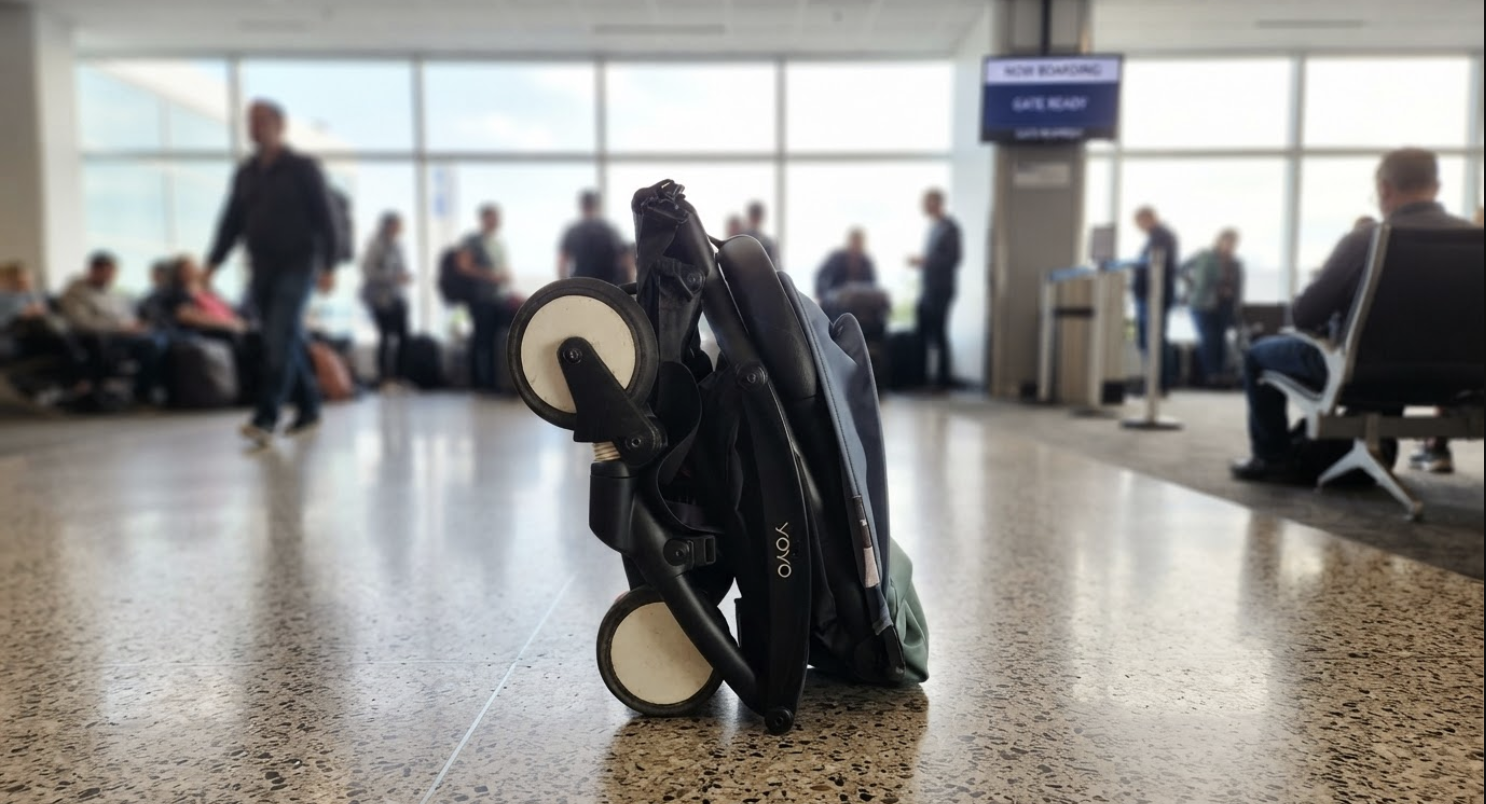
Yes, in a good way. An umbrella stroller (a lightweight stroller that folds into a compact shape, usually with one pull of a strap) is often small enough to skip gate-check and travel in the cabin instead, if the airline allows it and there’s room. Gate-checking a stroller for free is still standard airline policy, so a lightweight model never leaves you worse off, only sometimes gives you an extra option.
Here’s the part that trips people up: a full-size stroller and a travel/umbrella stroller aren’t treated the same way in practice, even though most airlines let you gate-check either one at no cost as a standard part of their baggage policy. What changes with a lighter model is what happens before the gate, at security and at boarding.
🧳 What’s actually different with a lightweight/umbrella stroller
- You may need to fold it for screening at security. Follow the TSA officer’s instructions at the checkpoint, they have discretion over how items get screened (TSA.gov, “What Can I Bring?”).
- Some compact strollers may fit in an overhead bin when folded, but only if the airline permits it and there’s enough space available that day. It’s a possibility, not something you’re guaranteed.
- A very compact stroller may sometimes fit under the seat in front of you when folded, depending on its dimensions and the aircraft. Treat this as a bonus option, not a standard feature.
- If the stroller can’t be stored in the cabin, the airline’s stroller policy typically lets you gate-check it instead, at no extra cost. Check your carrier’s current rules before boarding.
The honest way to think about it: an umbrella stroller gives you options a heavier stroller doesn’t. A full-size or travel-system stroller is much less likely to fit in the cabin because of its folded dimensions, so for many of these models, gate-checking is the most practical option, and that’s completely fine, it’s still free and still fast. A lightweight stroller just adds a second, more convenient path on top of that.
| Stroller type | Typical folded size | Fits overhead bin? | Free gate-check option? |
|---|---|---|---|
| Umbrella stroller | Compact, comparable to a folded camping chair | Sometimes, if folded dimensions meet cabin-storage limits | Yes |
| Lightweight travel stroller | Slightly larger than an umbrella model when folded | Sometimes, depends on the specific model and aircraft | Yes |
| Standard/travel system stroller | Bulky even folded | Usually too large for cabin storage | Yes |
| Double/jogging stroller | Large even folded | Generally too large for cabin storage | Yes, but confirm counter-check ahead of time |
I travel with a lightweight umbrella model with my daughter Lily, and the one habit that’s saved me every single time is folding it before I even reach the security line, not after. Some checkpoints will ask you to do it right at the belt, and doing it early with a toddler on your hip is a lot less stressful than doing it under pressure with a line building behind you. It also means I’m not fumbling with straps while holding a bag, a boarding pass, and a very wiggly kid at the same time.
🧭 My honest rule of thumb: if you’re buying a stroller specifically for flying, prioritize one that folds one-handed and stands on its own when collapsed. That single feature matters more than most people expect once you’re at security or boarding with a baby on your hip.
So once your stroller is folded, tagged, and handed over, whether you hand it off at the gate or at the jet bridge depending on the airline’s procedure, what actually happens to it between that moment and the moment you land? That’s worth walking through step by step, because it’s the part that makes most parents nervous the first time.
What Actually Happens at Gate-Check: A Step-by-Step Walkthrough
Gate-checking a stroller means it gets tagged and taken from you right at the jet bridge door, travels in the aircraft’s cargo hold during the flight, and gets returned to you either at the aircraft door or at baggage claim, depending on the airline, the airport, and the stroller itself. It’s a five-step process, and none of the steps require you to leave the boarding line.
I know the first time it happens it feels a little like handing over a piece of your parenting equipment to a stranger and just trusting it’ll come back. In most cases, it comes back without a problem. Here’s what usually happens, in order, so nothing catches you off guard.
You fold it right before boarding
Most gate agents want the stroller folded when you reach the jet bridge, not before you leave the gate area. Keep using it in the terminal, fold it in the last few steps of the boarding line.
A gate agent tags it with a claim ticket
A small paper tag gets looped through the frame with a barcode and your flight number on it. Keep the matching stub until you have your stroller back. If it ends up at baggage claim, the tag helps identify the item and supports your claim if there’s a problem.
Ground staff take it to the cargo hold
Once you hand it over at the gate, ground staff carry it down from the jet bridge and load it into the aircraft’s cargo hold along with the checked luggage.
It travels in the cargo hold for the flight
The stroller rides in the same hold as checked baggage for the entire flight, alongside suitcases, car seats, and other gate-checked items.
You collect it at the aircraft door, or at baggage claim
Depending on the airline and the airport, a gate-checked stroller may be handed back to you right at the aircraft door as you deplane, or it may be sent down to the oversized baggage belt instead. This varies by carrier and by stroller size, so it’s genuinely worth asking rather than assuming.
The one part nobody tells you until you’ve done it: at a busy connecting airport, the gap between deplaning and actually seeing your stroller can stretch to ten or fifteen minutes even when it’s coming back at the aircraft door. It’s not lost, ground crews are just moving several strollers and car seats off the same aircraft at once. I’ve stood there with Lily on my hip more than once, watching the door, and so far it has always shown up.
🧭 My honest rule of thumb: ask the agent scanning boarding passes as you board whether your stroller comes back at the jet bridge or at baggage claim. It takes five seconds and saves you from wandering an unfamiliar airport with a tired baby and no stroller.
The exact gate-check process, including where and how quickly you get your stroller back, is set by each airline’s own stroller policy, which is why it can vary from one carrier to the next and even from one airport to another with the same carrier. Major U.S. airlines generally handle strollers free of charge as part of standard gate-check service, but the return procedure isn’t identical across the board, which is exactly why checking with the gate agent before you board is worth the ten seconds it takes.
Most parents will get their stroller back without any issue. But it’s still equipment that gets loaded and unloaded by hand alongside hundreds of suitcases, and it’s worth knowing exactly what to do on the rare occasion it comes back damaged, delayed, or doesn’t come back right away.
If Your Stroller Gets Damaged, Lost, or Delayed
If your gate-checked stroller is damaged, delayed, or missing, report it to the airline as soon as possible and keep your gate-check receipt and other travel documents. Gate-checked strollers can be subject to the airline’s baggage liability rules if they’re lost, delayed, or damaged, the same general framework that covers your suitcases (U.S. DOT, 14 CFR Part 254). The single most useful thing you can do: report it to the airline’s baggage service desk before leaving the airport if possible, rather than waiting until you’re home unpacking.
This happens far less often than parents fear, most strollers come back exactly as they left. But when it doesn’t go smoothly, the fix isn’t complicated as long as you handle it in the right order.
📋 My advice: whatever happens with your stroller, whether it’s a snapped wheel or a no-show, head to the airline’s baggage service office inside the airport before you go to ground transportation, if you’re able to. Once you’ve left the building, everything gets slower and messier to sort out.
What to do right away
☑️ Go to the baggage service desk before leaving the airport, if possible. This is usually near baggage claim, and it’s staffed by the airline, not the airport itself.
☑️ Ask the airline to create a mishandled-baggage report and keep the reference number. This is your record for following up on the claim.
☑️ Take photos of the damage immediately, ideally right there at the desk, before it gets jostled around any more in your bag or trunk.
☑️ Ask for a written claim number and the expected timeline for a response, not just a verbal “someone will call you.”
☑️ Keep your boarding pass and the gate-check tag receipt if you still have it. It can help document that the stroller was checked with the airline.
☑️ If it’s delayed rather than damaged, ask whether it’s expected on a later flight and how the airline will contact you when it arrives.
On compensation for domestic U.S. flights: under 14 CFR Part 254, airlines cannot limit their liability for a lost, damaged, or delayed stroller checked at the gate to less than $4,700 per passenger, a limit the DOT raised from the previous $3,800 effective January 22, 2025 (U.S. DOT, Federal Register). That’s a ceiling, not a guaranteed payout, the airline will typically ask for the original receipt or a comparable replacement cost, so it’s worth keeping that email confirmation from when you bought the stroller somewhere you can find it.
For international flights, liability is governed by the Montreal Convention instead, an international treaty that sets baggage compensation limits for flights between member countries. The current limit is 1,519 Special Drawing Rights per passenger, in effect since December 28, 2024 (previously 1,288 SDR). A Special Drawing Right is an international reserve unit defined by the IMF, and its value against any given currency fluctuates, so rather than quote a dollar figure that will drift out of date, it’s more useful to know the SDR number itself if you ever need to reference it in a claim.
If your stroller is delayed rather than lost outright, the airline may arrange delivery once it’s located, or ask you to collect it at the airport. Ask specifically which option applies to your claim, because “we’ll be in touch” isn’t an answer you should accept at the desk.
🎒 My honest rule of thumb: if I’m flying with a stroller I genuinely can’t afford to see damaged, I bring a baby carrier in my carry-on as a backup, no matter how good the airline’s track record usually is. It’s not about expecting the worst, it’s about not being stuck with a fussy baby and zero way to move through an airport if the one plan doesn’t work out.
None of this is meant to make gate-checking sound risky. It genuinely isn’t, most strollers travel thousands of miles a year without a scratch. It’s just that knowing the exact steps ahead of time turns a stressful moment into a five-minute errand instead of a fight you don’t know how to win.
Flying Solo with a Baby and a Stroller: What Actually Helps
Flying solo with a baby and a stroller is completely doable with the right setup: a baby carrier for your hands-free moments, a stroller you can fold with one hand or foot, and a plan for the exact moment you’ll need to stow it before boarding. The hardest part isn’t the flight itself, it’s the ten minutes around gate-check and the jet bridge, when you genuinely only have two hands.
I travel solo with my daughter Lily most of the time, and I’ll be honest, nobody warns you that the actual hard part of flying with a baby has nothing to do with the plane. It’s the transition points. Security. The walk down the jet bridge. The moment you’re folding a stroller with a baby on your hip and someone behind you is sighing because you’re “taking too long.” That’s the part worth planning for, not the flight itself, which is usually the calmest hour of the whole trip.
Wear the baby before you need to
A baby carrier is not optional gear when you’re solo, it’s the thing that makes every other step possible. If Lily is on my chest in a carrier, both my hands are free to fold the stroller, hand over my boarding pass, grab the gate-check tag, and still manage a diaper bag. Without it, every single one of those steps becomes a small negotiation with gravity.
Put the baby in the carrier before you get to the gate-check line, not after. Trying to get a baby into a carrier while also holding a stroller, a boarding pass, and a bag is the wrong order of operations, and it’s exactly when things get dropped or forgotten.
Fold the stroller before you’re asked to
Don’t wait for the gate agent to tell you it’s time. Fold your stroller while you’re still in the boarding line, once your zone is called, so you’re not doing it under time pressure right at the jet bridge door with a queue building behind you. Practice the fold at home a few times before you fly if it’s a new stroller. A one-hand or one-foot fold can make solo travel much easier, and if you’re flying solo regularly, that feature matters more than almost anything else on the spec sheet.
Pack light on that one bag you’re also carrying
When you’re the only adult, every extra bag is a liability, not a convenience. I keep my diaper bag as a proper backpack rather than a shoulder tote specifically for this, because a bag that stays on my back is a bag that isn’t sliding off my arm while I’m managing a stroller fold. If you’re deciding between a tote and a backpack for a solo trip, the backpack wins every time.
👜 My advice: ask the gate agent whether pre-boarding is available for families traveling with young children, even if you’re not sure you’ll need it. If it is, those extra few minutes can make folding the stroller and getting settled in your seat much easier, without an entire boarding line watching and waiting.
Don’t be afraid to ask for a hand
If you need a hand, ask. Gate agents and flight attendants are there to help passengers, and most are genuinely happy to when you simply ask. “Could someone hold my stroller for a second while I get her settled” is a completely normal thing to say at a gate, and nobody’s going to think less of you for saying it. The families who struggle most solo aren’t the ones who ask for help, they’re the ones who try to prove they don’t need any.
Landing solo has its own small ritual too: I stay in my seat until most of the plane has cleared before I even start gathering things, because trying to get a baby, a bag, and myself into the aisle while everyone else is also standing and reaching for overhead bins is a fight nobody needs to have. A minute or two of patience at the end saves you the most stressful sixty seconds of the whole flight.
Frequently Asked Questions
These are the exact questions parents keep typing into Google right before a flight, so here are direct, sourced answers to each one, matching everything we’ve already walked through above, no scrolling through a wall of text required.
Does a stroller count as a carry on or checked bag?
No, on both counts. A stroller is treated as a free child-travel item on Delta, United, American, Southwest, JetBlue, Alaska, and Frontier, separate from your carry-on and checked bag allowance under each airline’s own policy. You gate-check it for free right at the jet bridge, exactly the way we walked through step by step above, and you still keep your regular carry-on and personal item with no extra fee.
Is bringing a stroller for free an airline policy or a federal rule?
It’s airline policy, not a federal mandate specific to strollers. The Air Carrier Access Act (14 CFR Part 382, U.S. Department of Transportation) requires airlines to accommodate mobility devices like wheelchairs for passengers with disabilities, but strollers and car seats fall under each airline’s own contract of carriage, which is why the comparison table earlier in this article matters: the rules are consistent in practice across the seven carriers we checked, but they’re set by each airline, not by law.
Does a stroller count as a carry on item for Southwest?
No, Southwest does not count a stroller against your carry-on allowance. Southwest allows strollers to be checked for free at the curb, ticket counter, or gate, on top of your regular carry-on bag and personal item, the same as the other major US carriers listed in our comparison table above.
Does a travel stroller count as a carry on?
A travel stroller doesn’t count as a carry on either, it’s still a free child-travel item under airline policy. The difference is practical, not a rule change: if it folds small and light enough to fit in the overhead bin, you often skip gate-check entirely and keep it with you, which is exactly why we recommend one for solo travel and tight connections in the section above.
Does an umbrella stroller count as a carry on?
An umbrella stroller doesn’t count against your carry-on limit, it’s free either way under airline policy, just like every other stroller type covered in this article. Its main advantage is size: most fold small enough to store in the overhead bin or a closet on board, so you keep it with you rather than sending it through gate-check, which matters most on the tight connections we talked about above.
Do you have to pay extra to bring a stroller on a plane?
No, none of the major US airlines charge a fee to bring a stroller, whether you check it at the counter or gate-check it. This holds across Delta, United, American, Southwest, JetBlue, Alaska, and Frontier regardless of fare type, though policies are set by each airline’s contract of carriage rather than a federal rule, so it’s always worth a quick check on the airline’s site before an unfamiliar route.
Can I bring a stroller and a car seat both for free?
Yes, both a stroller and a car seat travel for free on major US carriers, and neither counts against your carry-on or checked bag allowance. You can gate-check the stroller and check the car seat at the counter, or bring both all the way to the gate, without an added baggage fee for either item.
Do I need to fold my stroller at airport security?
Yes, TSA requires you to remove your child from the stroller and send the folded stroller through the X-ray belt at the checkpoint, per TSA’s official guidance for traveling with children (TSA.gov). If it’s too large to fit on the belt, a TSA officer will inspect it separately, so it’s worth practicing the fold at home before your trip, the same way we suggested practicing it for gate-check earlier.
What size stroller is allowed as a gate-check item?
There’s no single published size cap across every carrier for gate-checked strollers, since they’re stowed in the cargo hold rather than the cabin. Some airlines do set specific limits, though: American, for example, only allows collapsible strollers up to 20 lbs (9 kg) at the gate, with heavier or non-collapsible models sent to the ticket counter instead. The real limit is ultimately whether it fits through the aircraft’s cargo door, which mostly becomes a concern for oversized double or jogging strollers on smaller regional jets, not standard single strollers.
What happens if my stroller gets damaged or delayed at gate-check?
If your stroller is damaged or doesn’t show up at the jet bridge on arrival, report it to the gate agent or baggage service office before you leave the airport, the same way you would with checked luggage. In the US, checked items including gate-checked strollers fall under the Department of Transportation’s baggage liability rules, which currently cap compensation for domestic flights at $4,700 per passenger, effective January 2025 (U.S. DOT, 14 CFR Part 254). Keep your gate-check tag and file the claim on the spot rather than after you’ve left, since that’s when it’s hardest to get resolved.
Do all airlines let you gate-check a stroller for free?
Among the seven major US carriers we compared above (Delta, United, American, Southwest, JetBlue, Alaska, and Frontier), all of them allow a stroller to be gate-checked for free, in addition to your carry-on and checked bag allowance. Frontier and other budget carriers are worth a second look before you fly though, since low-cost airlines change baggage policies more often than the legacy carriers, so a quick check on the airline’s own site the week of your trip is never wasted time.
A stroller isn’t a carry-on, it’s a free child-travel item, and once you stop mentally counting it against your bag allowance, the whole airport experience gets a lot calmer.
Every major US airline I checked treats it this way: free, separate from your carry-on and checked bags, gate-checked right up to the jet bridge. The only real homework on your end is knowing where you’ll get it back (jet bridge or baggage claim depends on the airline) and folding it before anyone asks you to, especially if you’re flying solo with Lily like I usually am. That five-second habit has saved me more stress than anything else on this list.
Keep exploring