Updated Updated August 28, 2026
Table of Contents
- Quick Answer: Yes, You Can Bring It, But You Can’t Use It Mid-Flight
- Bring vs. Check vs. Use: The Three Questions Parents Are Actually Asking
- Why Booster Seats Can’t Be Used During Takeoff, Landing or Taxi
- How to Check a Booster Seat for Free (Step by Step)
- Gate-Checking a Booster Seat: What Actually Happens at the Jet Bridge
- Backless Booster Seats: The Trickiest One to Pack
- Airline Checked Baggage Policies for Car Seats and Boosters, Compared
- What to Use Instead of a Booster During the Flight
- Flying Outside the US? Rules Can Be Different
Here’s the fact that surprises most parents I talk to at the gate: the FAA has never approved a booster seat, backless or highback, for use during taxi, takeoff or landing on a commercial flight (Federal Aviation Administration). Not because boosters are unsafe on the road. Just because they rely on the plane’s own seatbelt working with a child’s body weight in a way the FAA hasn’t certified for turbulence and rapid deceleration. So yes, you can absolutely bring your booster seat on a plane. Whether you can actually use it once you’re in your seat is a completely different story, and that’s exactly where most parents get tripped up.
Quick Answer: Yes, You Can Bring It, But You Can’t Use It Mid-Flight
I’ve flown with my daughter Lily across several countries and airlines, and every single time I’ve packed some kind of car seat gear, the question I get asked most by other parents at the check-in counter isn’t “is this allowed?” It’s “wait, so what do I actually do with it once I’m on board?” Fair question, because the airline websites rarely spell it out clearly.
So let’s separate the two things that keep getting mixed up:
Bringing the booster
You can carry it, check it in the hold, or gate check it at no extra cost on almost every airline. No debate here.
Using it during the flight
FAA rules say booster seats can’t be secured or used during taxi, takeoff and landing. Your child sits in the regular seat with the regular seatbelt instead.
🧳 My honest rule of thumb: if your booster is only coming along for the rental car or the trip to grandma’s, check it as luggage and don’t overthink it. It’s dead weight on the plane either way, since your child won’t be using it in their seat.
In the sections below, I’ll walk you through exactly how to check a booster for free, what happens when you gate check one, how to pack a backless booster so it survives baggage handling, and what to actually do with your kid’s little bottom during the flight instead. I’ve packed and repacked enough car seat bags at 6am departures to know where the real snags are, so let’s get into it.
Bring vs. Check vs. Use: The Three Questions Parents Are Actually Asking
Here’s where I think most airline websites do parents a disservice. They answer “can you bring a booster seat on a plane” with a vague yes and call it a day, without ever separating out the three completely different situations hiding inside that one question. Every time I’ve searched this before a trip, I’ve had to piece together the real answer from three or four different pages. So let’s just do it properly, once, in one place.
Once you split it this way, the whole topic stops feeling like a grey area. Bringing and checking are logistics questions, and the answer is basically always yes. Using it in flight is a safety regulation question, and the answer is no, full stop, regardless of which airline you’re flying with. I’ve seen parents get genuinely stressed at the gate because they assumed “allowed on the plane” meant “allowed to use on the plane.” It doesn’t, and no gate agent is going to take the time to explain that distinction to you while boarding is happening around you.
🧳
Bring it
Carry-on, checked, or gate checked, your choice
🛄
Check it
Free under most baggage policies, doesn’t eat into your allowance
🚫
Use it in flight
Not permitted during taxi, takeoff or landing, no exceptions
One more thing worth flagging before we move on: the “bring it” and “check it” answers hold true across every airline I’ve personally flown with car seat gear in tow. The specifics of exactly how each one handles it at check-in differ a bit, which I’ll get into with the comparison table later in this article, but the core principle of “yes, you can bring your booster” never changes. What does change, and what actually deserves your attention, is why the “use it in flight” answer is a hard no everywhere. That’s not an airline policy choice, it’s a safety regulation, and understanding the reasoning behind it will make the whole thing click.
Why Booster Seats Can’t Be Used During Takeoff, Landing or Taxi
This is the part that trips up even organized, well-prepared parents, because it feels counterintuitive. You’ve spent months getting your child comfortable in their booster in the car. You know it works. You trust it. So the instinct is to assume that strapping it into the airplane seat during takeoff can only make things safer, not less safe. The reality is the opposite, and once you understand why, the rule stops feeling arbitrary and starts making a lot of sense.
In the US, the FAA is explicit about this: booster seats, whether they’re a standalone backless booster or a combination seat being used in booster mode, cannot be secured or used during taxi, takeoff or landing. The child must be restrained by the aircraft’s own seatbelt alone during those phases of flight. This isn’t a suggestion buried in an airline’s terms and conditions, it’s a federal aviation safety regulation, which is exactly why it applies the same way no matter which US carrier you’re flying.
🚗
What a booster does in a car
Lifts your child so the vehicle’s three-point seatbelt sits correctly across the shoulder and hips, working together with the car’s own structure and crumple zones.
✈️
What happens on a plane
Aircraft seatbelts are lap-only and designed around a completely different set of forces than a car seatbelt. Adding a booster underneath doesn’t improve that fit, it can actually shift how the belt sits and reduce its effectiveness.
The short version: a booster seat is engineered around the geometry of a car’s three-point belt, not an aircraft’s lap belt. Raising a child’s height with a booster while relying on a belt system it wasn’t designed for doesn’t add protection, it can introduce new risks in the exact moment when protection matters most, which is why regulators drew a hard line here instead of leaving it up to individual judgment.
🧭 My honest rule of thumb: if your child is old enough or big enough to be booster-eligible in a car, they’re generally sized to use the standard aircraft seatbelt safely on their own for the flight. That’s not a compromise, it’s the setup the aviation safety rules were built around. Bring the booster for your destination, not for the plane ride itself.
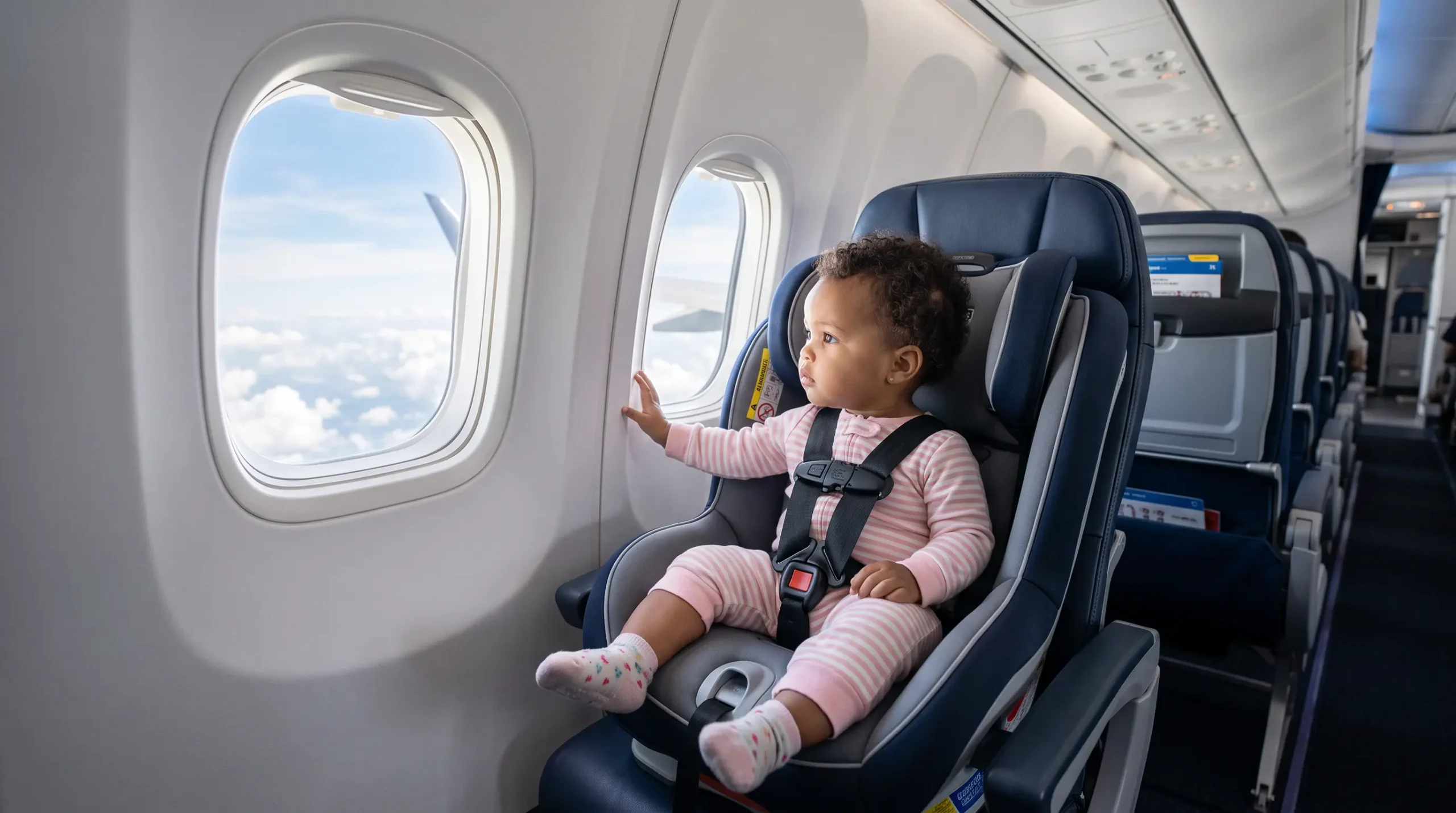
One nuance worth clarifying: this rule specifically targets booster mode. If you’re traveling with a combination seat, the kind that converts from a harnessed car seat into a booster as your child grows, it can still be used on board, but only in its harnessed configuration with the internal five-point harness engaged. The moment it’s switched into booster mode, relying on the seatbelt alone, it falls under the same restriction as a standalone backless booster. It’s a small distinction, but it matters if you’re trying to figure out whether your specific seat qualifies.
I know this can feel like one more thing to double-check when you’re already juggling a stroller, a diaper bag and a toddler who wants to explore the jet bridge, but it genuinely takes thirty seconds to confirm. Look at the label on your seat, or check the manufacturer’s manual if you’re not sure which mode it’s currently in. If it says “harness mode approved for aircraft use” or similar, you’re fine. If it doesn’t, plan on using the aircraft seatbelt for your child during the flight and saving the booster for the car seat waiting for you at your destination.
How to Check a Booster Seat for Free (Step by Step)
Here’s the good news buried under all those rules: checking a booster seat almost never costs anything. Car seats and booster seats fall outside standard baggage allowance on pretty much every major airline, and that includes budget carriers too. It travels free, separate from your regular suitcase limit, whether you check it at the counter or bring it to the gate. But “free” doesn’t mean “no effort”, so let’s walk through how to actually do it without your booster arriving cracked or missing a strap.
📋 Checking a booster seat, step by step
☐ 1. Confirm it’s free before you fly
Call or check the airline’s website the day before your flight. Policies rarely change, but staff at the counter sometimes need reminding that car seats and boosters aren’t counted against your baggage allowance.
☐ 2. Decide: check-in counter or gate
You can hand it over at check-in with your suitcases, or carry it through security and gate-check it right before boarding. More on that choice below.
☐ 3. Remove loose parts
Take off any cup holders, cushion inserts, or detachable padding that could snap off in transit. Store them inside your carry-on if there’s room.
☐ 4. Protect it with a bag or cover
A padded car seat travel bag is worth the investment if you fly often. A large plastic trash bag secured with tape works fine for occasional trips, mainly to keep it clean, not to cushion impact.
☐ 5. Buckle the harness or straps shut
Fasten any straps around the seat itself so nothing flaps loose and catches on conveyor belts or gets tangled with other luggage.
☐ 6. Tag it clearly
Attach a luggage tag with your name and phone number. If it’s an oversized item without a barcode sticker, ask the agent to confirm it’s properly tagged before it disappears down the belt.
I’ll be honest, the first time I checked a bulky item at the counter with a toddler on my hip, I felt like I was juggling more than I could manage. It gets easier. The agents handle oversized items like this constantly, and most are genuinely helpful once you’ve got your documents and the seat itself ready to hand over. The whole process adds maybe five extra minutes to check-in.
🧳 My honest rule of thumb: if your airline allows online check-in, do it, then arrive at the counter only to drop off checked items and confirm the booster seat is tagged. It saves you standing in a full check-in line holding a car seat, a stroller and a wriggly child all at once. I’ve learned this one the hard way more than once.
Gate-Checking a Booster Seat: What Actually Happens at the Jet Bridge
Checking your booster at the counter isn’t your only option. You can also carry it through security and gate-check it right at the boarding door, and honestly, this is the version I’d choose most of the time when I’m flying with Lily. It means the seat stays with you through the terminal instead of vanishing into the belly of the baggage system for an hour before you even get there.
Here’s how it actually works, step by step, because nobody explains this part clearly anywhere.
✈️ Gate-checking, in order
You carry the booster through security, on your back, over your shoulder, or clipped to your stroller if it’s compact enough. It goes through the X-ray scanner like a bag.
You keep it with you through the terminal and hold onto it while you board, right up until you’re about to walk onto the plane.
At the jet bridge, a gate agent or flight attendant tags it right there and takes it from you at the aircraft door. Some airlines hand you a claim tag, some don’t, so ask if they don’t offer one.
It gets loaded into the cargo hold from the jet bridge, separately from the rest of the checked bags, which usually means less handling and less time sitting exposed on a belt.
On arrival, it comes back the same way, at the jet bridge as you get off, or sometimes it’s brought up to the gate a few minutes after landing. It rarely ends up on the regular baggage carousel.
The upside is obvious: less time out of your sight, less chance of it getting crushed under someone’s oversized suitcase, and you don’t have to lug it through the whole airport on a wheelie cart. The downside is that you’re the one carrying it (and everything else) all the way to the gate, which with a toddler, a diaper bag and a boarding pass on your phone can feel like a lot in the moment.
💡 My advice: if your booster is on the lighter side and you don’t mind carrying it, gate-check it. If it’s bulky or heavy, or if you’re already stretched thin managing a stroller and a car seat too, hand it over at the counter and free up your arms for the walk through the airport instead.
Backless Booster Seats: The Trickiest One to Pack
If you’ve got a backless booster (the kind that’s basically a molded plastic shell with no frame, no straps, nothing to hold it together), checking it is a slightly different game than checking a bulky convertible car seat. A big car seat is awkward but sturdy, it’s built to survive impacts. A backless booster is light, hollow underneath, and the plastic edges crack more easily than you’d think when they get dropped, stacked under other bags, or squeezed into a tight cargo hold corner.
It makes sense once you think about how baggage handling actually works: bulky items like these get stacked and shifted around with everything else in the hold, and a hollow shell with no frame to absorb pressure is exactly the kind of item that ends up with a hairline crack near a cup holder or a scuffed edge if it isn’t padded properly. That’s not enough protection for a $60 piece of molded plastic that’s going to spend the flight sitting under someone’s golf clubs.
How to pack a backless booster for checked baggage
Wrap the corners and edges first. Bubble wrap or even a few folded towels taped around the sides where the plastic is thinnest (usually near the cup holders and the back edge) makes a real difference.
Slide the whole thing into a proper padded car seat travel bag if you have one. If you don’t want to buy one just for a lightweight booster, a heavy duty garbage bag secured with packing tape works fine to keep dirt and moisture off, it just won’t add cushioning on its own.
Stuff the cup holders and any hollow sections with socks, a rolled up muslin, or the small stuff you were going to pack anyway. It stops the shell from flexing and cracking if something heavy presses on it.
Strap it shut with a spare luggage strap if you have one, so it doesn’t pop open or shift inside its bag mid-transit.
Write your name and phone number on the outside with a permanent marker, on the bag itself, not just on a paper tag that can tear off.
💡 My honest rule of thumb: if the booster is inexpensive or already a bit worn out, I don’t stress over padding it perfectly, it’s not worth the hassle. But if it’s a good one you plan to use for years, spend the five minutes wrapping it properly. Cracked plastic near a buckle point isn’t just annoying, it can actually make the seat unsafe to use once you land.
One more thing worth knowing: a lot of backless boosters fold flat or at least sit fairly flush, which means they slide nicely into a large duffel or even a stroller travel bag alongside other soft items. If you’re already checking a stroller bag with room to spare, tucking the booster in there (well padded) can save you from checking it as a separate item entirely, and it stays a bit better protected surrounded by soft fabric than it would sitting alone in the hold.
Airline Checked Baggage Policies for Car Seats and Boosters, Compared
Here’s the thing nobody tells you until you’ve actually stood at a check in counter with a booster seat in your arms: every airline phrases this policy slightly differently, and the wording matters. Some say “car seat,” some say “child restraint device,” and a few genuinely don’t mention boosters by name at all, which leaves gate agents making their own call on the spot. I’ve flown with Lily across several countries and airlines, and I can tell you the actual experience at the counter varies a lot more than the fine print on airline websites suggests.
Below is the general pattern I’ve found researching and flying with major carriers versus budget airlines. Treat this as a solid starting point, not gospel, because policies get updated and the person scanning your boarding pass doesn’t always know the latest version of the rulebook.
| Airline type | Checked free as baggage? | Gate check offered? | What to expect in practice |
|---|---|---|---|
| Major full-service airlines | Yes, in addition to normal allowance | Yes, usually without issue | Counter staff tend to be relaxed about it, they’re used to families flying through with kids’ gear. |
| Regional and mid-size carriers | Yes, free, separate from luggage allowance | Yes | Ask at check in rather than assuming, the wording on some sites is a bit vague and agents sometimes need a moment to confirm it on their system. |
| Budget / low-cost carriers | Usually yes, but confirm in advance | Sometimes, can be inconsistent | This is the category I’d never assume anything about. Policies exist online but enforcement at the gate can feel more variable, so print your confirmation before you fly. |
💡 My honest rule of thumb: whatever the website says, I always screenshot the car seat and baggage policy page before I travel, with the date visible. It’s saved me twice at a check in counter when an agent wasn’t sure and needed to check with a supervisor. Having it right there on my phone made the conversation about thirty seconds instead of ten minutes.
If you’re flying with a US carrier and want the exact current policy for American Airlines, Delta, United, Southwest, Frontier or another major, go straight to their website’s “traveling with children” section rather than relying on a table like this one, because those policies do shift and the airline’s own page will always be more current than anything written after the fact. The general pattern across nearly every airline, though, is the same: a car seat or booster checked as baggage is free and doesn’t count against your regular luggage allowance. It’s the gate check consistency that varies, not the free part.
What to Use Instead of a Booster During the Flight
Here’s the question that actually keeps parents up the night before a flight: if my booster gets checked at the gate or in the hold, what does my child sit in during takeoff, landing and turbulence? The answer surprises a lot of people the first time they hear it, and it surprised me too when I first looked into it seriously with Lily. The FAA approved restraint for a child who’s old enough for a booster is simply the airplane’s own seatbelt. That’s it. No special equipment required by law.
🛡️ The reassurance nobody gives you: a booster seat is designed to position an adult seatbelt correctly in a car, where the seat geometry and belt angle are completely different from a plane. Airplane seats are more upright, closer together, and the lap belt sits lower across the hips by design. Aviation safety agencies have tested this extensively, the standard seatbelt is genuinely considered adequate protection for a booster age child in flight. You are not putting your child at risk by checking the booster.
That said, “adequate by regulation” and “comfortable for a wiggly four year old for six hours” are two different things. If you want something more structured than the bare lap belt, there are two realistic paths, and I want to walk you through both honestly rather than just naming a product and moving on.
The Standard Airplane Seatbelt
Free, always available, zero extra bag to carry. Works well for kids who are used to a regular seatbelt in the back seat of a car already, or who are close to the upper end of booster age.
A thin folded blanket or a small travel pillow tucked beside their hip can help the belt sit a bit more comfortably if they feel it’s cutting across the wrong spot.
A FAA Approved Harness (like CARES)
A lightweight fabric harness that clips onto the existing seatbelt and adds shoulder straps, roughly the weight and size of a small pouch, well under the usual 22 to 44 lb / 10 to 20 kg range most brands list.
It stays in your carry on, takes seconds to install, and gives an anxious flyer (or an anxious parent) an extra sense of security. I haven’t needed one yet with Lily, but it’s the first thing I’d pack if we had a long haul flight coming up with a squirmier toddler.
Before You Buy a Harness, Check This
It’s explicitly labeled FAA approved for use during flight, not just “travel friendly”
Your child’s weight falls within the manufacturer’s stated range, this matters more than age
Your airline allows harness devices in flight (nearly all US and European carriers do, but a quick check avoids surprises)
It can only be used on a forward facing seat, never on a lap or in a bassinet bulkhead row
One thing I’d add from having watched Lily go through different stages of flying: what feels like a necessity at 3 years old often feels completely unnecessary by 5 or 6, once they’re genuinely comfortable sitting still with just the belt. Don’t feel like you need to buy anything special before your first flight with a booster age child. Try the plain seatbelt first. If it goes fine, you’ve saved yourself a purchase and one more thing to pack. If it doesn’t, you’ll know exactly what you’re solving for the next time.
Flying Outside the US? Rules Can Be Different
Everything above comes from FAA rules, which apply to US carriers and US airspace. If you’re flying anywhere outside the US, don’t assume the exact same logic applies word for word. The overall principle usually holds (booster seats are for the car, not for takeoff and landing), but the fine print on checked baggage allowances, gate check policies and what counts as a “child restraint device” varies from one airline to another.
I’ve flown internationally with Lily on several European carriers, and honestly, the paperwork tone alone is different every time. Full-service airlines tend to be clear and fairly generous about checking child seats for free. Budget carriers sometimes bury the policy deeper in their baggage pages and charge for things a full-service airline includes, so I always double check car seat and booster allowances directly on the airline’s site before flying rather than assuming it works the same everywhere.
🌍 My honest rule of thumb: whatever airline you’re flying, outside the US or within it, look up their baggage page directly before the flight. Don’t rely on what a US based blog (including this one) says about “the rules.” Airlines update their own pages, and a two minute check the night before saves you an argument at check in.
The good news is that the core safety logic barely changes anywhere. No aviation authority I know of lets a child use a booster seat during taxi, takeoff or landing, because none of them are certified for that. The seatbelt (plain, or with a harness add on if your child needs it) is the approved solution everywhere.