Updated: Updated August 28, 2026
Hiking with a baby is one of those things that sounds intimidating until you actually do it. The questions parents type into Google aren’t vague, they’re specific: how old does my baby need to be, which carrier actually fits a 3 month old versus a 1 year old, and what happens if the trail gets too hot. This guide answers those questions directly, with an age-by-age breakdown, a full packing list, a carrier comparison, and the safety concerns that rarely get a straight answer anywhere else.
Table of Contents
- When Can You Start Hiking with a Baby?
- Which Baby Carrier Is Right for Your Baby’s Age?
- What Should You Pack for a Day Hike vs. an Overnight Trip?
- Which Baby Hiking Backpack Should You Choose?
- Is It Safe to Hike with a Baby? The Real Safety Concerns
- How Do You Hike Alone with a Baby?
- What’s Different Between a Newborn and an Older Infant on the Trail?
- How Do You Find Kid-Friendly Hiking Trails Near You?
- Frequently Asked Questions
When Can You Start Hiking with a Baby?
There’s no single official start age, but most pediatricians agree on three practical windows: gentle babywearing from birth once cleared postpartum, short front-carrier hikes from around 4 months when head control improves, and backpack carrier hikes from about 6 months once your baby sits unsupported. Age is a starting point, not a rule, readiness depends more on your baby’s development than the calendar.
Key term: Head control
The ability of a baby to hold their head steady and centered without support, even while moving. Most babies reach this milestone between 4 and 6 months, according to the CDC, and it’s the physical marker pediatricians look for before recommending an upright carrier.
0 to 3 months: Gentle, flat, and slow
Newborns lack steady head control, so any carrying method needs to fully support the head and neck. A soft-structured wrap or ring sling against your chest works better than a rigid carrier here. Stick to flat, easy paths, keep outings short, and get pediatrician clearance first, especially after a C-section or a difficult delivery.
Best gear: soft wrap or ring sling only, never a hard-frame carrier
4 to 6 months: Front carriers become an option
Most babies reach steadier head control around 4 months, per the CDC’s developmental milestone checklist, which most pediatricians use before recommending a soft-structured front carrier. This is also the window for short, easy trails with minimal elevation gain, scheduled around naps and feeds rather than the other way around.
Best gear: soft-structured front carrier with a head support panel
6 to 12+ months: Backpack carriers open up
Once a baby sits unsupported with full head control, usually between 6 and 9 months, a hard-frame backpack carrier becomes a realistic option. Most models on the market set their minimum age or weight requirement around this same range for exactly that reason. This is typically when longer, more varied trails become manageable.
Best gear: hard-frame backpack carrier with a sun canopy
The honest bottom line: a calm, well-fed baby with good head control at 4 months can handle an easy 45-minute loop just fine, while a fussier baby at 6 months might need shorter outings. Watch the baby in front of you, not the calendar.
Which Baby Carrier Is Right for Your Baby’s Age?
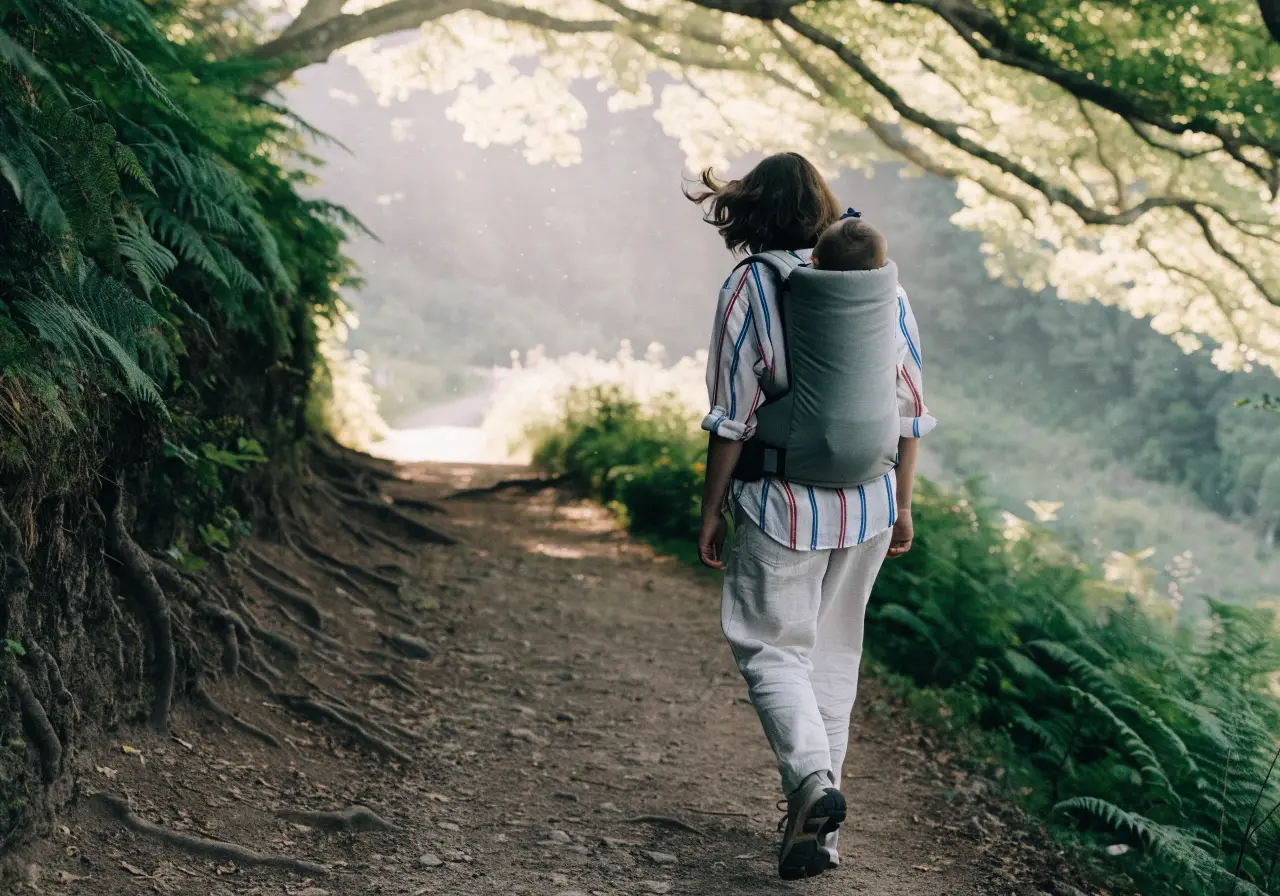
A soft-structured front carrier works for babies from birth up to roughly 20 lbs, while a hard-frame backpack carrier is built for babies from about 6 months and 16 lbs up to 30 to 50 lbs depending on the model. The real deciding factor isn’t the number on the label though, it’s whether your baby sits unsupported with steady head control.
Key term: Hard-frame carrier
A backpack-style carrier built around a rigid internal frame, with a hip belt that transfers most of the weight off your shoulders. It’s the carrier type used on multi-hour hikes, unlike soft-structured carriers which are better suited to shorter outings.
Simple rule of thumb: if your baby can’t sit unsupported yet, a backpack carrier isn’t safe regardless of what the weight limit says. Most manufacturers also cap continuous carrier time around 2 hours, so build breaks into longer hikes.
What Should You Pack for a Day Hike vs. an Overnight Trip?
A short day hike under 3 hours needs a lean, focused kit, while an overnight backpacking trip roughly doubles the list and adds sleep gear. Most baby hiking backpacks only offer 20 to 30L of cargo space, which is enough for a day hike but not for overnight supplies, so plan a separate bag for multi-day trips.
Key term: Buffer time
The extra time built into a hiking schedule to absorb unplanned diaper changes, feeds, or fussy stretches. With a baby, a realistic buffer is 30 to 50% more time than your normal hiking pace.
Short Day Hike (under 3 hours)
- Carrier appropriate for age/weight
- 2 to 3 diapers + wipes + small changing pad
- 1 extra outfit
- Feeding supplies (bottle, snacks, or nursing cover)
- Water for baby if age-appropriate
- Sun hat and one extra layer
- Small first-aid kit
Overnight / Backpacking
- Everything from the day hike list, doubled
- Full diaper supply for 24 to 48h + disposal bags
- Baby-specific sleep setup (portable bassinet, sleep sack)
- Extra layers for overnight temperature drop
- Backup feeding supply in case of delays
- Headlamp for nighttime diaper changes
- Way to warm bottles/food without power
- A clear, fast exit route in case plans change
Packing tip: since most baby backpack carriers only hold 20 to 30L, an overnight trip almost always requires a second pack carried by another adult, or a lighter shared load if you’re hiking solo.
Which Baby Hiking Backpack Should You Choose?
Weight capacity, torso fit, and sun protection are the three factors that matter most when comparing baby hiking backpacks. Most models cap out between 30 and 50 lbs, and prices typically range from $150 to $350 depending on cargo capacity and comfort features.
Key term: Torso fit
How well a carrier’s frame matches the length of your own back, not your height. A poor torso fit is one of the most common causes of shoulder and lower-back pain on longer hikes, so always adjust for torso length rather than relying on a generic size chart.
What testers agree on: Deuter, Osprey, and Thule are the three most tested brands on the market in 2026, with Deuter favored for long hikes, Osprey for built-in storage, and Thule for its lighter, more compact frame.
Is It Safe to Hike with a Baby? The Real Safety Concerns
Yes, hiking with a baby is safe when you manage five specific risks: overheating in the carrier, sun exposure, altitude, insect bites, and carrier-napping position. None of these require avoiding the trail, they just require knowing what to check and when.
Key term: TICKS positioning
A babywearing safety rule for a sleeping baby in a carrier: Tight, In view at all times, Close enough to kiss, Keep chin off chest, Supported back. It applies to any carrier use, not just hiking.
Is overheating a real risk in a carrier?
Yes. A baby pressed against your body absorbs your own body heat on top of the outside temperature. Check the back of the neck regularly for sweating or flushed skin, and dress baby in one fewer layer than you’d expect, since the carrier itself acts as insulation.
How do you handle sun exposure on a young baby?
The American Academy of Pediatrics recommends keeping babies younger than 6 months out of direct sunlight entirely, relying on shade, a canopy, or a carrier cover instead of sunscreen where possible. If shade truly isn’t available, sunscreen can be applied to small exposed areas only, according to HealthyChildren.org.
Does altitude affect babies on the trail?
Most everyday hiking trails don’t reach risky altitudes, but ascending quickly above roughly 2,500 meters (about 8,200 ft) with a young baby is generally discouraged. On higher-elevation trips, ascend gradually and watch for unusual fussiness, poor feeding, or breathing changes.
Is insect repellent safe on a hike?
Not for babies younger than 2 months, according to AAP guidance. Mosquito netting over the carrier or stroller, plus long sleeves, is the safer option at that age. From 2 months on, repellents with up to 30% DEET are considered safe when applied sparingly to exposed skin.
Is it safe if a baby falls asleep in the carrier?
Yes, if you follow the TICKS positioning rule above. Keep the chin off the chest, the face visible and unobstructed, and the airway clear at all times, exactly the same rule babywearing educators recommend for any carrier use.
Bottom line: none of these five risks should keep you off the trail, they just need a quick check-in every 20 to 30 minutes: neck temperature, sun coverage, and breathing.
How Do You Hike Alone with a Baby?
Hiking solo with a baby works best on loop trails with cell coverage, a shared route and return time sent to someone in advance, and a 30 to 50% time buffer built into your normal pace. Almost no existing guide addresses this directly, even though solo parenting on the trail is a completely different logistical puzzle than hiking as a pair.
Key term: Bail-out point
A spot along a trail where you can exit and reach the trailhead quickly if plans change. On a solo hike with a baby, picking a route with several bail-out points matters more than picking one with the best views.
- Choose loop trails over out-and-backs when possible, so you’re never doubling back through the same stretch if baby needs a break.
- Share your route and expected return time with someone before you go, since there’s no second adult to send for help if something goes wrong.
- Pack everything within reach without removing the carrier, using a small hip pack or the carrier’s own pockets, since taking a backpack carrier on and off solo mid-trail is genuinely difficult.
- Build in 30 to 50% extra time compared to your normal solo hiking pace, since every diaper change, feed, or fussy stretch happens without a second set of hands.
- Prioritize trails with cell coverage over trail difficulty or scenery when hiking alone.
Solo tip: a carrier with a built-in kickstand makes the biggest practical difference solo, since it lets you set the carrier down safely to load or unload baby without needing a second pair of hands or a picnic table.
What’s Different Between a Newborn and an Older Infant on the Trail?
The biggest differences are thermoregulation, immune resilience, and how long an outing can realistically last: a newborn manages 30 to 60 minutes before needing a break, while an older infant past 6 months often handles 2 to 4+ hours comfortably.
Key term: Thermoregulation
A baby’s ability to maintain a stable body temperature on their own. It’s underdeveloped in newborns, which is why they overheat or chill faster than older infants and need closer monitoring outdoors.
How Do You Find Kid-Friendly Hiking Trails Near You?
The best kid-friendly trails share five traits: elevation gain under 150m per hour, good shade coverage, accessible water or bathrooms at the trailhead, loop or multi-exit layouts, and recent, positive reviews. Rather than a list of specific trails that goes stale, this framework works for evaluating any trail, anywhere.
Key term: Elevation gain
The total vertical distance climbed over a trail’s length, usually listed in trail apps alongside distance and difficulty. It’s a better predictor of how tiring a hike will feel with a baby than total distance alone.
- Keep elevation gain under 150m per hour of hiking, a reasonable ceiling for carrier-based hikes with a baby.
- Check shade coverage using satellite view on trail apps, since exposed ridgelines are harder on a baby than forested paths.
- Confirm water access or bring your own, and check if the trailhead has a bathroom for changing.
- Look for loop trails or multiple bail-out points, so you’re never more than 30 to 45 minutes from the car if plans change.
- Use recent review filters on trail apps rather than relying on outdated trail descriptions.
Quick check before you go: pull up satellite view first. A trail that looks green and shaded on the map almost always beats one rated “easy” on paper but exposed the whole way.
Frequently Asked Questions
When can you start hiking with a baby?
There’s no fixed start date. Most parents begin with gentle babywearing on flat terrain once cleared by their pediatrician after birth, move to short front-carrier hikes around 4 months when head control improves, and start backpack carrier hikes from about 6 months once the baby can sit unsupported.
Is it safe to hike with a newborn?
Yes, with precautions. Get pediatrician clearance first, choose flat and easy paths, keep outings short, use a soft wrap or ring sling that fully supports the head and neck, and avoid direct sun exposure since newborns should stay out of direct sunlight entirely.
Can you hike with a 3 month old baby?
Yes, on flat and easy trails, using a soft-structured carrier or wrap with good head support. At 3 months, head control is still developing, so keep outings short and check regularly for signs of overheating or discomfort.
How do you keep a baby warm or cool while hiking?
Dress baby in one fewer layer than yourself, since the carrier adds insulation from your own body heat. Check the back of the neck periodically for sweating or coolness, use a sun canopy or hat for heat, and add a wind layer or carrier cover for cold.
What age can a baby go in a hiking backpack carrier?
Most manufacturers set the minimum around 6 months. More importantly, a baby needs to be able to sit unsupported with full head control before using a hard-frame backpack carrier, regardless of the age printed on the label.
How long can you hike with a baby before it’s too much?
For a newborn, 30 to 60 minutes is a realistic ceiling. Older infants past 6 months often manage 2 to 4 hours comfortably, but the real limit is your baby’s mood and feeding schedule, not a fixed duration.
What should you pack for a day hike with a baby?
An age-appropriate carrier, 2 to 3 diapers with wipes and a small changing pad, one extra outfit, feeding supplies, water if age-appropriate, a sun hat and an extra layer, and a small first-aid kit.
Is babywearing or a backpack carrier better for hiking?
It depends on age, not preference. Babywearing suits newborns and short outings, while a hard-frame backpack carrier becomes the better option once a baby sits unsupported, since it distributes weight through a hip belt for longer, more comfortable hikes.
How do you handle diaper changes and feeding on the trail?
Plan stops around trailheads with a flat surface, or bring a small changing pad for on-trail changes. For feeding, time outings around your baby’s usual feeding schedule and carry backup supplies in case the hike runs longer than planned.
Can you go backpacking overnight with a baby?
Yes, with more preparation than a day hike. A full diaper supply for 24 to 48 hours, a dedicated baby sleep setup, extra layers for the overnight temperature drop, and a clear exit route in case something changes are all essential.
“Hiking with a baby isn’t about waiting for the perfect age, it’s about matching the trail to the baby you actually have today.”
The gear and the milestones matter, but the real skill is reading your baby in the moment: a fussy 4-month-old and a calm one need two different plans, even on the same trail. Start small, watch the neck for overheating, keep the sun off before 6 months, and let the outings grow as your baby’s head control, sitting, and tolerance for the world grow with them.
Sources
- CDC, Important Milestones: Your Baby by Four Months
- American Academy of Pediatrics, Ultraviolet Radiation Exposure
- HealthyChildren.org (AAP), Sun Safety: Information for Parents About Sunburn & Sunscreen
- American Academy of Pediatrics, Insect Repellents
- Treeline Review, Best Baby and Toddler Carriers for Hiking of 2026
- CleverHiker, Best Baby Backpack Carriers for Hiking of 2026
Keep exploring