Updated Updated August 28, 2026
Here’s a number that surprised me when I first looked it up: TSA screens more than 2.5 million passengers every single day, and yet their own published guidelines make a very clear, very specific exception for parents traveling with babies, allowing formula, breast milk and baby food in quantities well over the standard 3.4 ounce liquid limit (TSA.gov). Most parents don’t know this exception exists until they’re standing at the checkpoint, bag half open, baby on hip, holding up the line behind them.
I’ve gone through airport security more times than I can count with my daughter Lily, from small regional airports to big international hubs, on Swiss, TAP Portugal, Norwegian and Ryanair. Security procedures shift slightly from country to country, but the underlying logic of what officers are checking for, and what actually slows families down, is remarkably consistent everywhere I’ve traveled with her. This guide focuses specifically on TSA, the security agency you’ll deal with at every US airport, and breaks down exactly what the rules say, what officers actually do in practice, and where parents lose the most time for no good reason.
What TSA Actually Requires When You Fly With a Baby (Quick Overview)
Before we go section by section, here’s the short version. If you only have two minutes before your flight, this is what you need to know.
Formula, breast milk and baby food are exempt from the 3.4 oz rule. Just tell the officer you’re carrying them before the bins go through.
Strollers go through the X-ray belt like any other item. You’ll need to fold it yourself in most checkpoints, so practice this at home first.
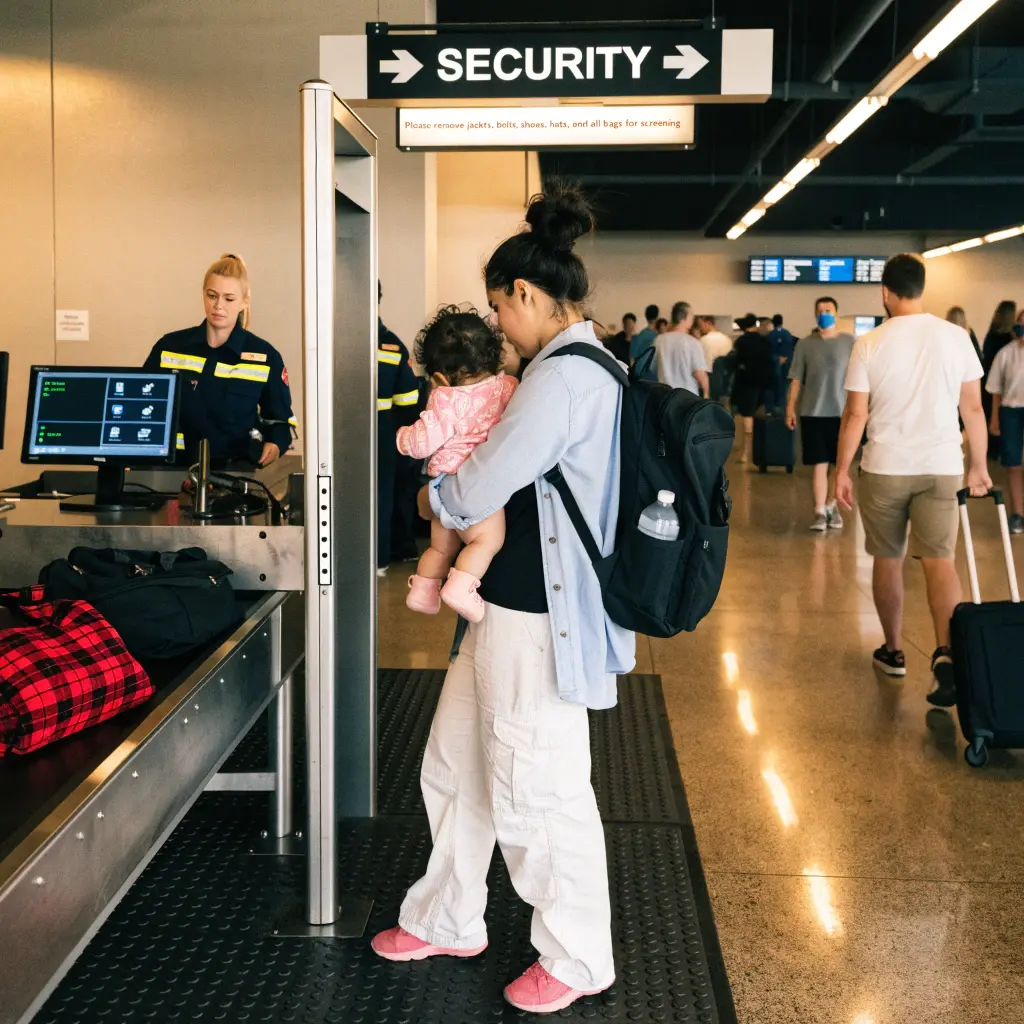
You can usually keep your baby in the carrier through the metal detector, but be ready to take her out if an officer asks for a pat-down.
Babies and toddlers don’t need a photo ID for domestic TSA screening. No boarding pass needed for infants under 2 either, in most cases.
Babies don’t need their own PreCheck membership. They can go through the expedited lane with a parent who has TSA PreCheck.
Budget extra time. Even with a smooth checkpoint, gathering a stroller, carrier and diaper bag back together always takes longer than you expect.
🍼 My honest rule of thumb: the parents who breeze through security aren’t the ones who packed the lightest. They’re the ones who separated their liquids and declared them out loud before the bins even started moving. That one habit alone saves more time than anything else on this list.
Now let’s go deeper into each of these, starting with the part that trips up the most parents: the liquids rule.
Table of Contents
- What TSA Actually Requires When You Fly With a Baby (Quick Overview)
- The Liquids Rule for Babies: Formula, Breast Milk and Baby Food Explained
- Can You Wear Your Baby Through Airport Security? What Really Happens
- Strollers Through Security: What Actually Happens, Step by Step
- TSA PreCheck With a Baby: What Changes and What Doesn’t
- Going Through Security Solo With a Baby: A Real Survival Strategy
- Packing Your Diaper Bag So Security Goes Faster, Not Slower
- Flying Internationally With a Baby: How Security Screening Compares Country to Country
- Common TSA Mistakes Parents Make With Babies (and How to Avoid Them)
- Full Baby Airport Security Checklist
The Liquids Rule for Babies: Formula, Breast Milk and Baby Food Explained
This is the section that stresses parents out the most before their first flight, and honestly, it’s the one that needs the least stress once you understand it. TSA doesn’t treat baby liquids like your shampoo. Formula, breast milk, baby food and even the ice packs you use to keep them cold are all exempt from the standard 3.4 oz (100 ml) rule. You’re allowed to bring “reasonable quantities” for your trip, and in practice, officers rarely question a diaper bag full of bottles and pouches as long as you flag it before screening starts.
I’ve flown with Lily on Swiss, TAP Portugal, Norwegian and Ryanair, and the one thing that stayed consistent across every single checkpoint is this: the officers care much more about how you present your liquids than how many ounces you’re carrying. Tell them clearly, keep the bag organized, and the whole thing takes thirty extra seconds instead of ten extra minutes.
What actually happens at the checkpoint: your liquids get pulled out of your bag and placed in a separate bin. Depending on the airport, an officer will either open a bottle to test it with a strip, or run it through a separate scanner without opening it at all. Both are normal. Neither means you did anything wrong. It just means the system is doing its job.
📌 One thing a lot of parents don’t realize: unlike your own liquids, formula, breast milk and baby food don’t need to fit inside a clear quart-size bag. TSA officially classifies them as “medically necessary liquids,” which means there’s no size cap and no bag requirement at all. I still keep mine in a clear pouch anyway, purely because it’s faster to hand over, but if you ever forget it or run out of bags, you’re not breaking any rule by carrying loose bottles through the checkpoint.
🍼 My advice: keep every liquid item in one clear, easy-to-open pouch inside the diaper bag, not scattered between compartments. When Lily was tiny, I’d unzip that one pouch, hand it straight to the officer, and say “baby liquids” before they even asked. That single move cuts the whole liquids conversation down to almost nothing.
One thing worth knowing if you’re connecting through multiple countries: the “reasonable quantity” wording gives officers some room for judgment, and in my experience flying through different hubs in Europe, some checkpoints are noticeably more relaxed than others about what counts as reasonable. It’s rarely a problem, but don’t be surprised if one airport barely glances at your bottles while another asks you to open every single one. Neither reaction means you packed wrong.
Now that the liquids question is settled, let’s talk about the part parents ask me about just as often: whether you really can keep your baby in the carrier while walking through the metal detector.
Can You Wear Your Baby Through Airport Security? What Really Happens
This is the question I get asked more than almost any other, usually by a parent standing in a checkout line at a baby store buying their first carrier before a big trip. The short answer is yes, you can generally wear your baby through the metal detector. But “generally” is doing some work in that sentence, so let’s break down what actually happens in practice, not just what the rulebook says.
TSA’s own guidance says babywearing through the walk-through metal detector is allowed. The officer will ask you to walk through as normal, baby and carrier included. If the detector doesn’t alarm, you’re done, no need to remove anything. That’s the scenario that plays out most of the time, especially with soft structured carriers and wraps that don’t have a lot of metal hardware.
Where it gets more complicated is if the detector does alarm, or if the officer decides they need a clearer view of you and the baby separately. In that case, you’ll usually be asked to step aside and either walk through again without the baby, or go through additional screening (a pat down, or a scan with a handheld wand) while someone else holds your baby, or your baby is briefly placed in a bin or on the belt area for a visual check while you’re screened.
🧷 What tends to trigger a second look when babywearing
- Metal buckles, rings, or hardware on the carrier itself
- A carrier with a lot of padding or structure that makes it hard to see the baby clearly on the scanner
- Snaps, teething pendants, or metal clips attached to the carrier straps
- Simply the officer’s own judgment call, which varies from person to person and airport to airport
None of this means you did something wrong. It just means the system flagged something and wants a closer look, which is exactly what it’s designed to do. Staying calm and cooperative moves things along far faster than getting flustered or arguing about it.
🍼 My advice: before you even get to the checkpoint, loosen your carrier straps just slightly so you can slip out of it in a few seconds if asked. Fumbling with buckles while a line forms behind you is stressful for everyone, including your baby, who can absolutely feel that tension. A carrier you can get in and out of quickly is worth more at security than one that looks impressive on Instagram.
If you’d rather avoid the whole conversation entirely, you always have the option to take your baby out of the carrier before you reach the detector and carry them through in your arms instead. This is what a lot of parents choose to do with newborns especially, since a tiny baby is easy to hold for the ten seconds it takes to walk through, and it sidesteps any question about the carrier hardware altogether. Neither choice is “more correct” than the other. It’s really about what feels manageable for you in that moment, especially if you’re traveling alone and juggling a bag on top of everything else.
One more thing worth mentioning: officers cannot ask you to remove your baby’s clothing or diaper as part of screening, and they should never ask you to separate from your baby entirely. If you’re ever told to hand your baby to a stranger or step somewhere you’re not comfortable with, it’s completely fine to calmly ask for a supervisor or for clarification. In all my years flying with Lily through different airports and different security systems, I’ve never had that happen, but it’s good to know your baby stays with you or with someone you trust throughout the process.
Once you and your baby are through, the next challenge is usually staring you right in the face: the stroller you just folded up, or the one you’re hoping to keep all the way to the gate. That’s exactly what we’re covering next.
Strollers Through Security: What Actually Happens, Step by Step
This is the part that trips up even parents who’ve done their homework on the liquids rule and the babywearing question. Everyone focuses on the baby going through the checkpoint, and then the stroller shows up like an afterthought that suddenly needs folding, X-raying, and re-assembling with a toddler squirming under one arm. I’ve done this at Geneva, at Lisbon, at Charles de Gaulle, and the sequence is basically the same everywhere, even if the exact wording the officers use changes.
🧠 My honest rule of thumb: if your stroller folds one-handed in under five seconds, you will have an easier security experience than with almost any other piece of gear you’re carrying. Practice folding it at home before your trip, not for the first time in the security line with three people waiting behind you.
The Actual Sequence, in Order
You reach the front of the line. An officer will usually tell you to fold the stroller before it goes on the belt. Some checkpoints have a designated spot to fold and stage it, others just want it done right where you’re standing.
The stroller goes through the X-ray machine like any other bag. Big strollers sometimes need to go through sideways or get walked around to a separate scanning belt if they don’t fit the standard opening. This is normal, not a sign something’s wrong.
You walk through the metal detector or body scanner with your baby, separately from the stroller, exactly as we covered in the babywearing section above.
You collect the stroller on the other side and unfold it right there. This is the moment I always try to buy myself a little space for, because you’re also collecting shoes, a laptop bag, the diaper bag, and a baby who wants to be picked up right now.
Gate-Checking vs. Bringing It All the Way to the Gate
A lot of parents don’t realize this, but in most cases you’re allowed to keep your stroller with you all the way to the gate and it gets tagged and taken from you right at the aircraft door, not at check-in. This matters because a folded stroller becomes a second pair of hands the moment your baby needs to nap, walk around, or just be contained for twenty minutes near the gate. I almost never check a stroller early unless it’s a large travel system that genuinely won’t survive the trip through security intact.
🎒 My advice: empty the stroller basket into your carry-on bag before you get in the security line, not once you’re already at the belt. Snacks, toys, and a spare blanket sitting in that basket are the single most common reason a stroller gets pulled aside for a manual look.
Once your stroller and your baby are both through and you’re upright again with everything back in its place, you might be wondering whether any of this changes if you have TSA PreCheck. Short answer: a little, but maybe not in the way you’d hope. Let’s get into that next.
TSA PreCheck With a Baby: What Changes and What Doesn’t
I get asked this constantly by other parents at the gate: is TSA PreCheck actually worth it when you’re traveling with a baby, or does the liquids exception and the stroller and the general chaos of flying with a small human cancel out the benefit? Here’s the honest answer after going through it enough times to know: PreCheck helps, but it doesn’t erase the baby-specific steps. It just removes some of the other friction so you have more hands and more patience left for the parts that actually take time.
What Stays Exactly the Same
- Formula, breast milk, and baby food still need to be declared and screened separately, PreCheck doesn’t waive this
- You’ll still need to remove your baby from the carrier or stroller if an officer asks for a clear view
- Diaper bags can still be pulled for a manual check, PreCheck lanes are not exempt from random additional screening
- Car seats, if you’re bringing one to the gate, still get their own screening pass
What Actually Gets Easier
- You keep your shoes on, which matters a lot more than it sounds when you’re holding a baby and don’t want to balance on one foot
- Laptops and light jackets can stay in the bag, one less thing to unpack and repack one-handed
- The lane itself is usually shorter and moves faster, so the whole process feels less rushed even though the baby-specific steps are identical
Does My Baby Need Their Own PreCheck Number?
This is the part that trips people up. Children 12 and under can go through the PreCheck lane with a parent or guardian who has PreCheck, without needing their own Known Traveler Number. So if you have PreCheck and you’re flying with your baby, you can bring them through that lane with you, no separate enrollment, no extra paperwork, no fee. It’s genuinely one of the simplest wins in the whole system and a lot of parents don’t realize it applies to babies too, not just older kids.
✈️ My honest rule of thumb: if you already fly often enough to justify PreCheck for yourself, it’s worth it even with a baby in tow. But if you’re booking one trip and wondering whether to get it just for this flight, I wouldn’t rush. The baby steps take the same time either way, PreCheck just shaves off the parts that were never the bottleneck in the first place.
Now, all of this assumes you’ve got a second adult around to help juggle the stroller, the bags, and the baby at the same time. If you’re doing this completely solo like I usually am, the logistics shift a bit, and that’s exactly what I want to walk you through next.
Going Through Security Solo With a Baby: A Real Survival Strategy
I fly solo with Lily most of the time. No second adult to hold the boarding passes while I fold the stroller, no one to watch the bags while I carry her through the metal detector. Just me, her, and whatever I managed to fit into one bag over my shoulder. So when people ask how to go through TSA with a baby, what they’re often really asking, without saying it directly, is how to do it when there’s nobody else there to help. That’s a different question, and it deserves a real answer instead of the generic “just be prepared” advice you see everywhere.
The honest truth is that solo security screening with a baby isn’t about being fast. It’s about being organized enough that speed stops mattering. Officers are not timing you. The people in line behind you might sigh, but that’s their problem, not yours. What actually helps is having a system so you’re not making decisions on the spot with a baby on your hip.
The Order I Actually Do Things In
- 1. Everything gets prepped in the line, not at the belt. Liquids bag out, laptop out if I have one, shoes loosened. The conveyor belt is not the moment to start rummaging, that’s what turns thirty seconds into three minutes.
- 2. I decide upfront: babywearing or stroller through the scanner, not both undone at once. If Lily is in the carrier, she stays in it right up until an officer tells me otherwise. If she’s in the stroller, I fold it at the very last second, not five people back in the line.
- 3. I put the diaper bag through first, then the stroller, then myself and Lily last. That way my hands are free for her the moment I step through, instead of trying to catch bins and a baby at the same time.
- 4. I don’t try to hold her AND collect bins AND put shoes back on all at once. I move everything to the side, away from the belt, and reassemble myself there. Nobody minds. The people trying to load their own bins mind a lot more if you’re doing this in their spot.
The part nobody tells you is that asking for help is not a failure. Every single time I’ve had a hard moment at a checkpoint, an officer has stepped in to hold the stroller for two seconds or help me shift a bin. They deal with parents traveling alone constantly, it’s not a novelty to them. I used to feel like I needed to prove I had it all under control. I don’t anymore, and the trips got easier the moment I let that go.
🧳 My advice: wear a baby carrier that you can get in and out of with one hand, and keep your ID and boarding pass in a pocket you can reach without opening your bag. Those two small choices save more time than any packing hack I know.
What I Keep Within Reach at All Times
✅ ID and boarding pass in an outer pocket, never buried
✅ Liquids bag on top, not underneath anything else
✅ A pacifier or small toy easy to grab without unzipping anything
✅ One free hand at all times, even if it means slinging the bag differently
None of this makes security instant. It still takes what it takes. But it takes it in a way that doesn’t leave me frazzled before I’ve even reached the gate, and that’s really the whole goal when you’re doing this without backup. The next part is where a lot of that groundwork actually gets laid, before you even reach the checkpoint, in how you pack the diaper bag in the first place.
Packing Your Diaper Bag So Security Goes Faster, Not Slower
Here’s something I learned the hard way, back when I still packed Lily’s diaper bag the way I’d pack any other bag: shoving things in wherever they fit. It works fine at home. It falls apart completely at a checkpoint, when an officer is waiting and you’re digging through burp cloths trying to find a bottle of formula you know is in there somewhere. The bag itself isn’t the problem. The order you put things in is.
I now pack Lily’s diaper bag the exact same way every single time, specifically with security in mind, not just the flight. It takes me maybe thirty extra seconds at home. It saves several minutes and a lot of stress at the checkpoint.
Think in Layers, Not Compartments
Forget organizing by “diapers here, snacks there.” Organize by what needs to come out at security versus what absolutely doesn’t. Everything that needs to be visible or removed goes on top and near an opening. Everything TSA has zero interest in, spare clothes, muslin cloths, the fifth backup pacifier, goes at the bottom.
Top layer (grab it fast)
Liquids bag, snacks for the security wait, phone, ID copy if you keep one
Middle layer (sometimes asked for)
Formula or milk bottles, baby food pouches, a change of clothes for spills
Bottom layer (never touched at security)
Extra diapers, spare outfits, muslins, toys not currently in use
Outside pocket (yours, not hers)
Your ID, boarding passes, phone charger, hand sanitizer
The liquids bag deserves its own callout here, because it’s the one thing officers will actually ask to see almost every time. I keep it in a clear quart bag even though the exemption technically means it doesn’t have to be, because pulling out one obvious bag is faster than explaining that the loose bottles rolling around at the bottom of my carry on are, in fact, formula.
🍼 My honest rule of thumb: if you can’t find it in your bag in under ten seconds without unpacking anything else, it’s not packed right for airport security. Repack it at home until it passes that test.
What I Pack Differently Since Lily Started Solids
Once we moved past just bottles, the bag naturally got more complicated, and I had to get more disciplined about it, not less. Pouches and snack containers are easy to lose track of in a bag that already has bottles, diapers and spare clothes fighting for space. I keep all food items, whatever their form, in one single pouch inside the bag rather than scattered across different pockets. When an officer asks what liquids or food I’m carrying, I can answer in one sentence and hand over one pouch, instead of patting down three different zippers while everyone waits.
Quick Packing Checklist
☑️ All liquids and food together in one pouch, near the top
☑️ Nothing that needs showing to an officer buried under clothes
☑️ Your own documents in a pocket separate from the baby items
☑️ Spare outfit and diapers at the very bottom, out of the way
☑️ One toy or pacifier easy to grab without opening the whole bag
☑️ Bag closed with a single zipper pull, not three you have to hunt for
None of this is complicated once you set it up. The point isn’t to have a perfect bag, it’s to have a predictable one, so that at the one moment where everyone behind you is watching, you’re not the parent turning a diaper bag upside down on the belt. And once your bag is doing its job, it’s worth stepping back and looking at how the whole screening experience changes once you’re flying across borders, not just through your home airport.
Flying Internationally With a Baby: How Security Screening Compares Country to Country
Everything above is written with the TSA specifically in mind, because that’s what most of you are searching for. But if you’re based in Europe like I am, or you’re connecting through more than one country on your way to the US, it helps to know that “airport security” isn’t one universal experience. I’ve flown with Lily on Swiss, TAP Portugal, Norwegian and Ryanair, and the checkpoint feels genuinely different depending on which one I’m walking through. Not better or worse across the board, just different in ways that change how I prepare.
The TSA rules I’ve described are American rules, full stop. The moment you fly out of Geneva, Lisbon, Oslo or wherever your Ryanair flight happens to depart from that week, you’re under a different authority with its own version of the liquids rule and its own culture around how officers interact with families. The good news is that the core logic (liquids in reasonable baby quantities are fine, strollers get screened, babywearing is generally allowed) holds up almost everywhere I’ve flown with her. The details around the edges are where it gets interesting.
What Changes, Airline by Airline and Airport by Airport
| Where I flew from | What stood out with a baby |
|---|---|
| Switzerland (Swiss, Geneva) | Calm, efficient, officers used to seeing families and rarely ask more than one question about the milk pouch. |
| Portugal (TAP) | Friendly and relaxed overall, but lines can move slower at peak times, so I build in more buffer time. |
| Norwegian routes | Very organized, clear signage for family lanes, staff proactive about pointing us toward the shorter queue. |
| Ryanair (various EU airports) | Depends entirely on the airport, not the airline. Smaller regional airports can be quick and quiet, bigger ones during peak holiday travel are the tightest squeeze I’ve dealt with, stroller and all. |
The pattern I’ve noticed isn’t really about the airline at all, it’s about the airport itself. Smaller, less crowded airports tend to be gentler with families no matter which carrier you’re flying. Big hub airports during peak season are the ones where you need every packing habit from the section above working perfectly, because there’s simply less patience and less space to fumble.
✈️ My advice: before any international trip, spend two minutes looking up the specific airport’s own security page, not just the airline’s. Rules around liquids for babies are broadly similar across Europe and the US, but the exact wording and the patience level of the staff can shift a lot from one terminal to the next.
One Thing That Doesn’t Change Anywhere
Whether I’m at Geneva, at a small regional airport in Portugal, or squeezed into a Ryanair queue somewhere I hadn’t planned on, the one constant is this: officers everywhere respond well to a parent who looks organized and calm, and they get understandably less patient with one who looks flustered. Your bag being ready, your baby being held rather than juggled, and you knowing exactly what’s about to come out of that carry on will smooth things over in pretty much any language, in pretty much any country. That’s the part worth practicing at home, because it travels with you no matter which border you’re crossing next.
Common TSA Mistakes Parents Make With Babies (and How to Avoid Them)
After enough trips through security with Lily, I’ve noticed the same handful of mistakes trip parents up over and over. None of them are about breaking a rule on purpose. They’re almost always about being rushed, distracted, or simply not knowing a small detail until an officer points it out mid queue with a line of people behind you. Here’s what actually slows families down, and the easy fix for each one.
❌ Mistake #1
Leaving milk and baby food buried in the diaper bag
If the officer has to dig for it, or you have to unzip three pockets to find it, that’s where delays start. Everything liquid should be in one spot you can reach in two seconds.
❌ Mistake #2
Not saying anything about the liquid exception
Staying silent and hoping the officer just knows leads to more questions, not fewer. A simple “this is formula/breast milk for my baby” upfront saves everyone time.
❌ Mistake #3
Freezing when asked to take the baby out of the carrier
If you didn’t know this could happen, it feels like an emergency. It isn’t. Knowing it’s a possibility ahead of time means you can undo the buckles calmly instead of panicking.
❌ Mistake #4
Keeping shoes, belt and jacket on until the very last second
Trying to undress at the bins while also holding a baby is how bags get left behind or bins get knocked over. Start peeling layers off while you’re still in the queue.
❌ Mistake #5
Not knowing the stroller has to be folded before the belt
Fumbling with a stroller you’ve never actually folded before, right at the checkpoint, is one of the most common holdups I’ve seen. Practice folding it at home before you fly, not for the first time at the airport.
❌ Mistake #6
Assuming the rules are the same at every airport
As I mentioned above, wording and patience levels shift from one country to another. What worked smoothly at your home airport might get an extra question somewhere else, and that’s normal, not a sign you did something wrong.
🎯 My honest rule of thumb: almost every one of these mistakes comes down to trying to figure something out for the first time while you’re already at the checkpoint. Whatever you can practice, learn, or organize at home the night before (folding the stroller, packing the liquids bag, deciding who holds the baby), do it there instead. The checkpoint is not the place to be improvising.
Full Baby Airport Security Checklist
Here’s everything from this guide pulled together into one checklist. I’d screenshot this or print it before your next flight, honestly. It’s the exact list I run through in my head every time we’re heading to the airport with Lily, split into the moments that actually matter: what to sort out at home, what goes in the bag, and what to do once you’re standing in that line.
Frequently Asked Questions About TSA and Babies
Can babies get TSA PreCheck?
Babies and children under 12 don’t need their own PreCheck membership. They can go through the PreCheck lane with a parent or guardian who has it. What they can’t do is skip the process entirely, an officer can still ask you to remove the baby from a carrier even in that faster lane.
How much breast milk or formula can I bring through TSA?
There’s no strict cap on quantity for formula, breast milk or baby food, they’re exempt from the standard 3.4 oz liquids rule. Just bring an amount that’s reasonable for your trip and keep it separate so it’s easy for an officer to see and screen.
Can I wear my baby through the metal detector at airport security?
Yes, in most cases, but be ready for the officer to ask you to remove the baby so the carrier itself can be scanned or checked separately. It’s not a sign anything is wrong, it’s just standard procedure.
Do strollers go through the X-ray machine at airport security?
Strollers typically need to be folded and sent through the X-ray belt like any other bag, though very large strollers sometimes get a manual check instead. Either way, plan to fold it before you’re right at the belt.
What ID does my baby need to go through TSA?
Domestically, babies don’t need their own ID for TSA screening in most cases. For international travel, your baby will need a valid passport (and sometimes additional documents depending on the destination), so that’s worth sorting out well before your flight.
Can I bring baby food through airport security?
Yes, jarred or pouched baby food falls under the same exemption as formula and breast milk. Keep it separate from your other liquids and be ready to mention it before the officer has to ask.
How early should I get to the airport when traveling with a baby?
I always build in extra time beyond what I’d normally allow, mostly because everything with a baby just takes longer, from folding the stroller to repacking the liquids bag after screening. Rushing is what turns a normal checkpoint into a stressful one.
Do I need to take my baby out of the carrier at security?
Not always, but you should be ready for it. Whether it’s requested depends on the officer and the checkpoint, so keep the buckles easy to undo just in case.
Does my baby’s car seat need to be screened separately?
If you’re bringing a car seat through the checkpoint (rather than gate-checking it unopened), it goes through the X-ray belt on its own, without the baby in it. Plan for a moment where you’re holding the baby and the car seat both need to be sent through.
Can I bring a stroller all the way to the gate?
Yes, most airlines let you use the stroller right up to the gate and gate-check it there, rather than checking it at the counter. It’s genuinely one of the easiest ways to make the whole airport walk with a baby less exhausting.
My Verdict
“TSA with a baby isn’t hard because the rules are complicated. It’s hard because you’re trying to remember rules while also holding a human, a stroller and a bag of liquids at the same time.”
If I had to sum up everything in this guide in one sentence, it’s this: the checkpoint itself is never the problem, the lack of preparation before it is. Every time we’ve had a smooth crossing with Lily, it’s because I’d already folded the stroller at home, already sorted the liquids into their own bag, already decided in my head what I’d say if an officer asked me anything. Every time it’s felt chaotic, it’s because I was figuring something out for the first time right there in the line.
You don’t need to memorize every rule word for word. You just need to walk in knowing roughly what to expect, keep your liquids and your baby’s things easy to reach, and give yourself the extra ten minutes you’ll almost certainly need. That’s genuinely it. The rest is just doing it enough times that it stops feeling like a big deal, because eventually, it really doesn’t.
Keep exploring