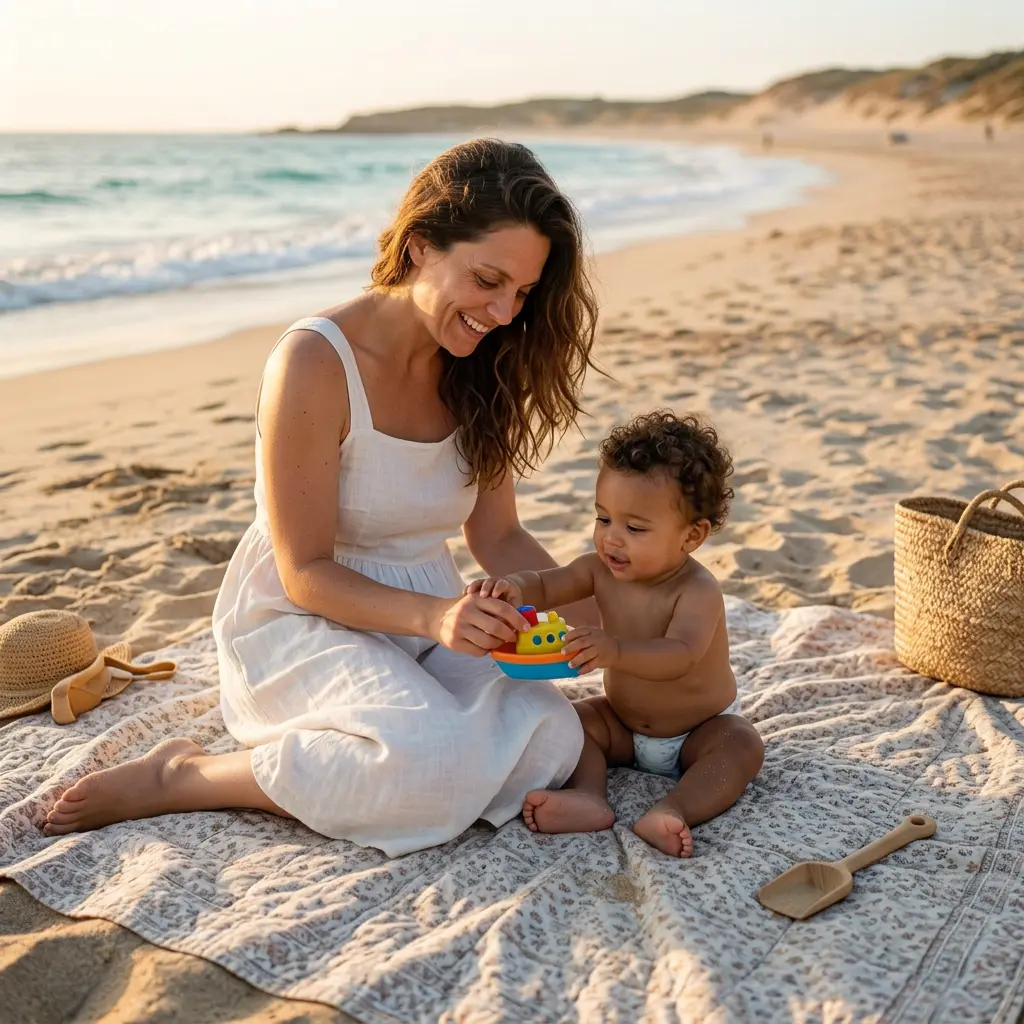
A note before we start: this one comes from real experience, Nayeli’s first beach day in Pornichet, France, at 5 months old, and a much bigger lesson learned at Lake Geneva when she was 15 months. Both are in here, including the part that didn’t go perfectly.
Table of Contents
Beach day with a baby is one of those topics where everyone has an opinion, and half of them contradict the other half. “Not before 3 months.” “Not before 6 months.” “Never sunscreen under 1.” Here’s the practical version, backed by what pediatricians actually say, and by what really happened the first two times we tried it.
What age to take baby to the beach
There’s no official medical minimum age, but there’s an important physical reality: the younger the baby, the more fragile their skin and the less able they are to regulate body temperature. Most pediatricians suggest waiting until at least 3 months for an actual beach outing.
At this age babies don’t yet produce enough melanin to offer any natural sun protection, and they can’t regulate body temperature well. Heat and sun are genuine risks. A short walk near the shore in early morning or late afternoon, fully shaded, is fine, but settling in on the sand isn’t the right move yet.
This is the age Nayeli had her first beach day, 5 months old in Pornichet. It’s doable, but it takes proper organizing: full shade, the right time of day, a short visit, and sunscreen on anything not covered by clothing. Plan on an hour, maybe two, not a full day.
Baby is sturdier and more alert, and starts genuinely interacting with sand and water. This is often when the beach becomes a shared joy rather than a logistics exercise. Sun precautions stay exactly as strict, skin remains very fragile until at least age 3.
Sun protection and the sunscreen dilemma
This is the one area not to compromise on. A baby’s skin absorbs UV far more readily than an adult’s, burns faster, and sunburn in early childhood carries long-term risk for skin cancer later in life.
- Clothing first, always. A UV-protective swimsuit, wide-brimmed hat, and a light long-sleeve layer are the most effective and least debated protection for young babies. The more you cover, the less you’re relying on cream.
- Mineral sunscreen, SPF 50+, on anything left exposed. Face, hands, feet, neck, anywhere clothing doesn’t reach. Choose mineral (zinc oxide or titanium dioxide) over chemical formulas. Reapply every 2 hours and after any contact with water or sand.
- Shade, always, no exceptions. Sand reflects up to 20% of UV rays, so being in the shade alone doesn’t eliminate the risk, sunscreen still matters even under an umbrella or tent.
- Stick to before 11am or after 4:30pm when UV intensity is lowest. Outside this window, even with shade and sunscreen, the risk is meaningfully higher for a baby.
Crying without an obvious reason, very red skin, unusual drowsiness or unusual agitation, or skin that feels hot to the touch even in the shade, these point to overheating. Head somewhere cool, cool baby down gently, offer fluids, and see a doctor if it doesn’t resolve quickly.
Beach shade for baby: tent vs umbrella
Shade is non-negotiable, but not all shade is equal. The sun moves fast over a couple of hours, and an umbrella that felt perfectly positioned at arrival can leave baby half-exposed twenty minutes later. This is the detail most guides skip past, and it’s worth getting right before you’re standing on the sand adjusting things.
Classic, cheap, and easy to pack. But it needs to be angled and moved as the sun shifts, and a gust of wind can tip it over in seconds if it isn’t anchored deep and firm.
Best for: short visits where you’re actively adjusting it, or as backup shade alongside a tent.
Pops up in seconds, stays anchored with stakes, and covers a wider, more consistent area of shade that doesn’t shift with the sun the way an umbrella’s shadow does. Mesh panels help with airflow so it doesn’t turn into a hot box.
Best for: longer stays, windy beaches, or whenever baby might nap in it.
- UPF 50+ fabric, this blocks around 98% of UV, standard polyester or cotton doesn’t offer the same guarantee
- Ventilation, mesh windows or open sides matter more than it seems, a sealed shelter can trap heat and undo the point of the shade in the first place
- Stakes or sandbags for windy beaches, a tent that blows over is worse than no tent, since it can startle or even fall on a baby underneath
- Check if it’s rated for safe sleep before assuming baby can nap inside it, most beach tents aren’t, if you want your baby to be able to nap in the shelter itself rather than in a stroller or your arms, look specifically for a model designed and rated for that
Water: cold, warm, and how much is too much
This was one of the real questions at Pornichet: is the Atlantic too cold for a 5-month-old? Short answer, yes, and babies don’t yet regulate body temperature well. We kept it simple: just her feet, a few seconds, and she loved it.
- Often below 68°F (20°C) in summer
- Waves can be strong, extra vigilance needed
- Feet-dipping possible from around 3-4 months
- Full dip from 6 months with a wetsuit
- Warmer, around 75-81°F (24-27°C) in summer
- Calmer sea, fewer waves
- Partial dip possible a bit earlier
- Heat is often more intense, sun protection matters even more
General rule on water: before the 2-month vaccines, avoid immersion in untreated seawater or lake water altogether, it carries bacteria baby isn’t protected against yet. After that, a feet-and-ankles dip is fine. Before 6 months, stick to feet and ankles. After 6 months, a few minutes at most, never unsupervised, wetsuit if the water is on the cooler side. The “5 minutes max” guideline holds until at least age 1.
Blue or purplish lips, shivering, or skin turning pale are signs of mild hypothermia. Get out of the water right away, dry off, wrap in a warm towel, and warm baby against your own body. Don’t count on the sun alone to warm up a shivering baby, it isn’t fast enough. See a doctor if symptoms persist.
Sand: the sensory experience (and the practical bits)
Most guides treat sand purely as a hazard. What they miss, and what I saw firsthand with Nayeli at Pornichet, is that sand is one of the richest sensory experiences you can offer a baby.
Touching sand for the first time, the texture, the warmth, the way it slips between little fingers. The sound of waves, the salty smell, the different quality of light, the wind. It’s an extraordinary sensory playground for a baby’s development.
- Skip letting baby go bare on the sand. Sand can irritate delicate skin and cause infections, especially in intimate areas. A swimsuit or bodysuit protects without cutting baby off from touching the sand itself.
- Baby eating sand isn’t an emergency. It’s normal, it’s basically inevitable, and it’s simply how babies explore at this age. Encourage them to spit it out gently and rinse the mouth with a little water.
- Sand in the eyes: rinse, don’t rub. Stop baby from rubbing, which makes it worse. Rinse thoroughly with clean fresh water. It usually clears quickly.
- A full bath as soon as you’re home, every time. Sand works its way into every fold and crease, in the diaper, in neck folds. A proper bath clears it all out and doubles as a nice end-of-beach-day ritual.
How long to actually stay
This is something I really understood at Pornichet: even in full shade, even well protected, the beach tires a baby out far faster than you’d expect. The ambient heat, the stimulation (waves, light, sand, people), the heat reflected off the sand, it’s a lot to take in all at once.
- Under 6 months: 1 hour maximum
- 6 to 12 months: 1.5 to 2 hours
- Favor before 11am or after 4:30pm, though with solid shade, overcast weather, and full protection in place, you can adjust somewhat based on conditions
- Plan a nap right after the beach, baby will likely be worn out
- Leave at the first signs of tiredness, not once baby is already overtired and crying
Beach day checklist
- Mineral SPF 50+ sunscreen, applied 30 minutes before heading out
- Wide-brimmed hat covering neck and ears
- UV swimsuit or lightweight covering clothing
- Baby sunglasses (CE certified)
- Umbrella or UPF beach tent
- Reapply sunscreen every 2 hours and after any water contact
- Milk or bottle, offered regularly even without obvious thirst cues
- Fresh water to cool baby’s face if needed
- A mat or blanket between baby and hot sand
- Spare clothes, sand ends up everywhere
- Diapers, pack double
- Neoprene or UV wetsuit if the water is on the cooler side
- Never leave baby unsupervised, even feet-only in the water
- Rinse after the sea, salt and sand irritate skin
- Full bath as soon as you’re back
- Favor before 11am or after 4:30pm, adjust based on weather
- Plan 1 hour max under 6 months, 2 hours max after
- Leave before signs of tiredness, not after
- Schedule the nap right after the beach, baby will be worn out
FAQ
What age can you take a baby to the beach?
Most pediatricians suggest waiting until at least 3 months. Before that, a baby’s skin lacks melanin and their temperature regulation isn’t developed enough for real sun exposure. Between 3 and 6 months it’s possible with strict precautions, full shade, short duration, sun protection.
Can you put sunscreen on a baby under 1?
This is the real dilemma. Official guidance generally advises against chemical sunscreen under 12 months. In practice, a mineral sunscreen made for babies on any skin left exposed by clothing is safer than an unprotected sunburn. Textile protection should still come first.
What’s the best beach shade for a baby?
A UPF 50+ beach tent generally works better than a plain umbrella for babies, since it stays anchored and provides consistent shade as the sun moves, rather than needing constant repositioning. Look for good ventilation and stakes for windy beaches.
Is the ocean too cold for a baby?
It can be, especially the Atlantic, often below 68°F (20°C) in summer. Watch closely for signs of cold, blue or pale lips and shivering mean it’s time to get baby out immediately, warm sun alone isn’t enough to counter genuinely cold water.
How long can a baby stay at the beach?
Less than most people expect. About 1 hour under 6 months, up to 2 hours between 6 and 12 months. Heat, reflected light off the sand, and general stimulation tire a baby out much faster than a typical outing.
What should I bring to the beach with a baby?
A UPF beach tent, mineral sunscreen, a wide-brimmed hat, a mat for the hot sand, plenty of water and milk, spare clothes and extra diapers, and a wetsuit if the water is on the cooler side. See the full checklist above for everything by category.
“Beach day with a baby is short, it’s gentle, and it takes planning. But it’s absolutely worth it.”
Pornichet with Nayeli at 5 months is still one of my favorite memories, her feet in the cold Atlantic water, her eyes wide open at the sea for the first time. We didn’t stay long, and that was exactly right. Prepare well, protect well, and go early. The rest, baby takes care of.