A note before we start: this guide is built from UK rail operators’ official policies plus real train trips I’ve done with Nayeli, on European lines like Eurostar and TGV rather than UK domestic routes specifically. Where I’m speaking from experience, I say so. Where it’s research, I say that too.
Table of Contents
- Can you take a pram on a train? The official rules
- Where to put a pram on the train
- Do you have to pay for a baby on a train?
- The “Baby on Board” badge (it’s not what you think)
- UK train companies compared
- What about the London Underground?
- What about commuter and suburban trains around London?
- Best type of pram for train travel
- What actually happens on a busy train
- Travelling solo with a pram and a baby
- FAQ
- My verdict
Every UK rail operator says the same thing on paper: prams and pushchairs are welcome, please fold if you can. But “welcome” doesn’t mean there’s actually anywhere to put one, and that gap between the official line and the real experience is exactly what trips parents up. Here’s what to expect, company by company, plus what I’ve genuinely learned rocking a stroller-refusing toddler up and down a train corridor.
Can you take a pram on a train? The official rules
Short answer: yes, on every single UK operator. Northern, GWR, LNER, Southeastern, Avanti West Coast, ScotRail, they all state the same core policy. Prams, pushchairs and buggies travel free, with no size restriction written anywhere in the National Rail Conditions of Travel beyond the general rule that they must be able to fold. In practice, almost nobody checks this at the barrier.
- Fold your pram before boarding if you’re able to, it speeds up boarding for everyone
- Never leave a pram unattended in a wheelchair space
- Never store luggage or bags on top of a pram in a wheelchair bay
- Give up the wheelchair space immediately if a wheelchair or mobility scooter user needs it
- Stay clear of doorways and the aisle, prams block fire exits and emergency access
Where to put a pram on the train
This is the part the official pages gloss over. There are exactly two options on most UK trains, and which one you get depends entirely on how full the carriage is.
The default answer on LNER, GWR and most long-distance services. Works well if your pram folds flat. You’ll need to carry your baby to your seat while it’s stowed there.
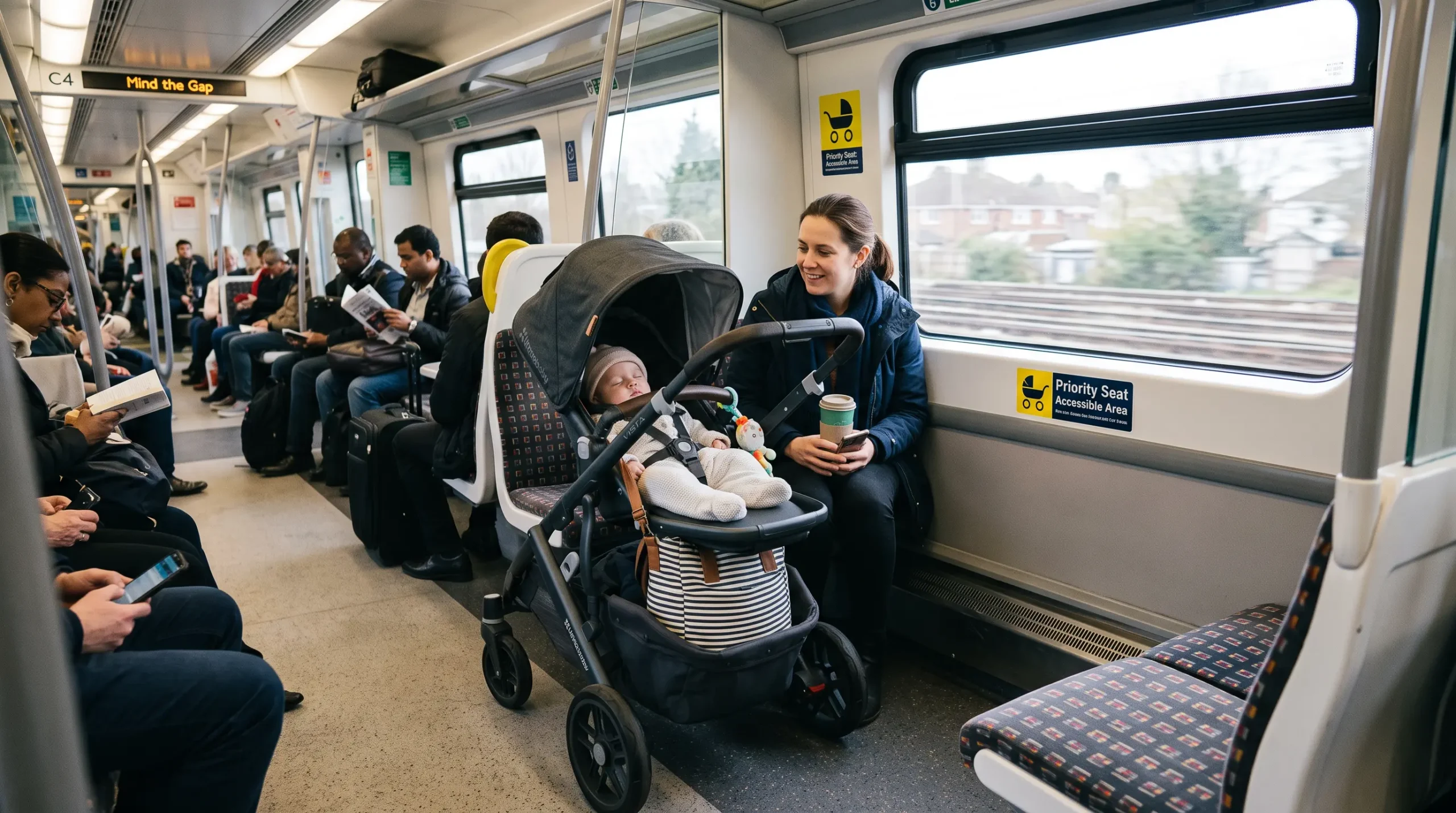
If it’s free, you can leave the pram unfolded, with baby in it, right next to your seat. The one condition: you must move immediately if a wheelchair or mobility scooter user needs the space.
There is no third option. Campaigners have been asking UK operators for years for a proper family bay, similar to what you’d find on Swiss or German trains, and it simply doesn’t exist yet on most services. Which means the honest advice is: check how full your specific train is likely to be, and have a folding plan ready regardless.
Do you have to pay for a baby on a train?
No, and this is one of the most parent-friendly rules on UK rail. Under the National Rail fare structure, children under 5 travel completely free alongside a fare-paying adult, no ticket needed at all. Children aged 5 to 15 pay half the adult fare. The pram itself never has a cost attached, unlike some airlines that charge for hold luggage allowance.
- Under 5: free, no ticket, no reservation needed for the child
- 5 to 15: half adult fare, railcards can often be applied on top
- Pram, pushchair or buggy: always free, treated as luggage, not a passenger
- Booking a seat for the pram itself isn’t possible, it travels in the luggage rack or wheelchair space, not on a seat
The “Baby on Board” badge (it’s not what you think)
If you’ve searched for this hoping it’s a badge for a baby already travelling with you, here’s the clarification: it isn’t. The Baby on Board badge, offered by TfL and most rail operators (Southern, Great Northern, Southeastern, c2c and others), is for pregnant passengers, not for babies who are already born. It signals to other passengers that you’re expecting and may need a seat, particularly useful in the early weeks when a bump isn’t visible yet.
UK train companies compared
Policies are broadly similar across operators, but a few details differ enough to matter when you’re planning a specific route.
| Operator | Pram policy | Dedicated space? | Baby changing |
|---|---|---|---|
| LNER | Fold if possible, welcome unfolded if space allows | No, luggage racks or wheelchair bay | Yes, on Azuma trains |
| GWR | Recommends folding before boarding | No, luggage racks | Varies by train |
| Northern | Welcome on all trains, folding requested | No, wheelchair space if free | Yes, on board toilets |
| Southeastern | Fold recommended, wheelchair bay usable | No, must vacate for wheelchair users | Limited |
| Avanti West Coast | Welcome, folding requested at busy times | No, luggage racks | Yes, most services |
| Eurostar | Free, folding pram in addition to luggage allowance | More space available if train isn’t full | Yes |
Policies can shift between updates, always worth a quick check on the operator’s own accessibility or “travelling with children” page before a long trip if you’re relying on a specific detail.
What about the London Underground?
The Tube is a different animal entirely from national rail, and the rules that apply to LNER or GWR don’t carry over. On the Underground, you’re allowed to take any pushchair on board, unfolded, with no requirement to fold it, even at busy times. The real obstacle isn’t the train, it’s the station.
Jubilee and the newer Elizabeth line have the best lift coverage and bigger trains. Good picks if step-free access matters for your route.
Northern and Bakerloo are some of the oldest lines, with fewer lifts and narrower platforms. Worth checking step-free status before you commit to a route.
- Check TfL’s step-free tube guide for your specific stations before you travel, not just the line in general
- Under 5s travel free, same as national rail, no ticket needed for the child
- Avoid peak hours (before 9:30am, 4:30 to 6:30pm) if you can, platforms and trains are noticeably easier outside this window
- If a station has stairs and no lift, most parents fold and carry rather than risk the pushchair on an escalator
- Buses are often the easier option for short hops, they kneel at the stop and take an unfolded buggy in the wheelchair space
What about commuter and suburban trains around London?
Southern, Thameslink, Great Northern, South Western Railway, and London Overground fall into their own category, neither the Tube’s stand-anywhere flexibility, nor the luggage racks of a long-distance LNER service. These are the trains most likely to be genuinely packed at commuter times, and where pram space gets contested hardest.
- Avoid 7 to 9am and 4 to 6:30pm if you possibly can. Outside these windows, suburban trains are genuinely manageable. Inside them, expect a full carriage and very little patience for an unfolded pushchair blocking the doors.
- London Overground is usually the easiest of the bunch. Dedicated wheelchair and buggy bays, step-free access at most stations, and none of the deep-level stairs that make the Tube harder work.
- South Western Railway, Southern and Great Northern services vary by rolling stock. Newer trains tend to have a clearly marked multi-purpose bay, older units sometimes don’t, so if you’re commuting the same route daily, it’s worth learning which carriage of your usual train has the space.
- If the bay is taken by a bike or luggage, ask politely, most cyclists and commuters will move if there’s another spot for their belongings and yours is a baby who needs somewhere to be.
Best type of pram for train travel
Given that luggage racks and shared wheelchair bays are your only real options, the pram itself makes a bigger difference than any rule on the operator’s website. A pram that folds in one motion changes the entire experience of boarding a busy train.
- Umbrella-fold strollers
- Compact travel systems (Babyzen Yoyo, Bugaboo Butterfly type)
- Anything that folds one-handed while holding baby
- Prams that stand up on their own once folded
- Bassinet/carrycot prams that don’t fold at all
- Double buggies, side by side especially
- Anything needing two hands and a flat surface to fold
- Very large all-terrain 3-wheelers
What actually happens on a busy train
The official policies describe the ideal case. Here’s what tends to happen in reality, based on my own experience travelling by train with Nayeli, and on what other parents report on forums like Mumsnet.
Un visuel simple en arbre de décision marcherait bien ici : “Mon train est-il plein ?” → Non → poussette non pliée dans l’espace fauteuil roulant / Oui → plier et ranger dans le porte-bagages + porte-bébé en solution de repli. Facile à scanner, bon candidat pour du partage Pinterest aussi vu que tes autres articles utilisent déjà ce type de visuel décisionnel.
Travelling solo with a pram and a baby
If you’re the only adult managing a pram, a bag, and a baby, the actual challenge usually isn’t the rule about folding, it’s the logistics of doing it alone on a platform with limited time between doors opening and closing.
- Ask directly. A simple “excuse me, I’m travelling alone with my baby, could you help me get the pram on board?” almost always gets a yes. Most people are glad to help, they just wait to be asked.
- Book Passenger Assist in advance. Every UK operator offers this free assistance service for anyone who needs help boarding, including parents travelling alone with a pram. It’s designed for reduced mobility passengers, but staff will help with a pram too if you ask when booking.
- Pick a quieter departure if your schedule allows it. A slightly earlier or later train, avoiding the school run or commuter peak, gives you far more room to manage boarding at your own pace.
- Position yourself near the right door before the train arrives. Standing near where the wheelchair bay or luggage rack typically is (usually near a door marked with a wheelchair symbol) saves you from walking the platform with baby and pram once the doors open.
FAQ
Can you take a pram on a train in the UK?
Yes, every UK rail operator allows prams, pushchairs and buggies on board, free of charge. Folding is recommended when the train is busy, but not always required if space allows.
Where do you put a pram on a train?
Folded prams go in the luggage racks at either end of the carriage. An unfolded pram can go in the wheelchair space if it’s free, but you must move it immediately if a wheelchair user needs that space.
Do you have to pay for a baby on a train?
No. Children under 5 travel free on UK trains alongside a fare-paying adult. Children aged 5 to 15 pay half the adult fare. The pram itself never has a cost.
What is a Baby on Board badge, and is it for the baby?
No, it’s not for babies already born. The Baby on Board badge is given to pregnant passengers to signal they may need a seat. If you’re travelling with a baby who’s already here, priority seats near the doors are the ones to look for instead.
Does my pram need to fold to travel on a train?
Not strictly required by rule, but strongly recommended, especially at busy times. Non-folding prams (like bassinet-style carrycots) can be genuinely difficult to manage on a packed train.
Can I get help boarding a train alone with a pram?
Yes. You can book free Passenger Assist in advance with any UK operator, or simply ask a fellow passenger or member of staff on the day, most people are happy to help.
“A pram on a UK train works, right up until the train fills up. Plan for both scenarios and you’ll never be caught out.”
There’s no dedicated family space waiting for you like there is on some European trains, but there’s also no fee, no fuss over ticketing, and plenty of goodwill from other passengers if you ask for help. Bring a pram that folds in one move, keep a carrier as backup, and pick your departure time with the crowds in mind if you can. The rest tends to sort itself out.
Keep exploring