From the stress the night before, to boarding as a full-contact sport, to the aisle seat that became my non-negotiable, all the way to the infamous ear pressure: here’s everything.
Before Lily, traveling was simple. A suitcase packed calmly the night before, headphones in, off I went. I was so relaxed I sometimes missed my flight (yes, really).
With a baby, nothing is the same. The packing, the boarding, the flight itself, the calm moments and the intense ones, every step can become a new thing to figure out. But here’s the good news: it’s all learnable. Over time you pick up the right instincts, the right hacks, the right seats, the right airlines.
I wrote this guide for the version of me who took off on her first flight with a 7-month-old and would have loved someone to tell her all of this beforehand.
Quick tips for flying with a baby
- Book the aisle seat. Non-negotiable, you’ll be up more than you think.
- Feed at takeoff and landing. Nursing, a bottle, or a fruit pouch helps ears adjust.
- Request the bassinet as soon as you book, not at check-in.
- Pack liquids in a separate clear pouch. Unlimited for baby, just declare them.
- Ask for priority boarding even if it’s not automatic, most gate agents say yes.
- Keep a “last-minute” mini packing list for the pacifier, bottle, and last diaper.
- Choose off-peak flights (midweek, shoulder season) for a better shot at an empty seat next to you.
📋 In this article ▼
- The night before departure
- The rules at a glance
- My complete packing checklist
- Airport and security with a baby
- Baby liquids at security
- Boarding with a baby
- During the flight
- Ear pressure: a real fear, not a certainty
- Which airlines are best for flying with a baby?
- Flying long-haul with a baby
- Flying solo with a baby
- Flying with a newborn
- Tips by baby’s age
- The ultimate advice
- FAQ
The night before departure: yes, there’s stress, but you learn to manage it fast
Here’s what genuinely surprised me the first time I flew with Lily: I didn’t sleep the night before. Before her, I always slept fine the night before a flight, I never once felt anxious about travel. That first flight with a baby was a different story entirely.
Good news: it gets better with experience. I sleep a bit better the night before now. Not perfectly calm, but I sleep.
I still ask myself the same questions and picture everything that could go wrong: what if there’s a delay? What if she has a huge meltdown? What if we lose the pacifier? What if she gets a fever?…and I mentally run through the cabin bag checklist and where everything is packed.
Because the cabin bag is my real pressure point. What goes in checked luggage, fine, that’s normal planning. But what you carry on board is what you’ll be using for 8-10 hours straight with a baby. Forget one thing (the pacifier, the milk pouch, the wipes) and the whole flight can tip sideways.
The tricky part: with a baby, you’re using certain items right up until the last minute. You can’t pack everything the night before. The pacifier, the comfort toy, the last-minute diaper change, the morning bottle, all of that stays out until 30 minutes before you leave.
It’s normal to stress. And it’s temporary. Here’s what experience has taught me:
- Most of the “what ifs” never happen. You picture the worst-case scenario, and 95% of the time, none of it plays out.
- When something unexpected does happen, you always find a solution. Missing a diaper? You buy some at the airport. Baby refuses the bottle? You wait 30 minutes. It all gets managed somehow.
- You come out of every trip with new confidence. And as you rack up departures, you stress less because you know you’ll handle it.
💡 My hack
The “last-minute” cabin bag list
Make a separate mini-list of items to pack at the very last moment: pacifier, morning bottle, main comfort toy, the diaper not yet used. Put this mini-list right on the cabin bag itself, or stick it on with a Post-it. The morning you leave, all you have to do is check things off as you toss them in. This list becomes your best antidote to the looping brain. You check, you pack, you sleep better.
Flying With A Baby: The Rules At A Glance
| Topic | What to know |
|---|---|
| Minimum age | Most airlines accept babies from 7-14 days old, though many parents (and paediatricians) prefer to wait until 6-8 weeks, especially before a long-haul flight. |
| Liquids | Water, formula and baby food travel in unlimited quantities in the cabin, as long as you declare them and show them separately at security. |
| Bassinet weight limit | Usually around 10-11kg depending on the airline. Never 100% guaranteed, so always have a carrier as backup. |
| Documents if flying solo (UK) | Worth carrying a signed consent letter from the other parent, alongside your baby’s own ID document. Full guidance on gov.uk. |
| Fares | Babies under 2 usually fly as a lap infant for a reduced fee (often around 10% of the adult fare), not completely free. |
My complete packing checklist for flying with a baby
It took me a while to build this, but here’s my real checklist: the one that runs through my head before every flight, and that I finally wrote down to travel with more peace of mind. To avoid stress once I’m there, I always organize everything by category. The more everything is sorted and anticipated, the easier it is to handle the unexpected and the small meltdown moments along the way.
Airport and security with a baby
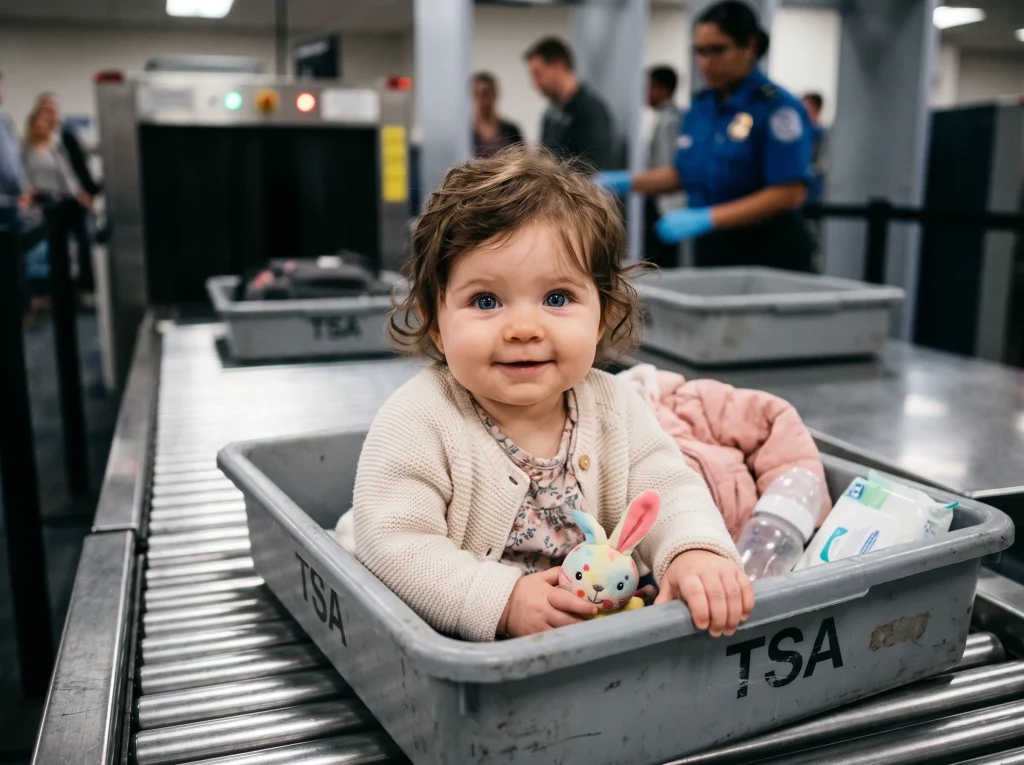
Security is usually the part that worries first-time flying parents the most, and honestly, it’s simpler than it looks once you know what to expect.
You’ll likely need to remove your baby from the carrier or stroller to walk through the scanner. Babywearing with a soft carrier that’s quick to unclip makes this faster.
Strollers can usually be used right up to the gate and gate-checked, so you don’t have to carry your baby through the whole airport.
Some airports have a dedicated family lane at security. Ask staff if you don’t see it clearly signposted, it’s not always visible at first glance.
Baby liquids at security: unlimited, but declared
Here’s something many parents don’t know before their first flight: water, formula, and baby food are allowed in unlimited quantities in the cabin when traveling with your baby.
But there are rules to follow:
- Take them out of your bag at the checkpoint, don’t leave them tucked inside
- Declare them to the officer (“I have liquids for my baby”)
- Sometimes they’ll ask you to open them, or occasionally taste one, though I’ve personally never had that happen
💡 My tip
I put all of baby’s liquids in a separate clear pouch, kept within easy reach. At the checkpoint, I pull out the pouch at the same time as my laptop. It goes twice as fast, and the officer is more relaxed because they can see you already know the drill.
What About Baby Formula, Specifically?
Pre-measured formula sachets are the easiest way to travel: no guessing scoops mid-flight, just tip and shake. Security will sometimes ask you to open one to check it, and occasionally to taste a small amount, though that’s not something I’ve personally had happen every time.
If your baby needs a warm bottle mid-flight, most cabin crew are happy to warm one for you using hot water, just ask early rather than mid-meltdown when the trolley is three rows away.
Boarding with a baby: the “workout” moment of the trip
This is the moment I dread most, and paradoxically, it’s the one that almost always goes fine.
Picture the scene: at the gate, in line, baby in the carrier, the folded stroller on one arm, the diaper bag on the other, my handbag across my body, and three narrow steps to climb up the jet bridge.
Workout. That’s the word for it.
💬 Real talk
Going through security solo with Lily, the hardest part was never the baby, it was folding the stroller one-handed while holding her. I learned to practice folding it at home a few times before the trip so I wasn’t fumbling with it for the first time in a security line.
People genuinely help, especially if you’re alone
Here’s something I’ve noticed after a lot of flights: when I’m traveling solo with a baby, people offer help spontaneously. When I have someone with me, they offer much less. It’s as if they instinctively see you’re managing alone and switch into “solidarity” mode.
So I’ve learned to accept without hesitating. And even to ask. The mom who says “Excuse me, could you hold my bag for a minute?” always gets a smiling yes. Don’t hold back.
Priority boarding: not always automatic
Depending on the airline, priority boarding with a baby is more or less automatic. A few things I’ve experienced firsthand:
- Swiss: yes, automatic. A warm welcome at the counter.
- TAP Portugal: yes, automatic too. Very family-friendly.
- Norwegian: not offered spontaneously. You have to ask explicitly.
💡 My tip
At the airport, find the gate agent before boarding starts and ask: “Hi, I’m traveling with a baby, could I board early?” Most of the time it’s a yes.
First or last: it depends on your situation
A common idea floating around: “the earlier you board, the longer you’re stuck in a confined space and the more restless baby gets.” That’s true in some situations.
But personally, when I travel solo with Lily, I prefer boarding first. I don’t have to juggle the stroller and the baby in the queue outside, I settle in calmly inside, I have space to organize my things, and I can even change her on a comfortable seat before other passengers arrive.
→ My solution: think about YOUR situation before deciding. If baby can wait calmly outside and you don’t have too much gear, board last. If you’re carrying a lot or traveling solo, board first, those 10 minutes of calm are worth their weight in gold.
The aisle seat: my real non-negotiable
If I had to optimize ONE thing when booking a flight with a baby, it’s the aisle seat. Always. No exceptions. Here’s why:
- I go to the bathroom about 3 times more often than before
- I need to change baby in the cabin at least once per flight
- Baby wants to move, play, stand, not stay on my lap for two hours straight
- When there’s turbulence and you have to stay seated with baby on you, being able to move between calm stretches helps enormously
💡 My tip
Plane bathrooms almost always have a fold-down changing table built into the wall, you just have to look for the little handle. It’s not spacious, but it works. I always check for it as soon as I board, so I’m not searching for it mid-meltdown.
During the flight: yes, there’s stress, but it’s almost always better than in your head
During a flight with a baby, there are three kinds of moments that blend together. And the real surprise is their proportion.
The calm moments
Most of your flight.
Baby looks out the window, eats a few snacks, plays quietly. You get to breathe, read, maybe even doze off. This IS the real experience for most of us, nobody tells you that beforehand.
The magic moments
Rarer, but unforgettable.
Baby falling asleep on your shoulder. The shy smile that melts the passenger next to you. 6 hours of straight sleep on a long-haul. You remember these for years.
The hard moments
They happen. It’s inevitable.
Short and intense (a 10-minute crying spell, a diaper change mid-turbulence), or longer (accumulated fatigue, jet lag). They coexist with the good, and that mix is what makes it formative.
The genuinely tricky moments (and how I handle them)
Eating during the flight. With baby on your lap and a tiny meal tray in front of you, you literally have one free hand (if baby is less than 6) or none (if baby already moves a lot and touches a lot). You might skip the hot meal tray if you have nobody you can leave baby with and make sure you have your own snack for later.
Turbulence. When baby wants to move but you have to stay seated with her on you, it’s tough. Strategy: pull out a new toy from the “novelty stash,” do finger puppets, offer the pacifier.
🚶 Restless, not upset. If baby is just fidgety (no turbulence, seatbelt sign off), walking her up and down the aisle for a few minutes works better than anything else in my bag. The movement plus the change of scenery resets her almost every time.
Crying. If baby cries and you feel eyes on you, breathe. People understand. The rare ones who don’t have never had kids of their own.
“This too shall pass. This moment will pass too.”
Seriously, that mantra works. In the middle of a meltdown on a Paris to Lisbon flight, I whispered it to myself for 10 minutes straight. Five minutes later, Lily was asleep on my shoulder.
🩹 If baby gets sick
Always keep in your cabin bag: baby paracetamol in individual doses, saline solution, a thermometer, your pediatrician’s phone number, and the address of a pediatric service or emergency room at your destination. That’s what turns a hard moment from “panic” into “manageable.”
Ear pressure: a real fear, not a certainty
During takeoff and landing, air pressure changes suddenly, and babies don’t yet have the reflex to equalize it on their own. The result can be pain, crying, an unhappy flight.
But here’s the good news: not every baby reacts the same way. Some babies are simply more tolerant of pressure changes than others.
Some babies
barely notice the pressure change at all
Others
feel it strongly, especially if congested
💬 Real talk
Lily never seemed to suffer from blocked ears on a plane, even as a young baby. It’s almost strange compared to me as a kid, I had real pain and cried on every flight. Every baby is different when it comes to this.
🤧 The real risk factor: congestion
If your baby has a stuffy nose, a cold, or lingering mucus, that’s when it can really hurt. Mucus blocks air from moving through the Eustachian tubes, which are already narrow in babies. That’s the real problem, more than the pressure change itself.
Stuffy nose? Gently clear it with saline solution before boarding.
Tired baby coming down with something? Keep it in mind so you can anticipate.
🍼 What you can do either way (prevention by age)
Even if your baby has never shown signs of pain, it’s better to prepare for takeoff and landing. Swallowing helps balance pressure naturally:
This is prevention, not a guarantee. If your baby refuses to drink at takeoff, don’t stress, there’s a good chance it’ll be fine anyway.
💡 Pre-flight tip
15-20 minutes before boarding if you have time, gently clear your baby’s nose with saline solution, even if they don’t seem congested. A little extra moisture in the nasal passages helps a lot with pressure balancing. It’s free and it can change everything.
A quick note on ear infections: everything above is about normal, healthy ears adjusting to pressure changes. If your baby already has an ear infection or is showing signs of one, that’s a different situation, and it’s worth checking with your paediatrician before flying rather than relying on general tips like this one.
Which airlines are best for flying with a baby?
Not all airlines are equal. Here’s my ranking after a few years and 7 countries of experience.
Genuinely family-friendly
- Swiss: automatic priority boarding, attentive staff
- TAP Portugal: very welcoming, sometimes small gifts
- Lufthansa: excellent bassinets, professional crew
- Air France: request the baby meal 48h ahead
- Emirates / Qatar: the gold standard
The “it depends” ones
- Norwegian: good value, minimal baby service
- British Airways: fine, nothing exceptional
- KLM: good overall, average bassinets
Avoid flying solo on these
Ryanair / easyJet: luggage is a workout, no baby service, chaotic boarding. Doable if you’re very organized, avoid for long-haul.
💬 Real talk
A round trip from Geneva to Brazil with my mom and Lily, we had our full row of 3 to ourselves both ways, traveling in March. Pure happiness on a flight that long. On a shorter Geneva to Norway route, we ended up on two completely full flights both ways instead. I never figured out why, no obvious tourist peak. It happens. The off-peak trick works often, but it’s not an exact science. The upside stays the same either way: if it doesn’t work out, at least you didn’t pay extra for a seat you didn’t need.
🗓️ Picking a quieter flight: timing matters
Instead of paying extra to reserve seats, my real trick is choosing flights that are less in demand:
Off-peak season: avoid school holidays, major holidays, and July-August for sun destinations. Favor May, September, October, or November.
Midweek: Tuesday and Wednesday tend to be the least full days. Avoid Friday through Sunday.
Off-peak hours: very early morning (5-7am) or midday (11am-2pm) rather than evening flights.
Nothing is guaranteed, luck plays a role too. But on quieter flights, your odds of having empty seats next to you go up significantly. And when that happens, baby can stretch out and you can actually breathe.
🛠️ Useful tools
SeatGuru for plane layouts and the best seats, Skyscanner‘s “whole month” view to spot quieter days, and Google Flights‘ price calendar, which tends to reveal less busy days too.
🛏️ The bassinet: reserve it as soon as you book
On a medium or long-haul flight, request a bassinet (the wall-mounted cabin crib) as soon as you buy your ticket. Weight limit: around 10-11 kg depending on the airline.
Important: the bassinet is never 100% guaranteed. The airline can reassign it if the aircraft changes. Always have a backup plan: a baby carrier or a wrap.
Flying Long-Haul With a Baby: What Actually Changes
A short hop and a long-haul flight with a baby are genuinely two different experiences, and it took me a couple of trips to understand why. On a longer flight, the bassinet stops being a nice-to-have and becomes something worth fighting for: request it the moment you book, not at check-in, and reconfirm it a few days before you fly.
The other thing that changes is how much an empty seat next to you matters. On a round trip from Geneva to Brazil with my mum and Lily, we had our full row of 3 to ourselves both ways, flying in March. Pure happiness on a flight that long. On a much shorter Geneva to Norway route, we ended up on two completely full flights instead, both ways, and I never figured out why. It happens. Off-peak timing improves your odds, but it’s not an exact science.
If your flight is overnight, that can actually work in your favour: baby’s own sleep rhythm does a lot of the work for you, whereas a long daytime flight means more hours to fill with snacks, toys and patience.
Flying solo with a baby: what actually changes
Flying solo with a baby is a different dimension entirely. Not for the reasons you’d expect (the flight itself usually goes fine), but for everything that happens around it.
Physically, it’s more demanding. Logistically, it’s denser. Emotionally, it’s more intense, there’s no one else to take over when you’re at your limit.
What I’ve learned to do
Ask for help without overthinking it. “Excuse me, I’m traveling alone with my baby, could you help me with…” works 95% of the time.
Choose family-friendly airlines whenever the route allows it.
Optimize every step: online check-in, aisle seat, suitcase packed 48 hours ahead.
Accept that things won’t be perfect. You’ll forget one thing, baby will pee on your lap at some point, and that’s okay.
💬 Real talk
The fear before a solo flight is always worse than the flight itself. Every single time. I still get nervous before boarding, and every single time it turns out fine, or at least, manageable. That’s the honest truth nobody tells you before your first solo flight.
Flying With A Newborn: What’s Actually Different
A newborn’s first flight isn’t just a smaller version of flying with an older baby, it comes with its own set of questions, mostly about timing rather than logistics.
💬 Real talk
I didn’t actually fly with Lily before she was 7 months old. We travelled plenty before that, just not by plane. So this section comes from research and from other parents I’ve talked to, not from my own newborn flight, and I’d rather tell you that than pretend otherwise.
Timing
Most airlines technically accept babies from 7-14 days old, but many parents choose to wait 6-8 weeks so the immune system has a bit more time to develop.
Sleep is usually on your side
Newborns tend to sleep most of the flight, which is why several parents I’ve spoken to found this age easier to fly with than the 6-12 month stretch.
The bassinet matters more here
Weight limits mean a newborn is the best window to actually use one, request it as early as possible.
Feeding on takeoff and landing
Nursing or a bottle right at those two moments is the simplest way to help a newborn manage the pressure change, since they’re too young for a pacifier trick or a fruit pouch yet.
A note if your baby is under 2 weeks old
Some airlines ask for a doctor’s letter confirming your baby is fit to fly if they’re under 2 weeks old at departure. It’s worth checking directly with your airline before booking rather than assuming.
Tips by baby’s age
Every stage brings its own version of easy, and its own version of hard.
0-3 months
Baby sleeps a lot. The easiest age. Bassinet possible and genuinely helpful. Nursing at takeoff and landing works like magic.
3-6 months
Still very calm. Baby smiles at other passengers. Weight starts to matter for the bassinet weight limit.
6-12 months
Baby wants to move and explore. The age of potential meltdowns. Stock up on new toys they haven’t seen yet.
12-24 months
Full toddler energy. The fruit pouch becomes your best ally, both for ears and for occupying tiny hands.
2 years and up
Understands instructions much better. Needs their own seat from this point on.
💬 Real talk
Babies pick up on how their parent is feeling, and mine is no exception. The flights where I managed to stay outwardly calm, even when I wasn’t fully calm inside, were always the smoothest. It’s not magic, it’s just one less thing making baby unsettled.
FAQ: Flying With a Baby
What age can a baby first fly?
Officially, from 2 to 7 days old depending on the airline. Medically, it’s recommended to wait at least 6 weeks, especially for long-haul flights.
Does a baby fly for free?
On most airlines, yes, up to age 2, but on your lap (not their own seat). You’ll often pay a small fee (10-15% of the adult fare).
Does my baby need a passport?
Yes, from birth for international travel. A baby passport is typically valid for 5 years.
How do I relieve my baby’s ears on a plane?
Give them something to drink (bottle, nursing, or a fruit pouch) right at takeoff and landing. Swallowing helps balance the pressure.
Does the stroller fly for free?
On nearly all airlines, yes. You can keep using it right up to the boarding gate.
Which seat should I choose with a baby?
The aisle seat is non-negotiable. On long flights, request a bassinet (wall seats) as soon as you book.
Can I bring milk and water in the cabin for my baby?
Yes, in unlimited quantities, as long as you declare the liquids at the security checkpoint.
What are the best tips for flying with a baby?
Book an aisle seat, feed your baby at takeoff and landing to ease ear pressure, request the bassinet as soon as you book, and pack a separate pouch for liquids. See the quick tips box above for the full list.
How do I travel with a baby on a plane, step by step?
Pack liquids separately for security, remove baby from the carrier at the scanner, board with priority if you can, feed at takeoff and landing, and keep your carrier as a backup in case the bassinet isn’t available. Full breakdown in the sections above.
How do I travel abroad with a baby?
Your baby needs their own passport from birth for international travel, and if you’re flying solo, it’s worth carrying a signed consent letter from the other parent. See our full guide on baby passports for details.
My verdict
Flying with a baby is scary before. After the first flight, you wonder why you stressed so much.
It’s not always perfect, there are hard flights, babies who cry, looks that weigh on you. But it’s manageable. And with every flight, you gain confidence. The world stays accessible with a baby, you just have to prepare well. ✈️
Keep exploring