
2-12
Peak age range for motion sickness
RARE
Under 12 months, though not impossible
50%
Chance if one parent gets motion sick
Table of Contents
Motion sickness is one of those things that seems to strike out of nowhere on a trip that started perfectly fine. It’s not caused by anxiety or an upset stomach, and it’s definitely not something your child can control with willpower, it’s a genuine mismatch in the signals different parts of the body are sending the brain. The good news is that a few practical adjustments make a real difference, and most children eventually outgrow it entirely.
What causes motion sickness
You’ll see this called motion sickness, travel sickness, or car sickness depending on where you’re from, they all describe the same thing: the sensory mismatch that happens whenever the inner ear, eyes, and body disagree about movement, whether that’s in a car, on a boat, or on a plane.
Motion sickness comes down to a sensory mismatch. Your child’s inner ear senses movement, their eyes are looking at something that appears still (the back of a seat, a book, a screen), and their muscles feel a third, different set of cues. The brain receives three conflicting stories about whether the body is moving, and that confusion is what triggers nausea, dizziness, and eventually vomiting.
- It’s strongly genetic, if one parent gets motion sick, there’s roughly a 50% chance their child will too
- It’s not psychological, it isn’t caused by anxiety, and it isn’t something a child can control through willpower, however calm or used to travel they are
- Certain conditions make it worse: reading, screens, a stuffy or overheated space, and winding or stop-start routes all increase the sensory mismatch
- It’s not limited to cars, planes, or boats, some children also get it on swings, roundabouts, or even watching fast-paced videos
Understanding it as a genuine sensory conflict rather than fussiness or anxiety matters, it changes how you respond. There’s nothing to correct in your child’s behaviour, the goal is simply to reduce the mismatch itself.
Is Motion Sickness Common in Babies Under 2?
It’s genuinely uncommon, and that’s good news if you’re travelling with a very young baby. Motion sickness is rare before 12 months and only starts becoming a real possibility from around age 2, then peaks between ages 2 and 12. If your baby under 2 seems unsettled on a journey, it’s more often overstimulation, hunger, or wanting to be held than true motion sickness, though a genuine sensitivity can occasionally show up earlier, especially if one parent is prone to it.
That timing matters practically too, because it changes what you can safely offer. Under age 2, medication is off the table entirely (more on that below), so seat position, timing, and comfort are your only real tools, and thankfully they’re usually enough at this age.
Nay had her first episode at around [12/14] months, in the car, after a big serving of sweet potato puree. Normal road, no particular heat, just a stomach that was too full. The trigger was food, not the road itself.
Signs to watch for in babies who can’t tell you
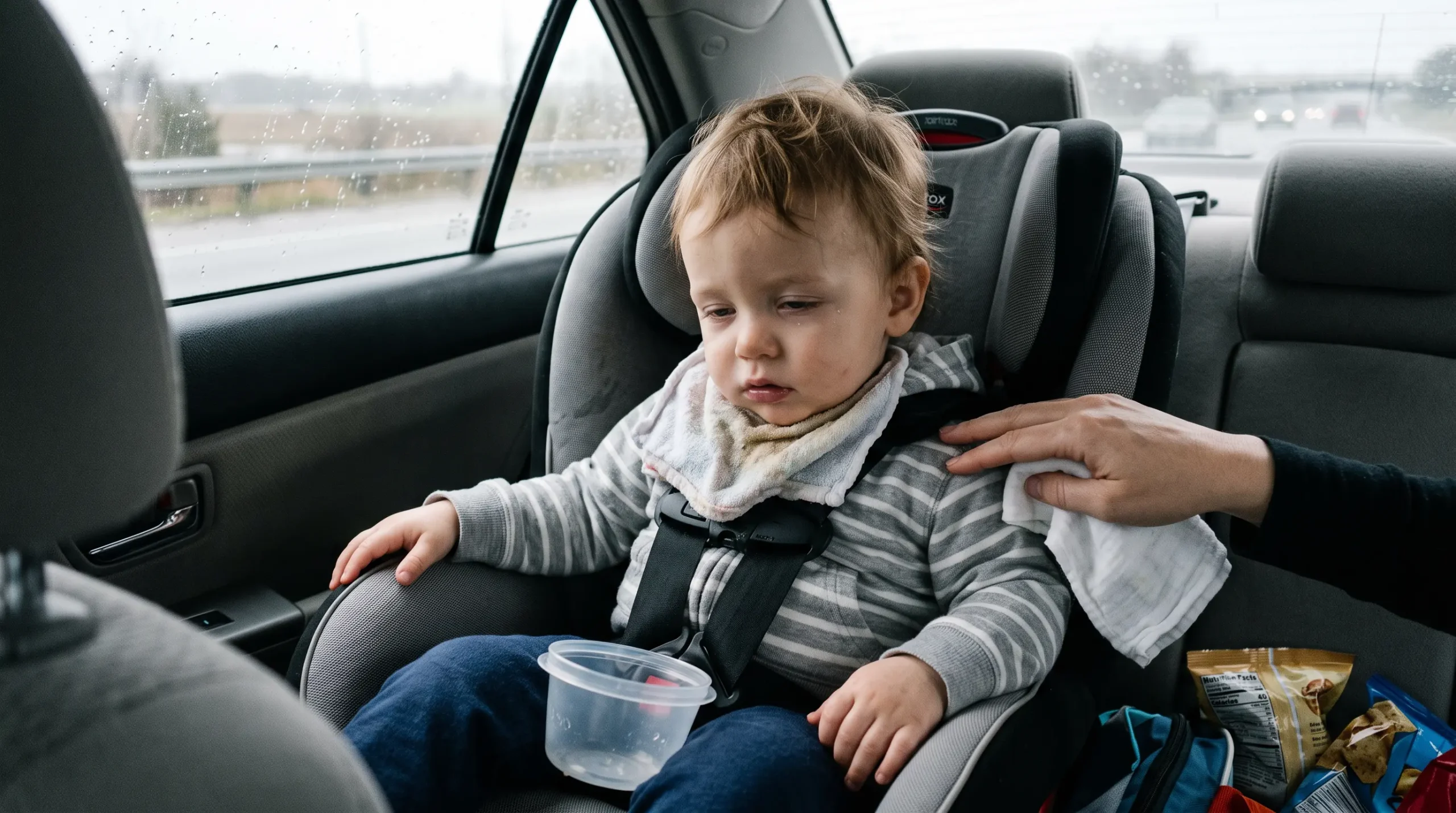
Toddlers might complain of a “tummy ache” or feeling “funny,” but a baby or very young toddler has no words for what they’re experiencing. The cues are more subtle, and catching them early gives you a chance to intervene before it progresses to vomiting.
Unusual paleness, excessive yawning, increased drooling, sudden quietness or stillness after being active and vocal, or a general “off” look that’s hard to put your finger on.
Cold sweats, visible distress or crying that doesn’t match anything else going on, and finally vomiting. If you catch the early signs and can stop the motion, you can often prevent it from reaching this point.
- Unusual paleness
- Excessive yawning
- Increased drooling
- Sudden quietness after being active
- A general “off” look
- Cold sweats
- Visible distress or unexplained crying
- Vomiting
Catching the early signs helps you stop the motion before this stage.
Best seat position by mode of travel
Where your child sits genuinely changes how much motion their inner ear picks up, and it’s one of the easiest adjustments to make since it costs nothing and takes no planning.
| Mode of travel | Best position |
|---|---|
| Car | Middle rear seat, facing forward, looking out the front windscreen rather than a side window |
| Plane | Over or near the wings, where turbulence and motion are felt least |
| Boat | On deck in the fresh air rather than below, ideally near the centre of the vessel |
Prevention tips
- Offer a light snack 30 to 60 minutes before travel, an empty stomach and an overly full one both seem to worsen symptoms
- Keep the car well ventilated and not too warm, a stuffy cabin makes symptoms noticeably worse
- Skip books, tablets, and phone screens during the journey, anything requiring close-up focus increases the sensory mismatch. Music or an audio story works far better than visual entertainment
- Encourage your child to look ahead towards the horizon rather than at something close up or moving alongside the vehicle
- Build in frequent stops on longer journeys, even a few minutes out of the seat and moving around resets the senses
- For older toddlers who can understand it, gently pointing out upcoming turns (“we’re turning left now”) can help their brain anticipate the motion rather than be surprised by it
- Some car seats are designed with reclining or wider viewing angles specifically to reduce the sensory mismatch that triggers motion sickness, worth considering if you’re due for a new one anyway and your child struggles regularly
What to do if it happens
If you catch the early signs, or symptoms have already progressed, the priority is simple: stop the motion as soon as safely possible.
- If you’re driving, pull over as soon as it’s safe, take your child out of their seat, and let them stand or lie down for a few minutes with their eyes closed
- A cool, damp cloth on the forehead can help ease the queasy feeling
- Offer only small sips of water or another clear fluid once symptoms ease, rather than a full drink right away
- If vomiting happens, it’s usually a single episode rather than repeated, keep a bag or container within reach on longer trips so you’re not scrambling in the moment
- Once your child feels better, symptoms typically resolve within a few hours of the motion stopping entirely
Everything seemed set for a smooth journey. She’d napped 45 minutes in the car before we got on the train, eaten well at lunch, fallen asleep again in the carrier, but the heat was intense and she kept resting her head against me, clearly too warm. She slept another 45 minutes. Then, an hour from arrival, she started vomiting, three times in a row. What I understood afterwards: a stomach that was too full, the heat of the carrier, and the sustained motion of the train all stacking up at once. The train is usually the best tolerated, but even it has its limits once enough things pile up.
- Seat position
- Light snack timing
- Fresh air, no overheating
- Frequent stops
- Acupressure wristbands (child size)
- Everything from the left, plus:
- Ginger, in small amounts
- OTC antihistamines, with pediatrician guidance
- Never
Remedies overview
For children who get motion sick on most journeys despite the prevention steps above, a few additional options exist, though it’s worth discussing any of them with your pediatrician before your trip rather than trying them for the first time on travel day.
Non-medication optionsGinger, in small amounts of tea or a chewable form suitable for young children, has some evidence behind it for easing nausea. Travel sickness bands, worn on the wrist, use acupressure rather than medication, so many parents try them first. Adult-sized bands are too loose to work properly on a small wrist, so look for a child-specific size, and expect them to be most reliably effective from around age 3, once the wrist is big enough to hold the band snugly in the right spot.
Medication optionsOver-the-counter antihistamines such as dimenhydrinate or diphenhydramine are sometimes used for motion sickness, but they are not recommended under age 2, and should only be used from age 2 upwards with your pediatrician’s guidance on dosing. Motion sickness patches are not suitable for children at all, the dose is too high. If your child is under 2, non-medication strategies (seat position, snacks, fresh air) are your safest and, in practice, usually sufficient approach.
When kids usually grow out of it
Motion sickness tends to peak between ages 2 and 12, which unfortunately covers most of the family travel years. The good news is that it very commonly improves with age as the inner ear and brain get better at reconciling conflicting sensory signals, and many children grow out of it almost entirely by their teens. Some adults remain motion-sensitive their whole lives, particularly on boats, but the intensity and frequency in children usually decreases well before then.
Starting small helps. If you know your child is prone to it, easing in with shorter trips before a long-haul journey lets you test what works (seat position, timing, snacks) without the stakes of a long drive or flight riding on it.Frequently Asked Questions
Can babies get motion sickness?
Yes, though it’s harder to spot since they can’t describe how they feel. Watch for unusual paleness, excessive yawning, increased drooling, or sudden quietness, these are often the earliest signs before vomiting.
Why do kids get car sick more than adults?
Children’s sensory systems are still developing, and their eye level in the back seat often means less of a clear view forward, both increase the sensory mismatch that causes motion sickness. It’s also strongly genetic, so a child with a motion-sensitive parent is considerably more likely to experience it themselves.
Where’s the best seat for a child prone to motion sickness?
In a car, the middle rear seat looking out the front windscreen. On a plane, over or near the wings. On a boat, on deck near the centre rather than below, and in the fresh air where possible.
Do screens make motion sickness worse?
Yes. Focusing on something close up and relatively still, like a screen or book, while the inner ear senses motion increases the sensory mismatch that triggers symptoms. Audio content like music or stories is a much better alternative during travel.
Will my child grow out of motion sickness?
Very likely, at least partly. Motion sickness typically peaks between ages 2 and 12 and tends to improve significantly by the teenage years as the brain gets better at processing conflicting sensory signals. Some adults remain sensitive on boats specifically, but frequency and intensity usually decrease well before adulthood.
My Verdict“Motion sickness isn’t a behaviour to manage, it’s a sensory mismatch to reduce, and the fix is almost always simpler than it feels in the moment: the right seat, a light snack, and eyes on the horizon instead of a screen.”
My verdict: start with the free fixes, seat position, ventilation, no screens, frequent breaks, before reaching for anything else. Watch for the early signs rather than waiting for vomiting to confirm what’s happening, especially with a baby who can’t tell you directly. If your child struggles despite all of that, ginger and acupressure bands are worth a gentle try, and medication is there as a backup with your pediatrician’s guidance, not a first resort. Most of all, remember this genuinely does get better with age, the toddler who can’t handle a winding mountain road usually turns into the teenager who reads in the back seat without a second thought.
Keep exploring
You might also like