A note before we start: at 5 months old in Pornichet, I didn’t put Nay in the campsite pool, hygiene worried me. She’s now 16 months old and still hasn’t been in a swimming pool at all. Am I overthinking it? Maybe a little. But the questions behind that hesitation are legitimate ones, and this guide answers them honestly rather than just telling you it’s fine.
Table of Contents
Baby and the swimming pool is a topic that genuinely worries a lot of parents. What age? Is a public pool actually hygienic? Is an outdoor campsite pool a good idea at all? Here are the honest answers, not the reassuring ones people expect to hear.
When can babies go swimming
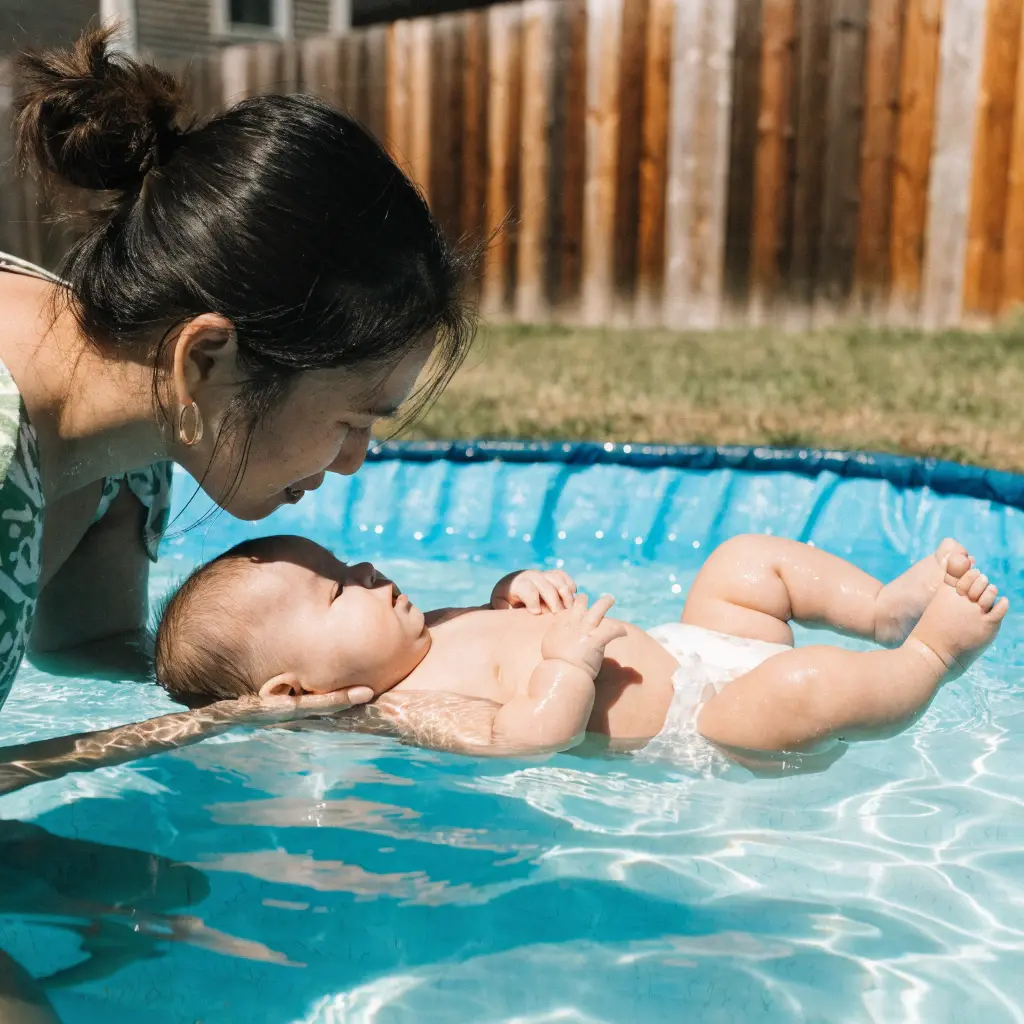
According to NHS guidance, babies can go swimming at any age, from birth, without needing to wait for their vaccinations. What actually matters is water temperature, cleanliness, and your baby’s general health, not a fixed age milestone.
The water should be at least 32°C, never above 35°C. A neoprene baby swimsuit helps retain body heat if the pool runs slightly cooler. Keep the first sessions to 10-15 minutes.
Baby handles temperature swings a bit better. Duration can increase gradually, though still under 30 minutes total for a baby under 1 year.
Better able to handle standard pool temperatures. Often the age parents feel most comfortable starting proper baby swim lessons.
Official guidance says there’s no need to wait, but I did, and I still haven’t taken Nay swimming at 16 months. That’s not a contradiction of the guidance, it’s just my own comfort level around hygiene in shared pools, and that’s a completely valid reason to wait too. If the official green light doesn’t match your own gut feeling, trust the gut feeling. There’s no wrong timeline here as long as your baby is healthy and the water is warm and clean.
Can newborn babies swim?
Yes, technically. Newborns have an instinctive reflex, sometimes called the laryngeal reflex, that makes them briefly hold their breath when water touches their face, which is part of why some specialist baby swim providers in the UK take babies from just a few days old.
- Water temperature of at least 32°C, specialist baby swim pools are often kept exactly at this temperature for under-12-week-olds
- A clean, well-maintained, temperature-controlled pool, not an unheated outdoor pool
- Your baby being in good general health, with no fever or illness
- Checking with a doctor first if your baby was born prematurely
- Your own postnatal recovery, wait at least 7 days after giving birth before you get in yourself
Pool temperature guide
Babies, especially newborns, lose body heat far faster than adults do, so pool temperature genuinely matters more for them than it does for you.
| Age | Minimum water temperature |
|---|---|
| Under 3 months / 5.5kg | 32°C, never above 35°C |
| 3 to 12 months | 28 to 30°C minimum |
Is a campsite or hotel pool hygienic enough?
This is the real question a lot of parents have and few articles answer honestly. The truth: it depends entirely on how well that specific pool is maintained, there’s no blanket yes or no.
An outdoor campsite pool at 24-26°C isn’t right for a baby under 6 months. Babies lose body heat fast and don’t always show discomfort before it’s already a problem.
A well-treated pool doesn’t smell strongly of chlorine. Counterintuitively, a strong chlorine smell often signals poorly treated water reacting with contaminants. Water should be clear, transparent, with no foam. If you’re unsure walking up to it, don’t go in.
Watch baby’s lips, pale or bluish means get out immediately. Don’t wait for baby to seem used to cold water before deciding to leave.
Every public pool requires a proper swim nappy. Regular nappies swell up in water and don’t contain anything. Reusable or disposable swim nappies are made specifically for this.
How long can baby stay in the water
Shorter than you’d think, and shorter than baby’s own enthusiasm might suggest. A baby who’s clearly enjoying the water can still be getting cold without showing it clearly until it’s already gone on too long.
- First few sessions, any age: 10 to 15 minutes maximum
- Under 1 year, once settled into it: 30 minutes maximum
- Watch the lips, not just the mood. Pale or bluish lips and shivering mean it’s time to get out immediately, don’t wait for baby to seem tired of the water first
- Better to leave a little early than to push for “just a few more minutes” once baby’s had enough
Tips for taking baby swimming
- Check baby is in good health, no fever, no ongoing infection
- Confirm the pool’s water temperature and cleanliness before committing to a full session
- Get baby used to water during regular bath time first, gently trickling water over their face and head so the sensation isn’t brand new at the pool
- Swim nappy, required at every public pool
- Swimsuit, neoprene if the water tends to run cooler
- A hooded towel, to wrap baby immediately on getting out
- Warm clothes for afterward, baby cools down fast once out of the water, even in summer
- Milk or a snack, swimming is tiring and appetite-inducing
- Moisturizer, chlorine dries out skin
At a pool, the danger isn’t only direct sun, reflections off the water and chlorine washing off sunscreen both play a role too.
- Under 6 months, avoid the poolside in direct sun altogether, even for just a few minutes
- Reapply sunscreen every hour if baby’s going in and out of the water
- Look for shade cast by buildings or a pergola rather than a parasol alone, reflections off the water can reach around the sides of lateral shade
- A long-sleeve UV swimsuit works better than sunscreen alone
- A hat that stays on wet, with a chin strap, actually stays on
- Avoid the busiest hours, generally 11am to 5pm, which also tend to be peak UV hours
Teaching your baby to swim
Baby swim classes, sometimes called “water confidence” sessions, are supervised pool sessions run by a trained instructor, typically available from a few weeks old in the UK. This isn’t teaching a baby to swim in the technical sense, babies don’t actually swim independently until around 3 to 4 years old, it’s about building comfort and confidence in water from an early age.
- UK providers like Water Babies and Turtle Tots run classes from just a few weeks old, using dedicated hydrotherapy-style pools kept at a controlled 32-34°C, well above a standard pool
- No need to wait for vaccinations, per NHS guidance, though check with your doctor first if your baby was born prematurely
- What to bring: swim nappy, swimsuit, hooded towel, warm clothes for after, and milk or a snack, classes are tiring and appetite-inducing
- Look for a nationally recognized qualification in the instructor’s training if you’re booking outside a specialist provider like the ones above
Safety: what actually matters
Drowning is the leading cause of accidental death in young children, and it happens in seconds, silently. Even with a float, even in 20cm of water, even for one second, baby needs to stay within arm’s reach at all times. No phone, no conversation that pulls your attention away.
- A quick shower before entering the pool, even for baby
- Rinse baby with clean water immediately after, to remove chlorine residue
- Moisturize afterward, chlorine dries out skin
- If baby is unwell, skip the session, for their sake and everyone else’s in the pool
If baby cries going into the water, don’t push through it. Forcing the moment can create a lasting fear of water. Get out, wait, and try again another day. Patience matters more than progress here.
FAQ
When can babies go swimming?
According to NHS guidance, babies can go swimming at any age from birth, with no need to wait for vaccinations. What matters is water temperature (at least 32°C for under 3 months), cleanliness, and your baby being in good health.
Can newborn babies swim?
Yes, technically, thanks to an instinctive reflex that makes them briefly hold their breath when water touches their face. Some UK baby swim providers take babies from just a few days old, though the water must be kept at a controlled 32°C or higher.
What temperature should a baby swimming pool be?
At least 32°C for babies under 3 months or 5.5kg, never above 35°C. Between 3 and 12 months, 28 to 30°C minimum. Standard public pools run at 26-28°C, look for a dedicated baby pool session if that’s too cool for your baby’s age.
How long can a baby stay in the pool?
10 to 15 minutes for the first few sessions at any age, up to 30 minutes maximum once settled in, for a baby under 1 year. Watch for pale or bluish lips, that’s the signal to get out immediately, regardless of how the session is going.
Is a campsite or hotel pool safe for a baby?
It depends entirely on how well maintained it is. Check the water is clear with no strong chlorine smell, and confirm the temperature is appropriate for your baby’s age before committing to a session. If anything feels off, it’s fine to skip it.
“The real question isn’t ‘what age’, it’s ‘under what conditions.'”
NHS guidance says there’s no need to wait, and that’s genuinely true. Warm water, a clean pool, and a healthy baby matter far more than a specific age on a chart. If you’re still hesitant, like I still am with Nay at 16 months, that’s a valid choice too, not a failure to follow the “right” timeline. And if you’re looking for an easier way in, baby swim classes in a properly heated, controlled pool are worth a serious look.