Updated August 28, 2026
Table of Contents
- Why 1-Year-Olds Need Different Travel Toys
- What Makes a Toy Travel-Friendly at This Age
- Best Airplane Travel Toys for a 1 Year Old
- Best Car Travel Toys for a 1 Year Old
- Car Toys vs Plane Toys vs Both
- How Many Toys to Pack (and a Rotation Timeline)
- Real Toys That Actually Worked for Us at 1 Year Old
- Travel Toys to Avoid at This Age
- Free and Budget-Friendly Alternatives
- Frequently Asked Questions
Why 1-Year-Olds Need Different Travel Toys Than Younger Babies (or Toddlers)
A 1 year old needs travel toys built around a very specific set of new skills: a working pincer grip, the ability to sit up and reach independently, and just enough understanding of cause and effect to actually get bored of a rattle. Most “baby travel toy” lists you’ll find lump together everything from newborn to age 3, which means half the suggestions are too advanced for a 6-month-old and half are already too babyish for your 1 year old.
This is the exact age where things shift. At 12 months, most babies are refining their pincer grip and picking up increasingly smaller objects with real precision, which is fantastic for development and also exactly why the small-parts rule matters more now than it did six months ago. Your baby isn’t just holding toys anymore, they’re testing, dropping, throwing, and mouthing every single thing that fits in a hand, on a moving vehicle, in a confined seat, often at 30,000 feet.
🖐️ Pincer grip
Your baby can now pick up small objects between thumb and forefinger, which opens the door to toys with buttons, latches, and textures but also raises the stakes on the small-parts rule.
🪑 Sitting and reaching
Most 1 year olds can sit independently and reach for a toy without toppling over, which means car seat attachments and tray-table play finally work well.
🔁 Cause and effect
Push a button, hear a sound, do it again. This is why simple interactive toys hold attention now in a way they simply didn’t a few months ago.
This also means younger-baby staples like rattles and soft squeeze toys tend to get boring fast on a long trip, while older-toddler toys like small figurines, tiny puzzle pieces, or anything with detachable parts are still genuinely unsafe at this age. The sweet spot is narrower than most lists admit, and that’s exactly what the rest of this guide is built around.

What Actually Makes a Toy Travel-Friendly at This Age
A travel-friendly toy for a 1 year old is small enough to pass the choking-hazard test, quiet enough not to bother a whole airplane row, drop-proof or tethered, wipeable, and free of any part that could detach. That’s the real checklist, and it applies whether you’re packing for a car seat or a plane seat.
📏
Passes the tube test
If the toy or a detached piece fits inside a toilet paper tube, it’s a choking hazard for this age and shouldn’t come along.
🔇
Quiet or silent
Save the beeping, singing toys for home. On a plane or in a packed car, silent play wins every time.
🪢
Drop-proof or tethered
A short clip or ribbon keeps the toy from vanishing under a plane seat or into the front footwell of the car.
🧼
Wipeable
Everything gets mouthed. If it can’t be wiped down with a baby wipe between uses, leave it home.
⚠️ One rule most parents don’t know: never attach a toy directly to the car seat’s straps, harness, or handle. Car seat manufacturers explicitly warn against this, since anything clipped to the seat itself can become a projectile in a crash. If you want a hanging toy in the car, attach it to the vehicle’s headrest bar or a dedicated car seat toy arch designed for that purpose, not the car seat.
Storage matters just as much as the toy itself. Keep whatever isn’t currently in play zipped in a soft pouch, not loose on the seat next to your baby, both for the same projectile-risk reason and because a loose toy rolling around the car is one more thing you’ll be reaching for one-handed at 70 mph.
Best Airplane Travel Toys for a 1 Year Old
The best airplane toys for a 1 year old are completely silent, small enough for a tray table, and self-contained so nothing rolls under the seat in front of you. On a plane you’re not just entertaining your baby, you’re doing it in a shared space with strangers three feet away, which changes what actually works.
🪟
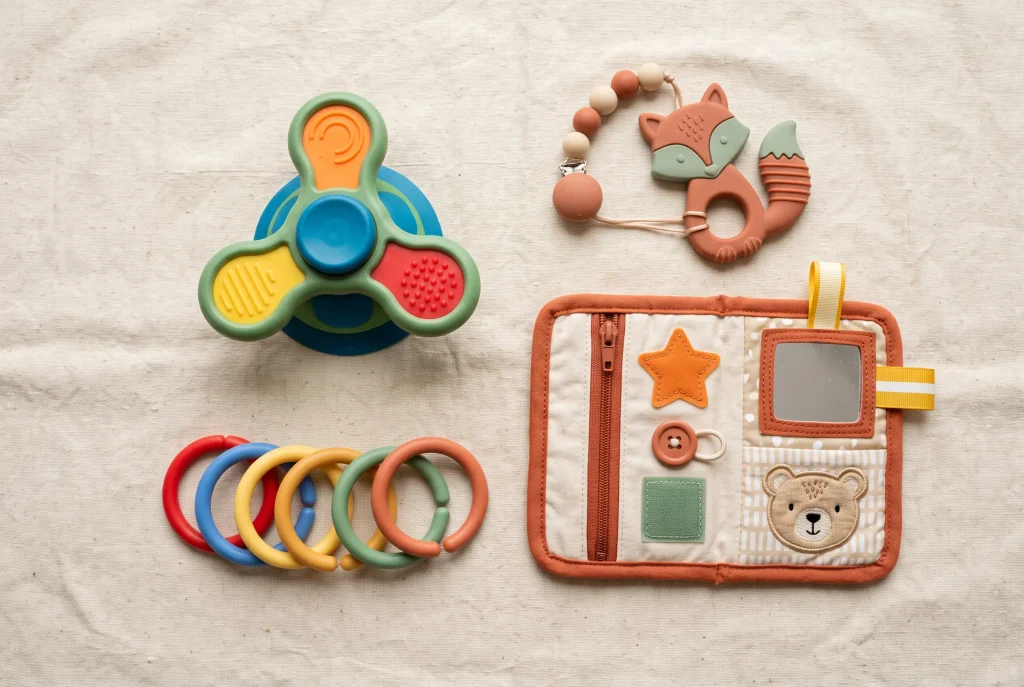
Suction spinners
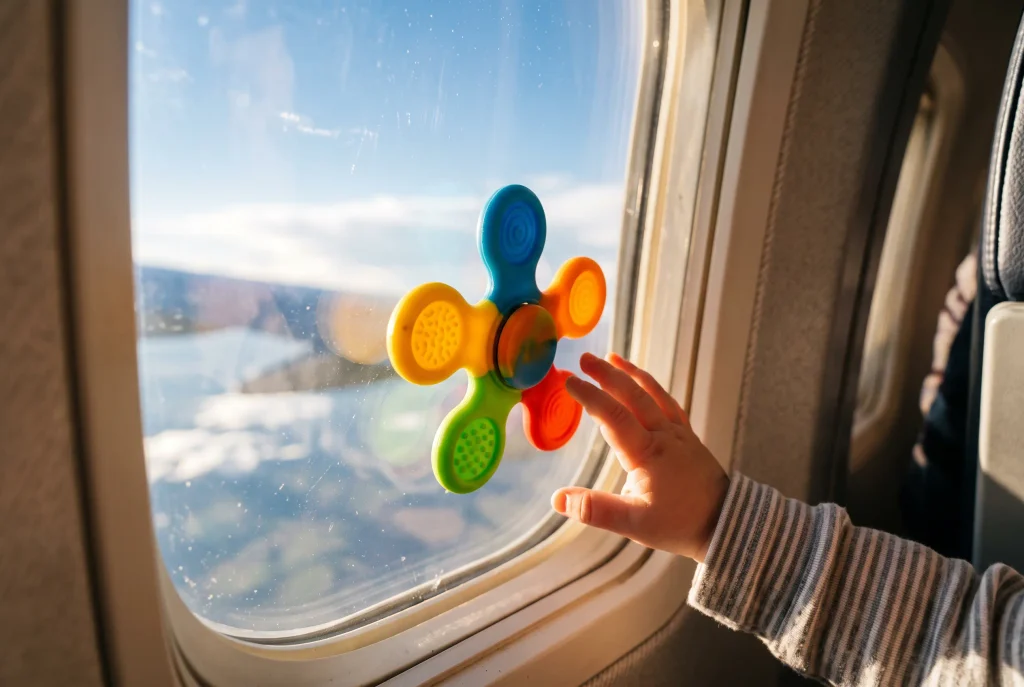
Stick to the window or tray table and spin. Completely silent, and the visual movement holds attention for surprisingly long stretches.
🧵
Soft felt busy board
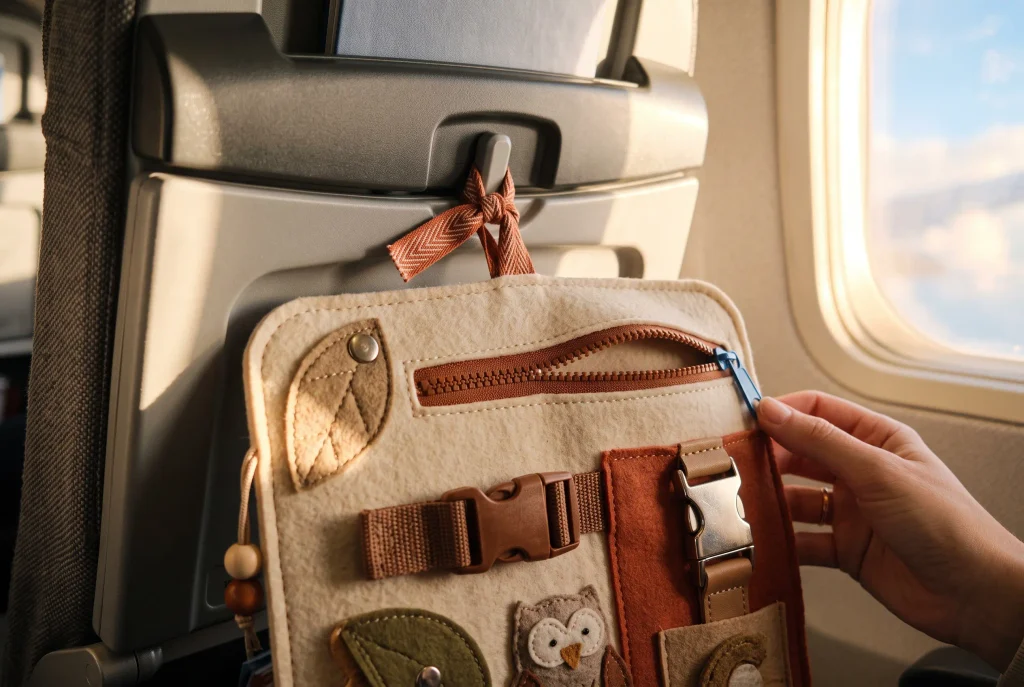
Zippers, buckles, and snaps sewn onto one flat piece of fabric. Nothing detaches, so nothing gets lost between the seats.
📖
Lift-the-flap board books
Durable, silent, and repeatable. A 1 year old will happily “read” the same flap book on a loop for a whole flight.
🐘
A teether they already know
Something familiar and safe to mouth during takeoff and landing, when ear pressure makes sucking and chewing genuinely comforting.
Real tip that actually works: clip or tie the busy board to the tray table latch with a short ribbon before takeoff. Parents who fly regularly swear by this specific trick, since it means the toy never ends up on the floor of a full flight where you can’t easily reach it.
What to Skip on a Plane
Anything with sound effects, music, or a speaker is the fastest way to become the most disliked row on the plane. Also skip anything with loose small pieces, like tiny figurines or blocks, since a dropped piece on a plane is genuinely gone until landing. And skip anything that requires two hands from you to operate, since you’ll often be holding a bottle, a bag, or your baby at the same time.
Best Car Travel Toys for a 1 Year Old
The best car toys for a 1 year old are reachable without unbuckling, tolerant of being dropped repeatedly, and don’t need your hands to work. Unlike a plane, noise isn’t the enemy in the car, but reachability is: your baby is strapped in a rear-facing or forward-facing seat, often out of your line of sight, and every dropped toy either stays dropped or requires you to pull over.
🔗
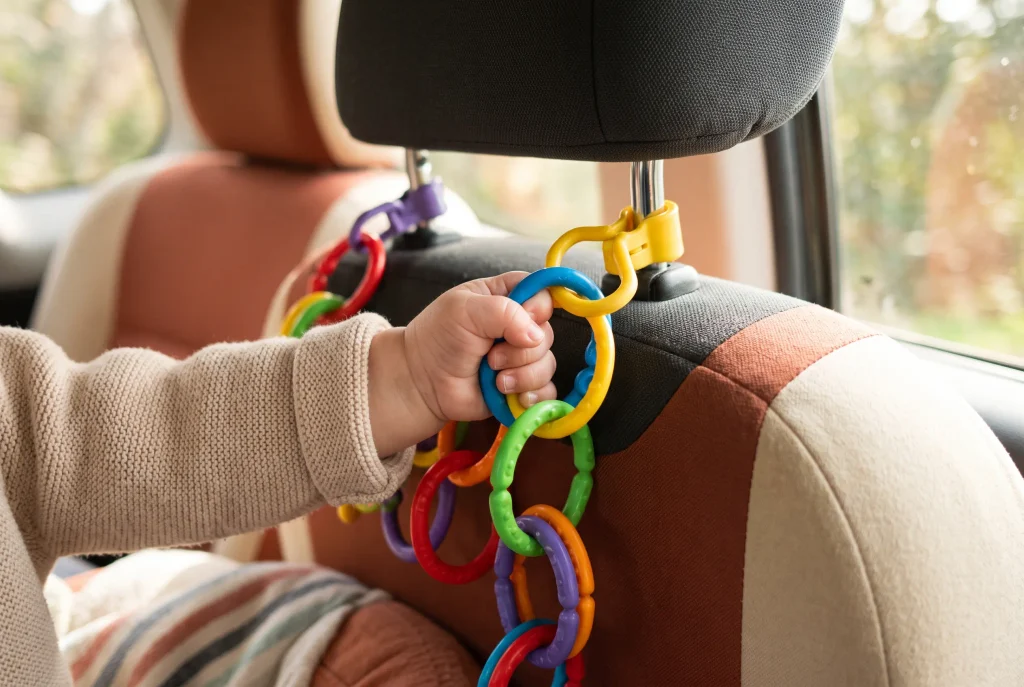
Linking rings
Clip them to the car’s headrest bar or a dedicated toy arch, never to the car seat itself, and your baby can pull, teethe, and fidget without ever dropping them out of reach.
🚙
Soft pull-back cars
Fabric-bodied, no small wheels to detach, and forgiving when they inevitably get thrown at the door or the window.
🧵
The same soft busy board
Works just as well in the car as on a plane, with the bonus that a dropped busy board on the car floor is far easier to retrieve at your next stop.
🧸
Cloth books with crinkle pages
Easy for small hands to hold onto even over bumps, and the crinkle sound is genuinely engaging without being disruptive.
Real tip that actually works: keep two or three toys tethered within reach at all times, and store the rest in a soft pouch on the seat next to your baby, not the passenger seat up front. That way rotating toys doesn’t mean stopping the car, just reaching back at a red light.
What to Skip in the Car
Skip anything hard and heavy enough to hurt if thrown, since a bored 1 year old will absolutely throw it. Skip toys with strings longer than a few inches, which can become a strangulation risk in a moving vehicle where you can’t react instantly. And never, ever attach anything directly to the car seat’s harness, straps, or handle, no matter how tempting a “hanging toy right in front of baby’s face” setup looks. It’s one of the most common car seat safety mistakes parents make without realizing it.
Quick Comparison: Car Toys vs Plane Toys vs Toys That Work for Both
Some toys genuinely only work in one environment. Others earn their spot in the bag precisely because they work everywhere, which matters if you’re doing a car ride to the airport followed by a flight on the same day.
| Toy Type | Best For | Noise Level | Mess-Free | Drop Risk | Why It Works at This Age |
|---|---|---|---|---|---|
| Suction spinner | Plane only | 🔇 Silent | ✅ Yes | Low, sticks in place | Pure visual and motion play, no fine motor skill required |
| Linking rings | Car only | 🔇 Silent | ✅ Yes | Low, tethered by design | Matches the emerging pincer grip, and it can’t disappear |
| Soft felt busy board | Both | 🔇 Silent | ✅ Yes | Low, one piece | Multiple activities in one item, nothing to lose track of |
| Lift-the-flap board book | Both | 🔇 Silent | ✅ Yes | Low, durable | Repeatable, and shared reading time calms an overstimulated baby |
| Soft pull-back car | Car only | 🔇 Silent | ✅ Yes | Medium, gets thrown | Forgiving of the throwing phase, no small wheels to lose |
| Teether | Both | 🔇 Silent | ✅ Yes | Medium, easy to grab back | Genuinely soothing during ear-pressure moments at takeoff and landing |
| Cloth crinkle book | Both | 🔈 Very quiet | ✅ Yes | Low | Easy grip even over bumps, sensory feedback holds attention |
| Empty cup with lid | Both | 🔇 Silent | ✅ Yes | Low, free replacement anywhere | Free, novel, and surprisingly effective at this exact age |
If you’re packing for one trip that includes both: lean toward the “Both” row entries. Three toys that work everywhere beat six toys that only work in one specific seat, especially once you’re juggling a stroller, a car seat, and a diaper bag through an airport.
How Many Toys to Pack (and a Realistic Rotation Timeline)
Pack 5 to 7 toys total for a trip, and rotate through them one at a time roughly every 15 to 20 minutes. That’s it. Bringing everything your baby owns doesn’t buy you more entertained minutes, it just means more stuff to lose track of and more choices your 1 year old doesn’t actually want to make.
“Rotate your toys” is advice you’ll see on nearly every travel list, but almost nobody tells you what that actually looks like in practice, on a real flight, with a real fussy baby. Here’s the timing that tends to work.
A Realistic 2 to 3 Hour Trip, Toy by Toy
Takeoff or the first 15 minutes: hand over the teether or a familiar comfort toy. This is about ear pressure and settling in, not entertainment yet.
Minute 15 to 35: swap to the busy board or suction spinner. Something with more to explore, once your baby has settled into the seat.
Minute 35 to 55: bring out the board book. A change of pace from hands-on play to something you can narrate together.
Around the 1 hour mark: this is often the hardest stretch. Consider a snack-based activity here, like puffs in a snack cup with a lid, which buys real time and doubles as a fine motor exercise.
Second half of the trip: cycle back through the earlier toys. At this age, novelty resets fast, a toy set aside for 40 minutes often feels new again.
Why this works better than handing everything over at once: a 1 year old given six toys simultaneously usually drops five of them within a minute and fixates on none. One toy at a time, introduced with a small pause in between, actually holds attention longer than a pile ever will.
This timeline is a starting point, not a script. Some babies stay content with one toy for 40 minutes straight. Others need a swap every 8 minutes on a bad day. Watch your own baby’s cues and treat the clock as a loose guide, not a countdown you’re racing against.
Real Toys That Actually Worked for Us at 1 Year Old
Every list has the obvious picks. These are the five that actually earned their spot in our bag at 12 to 18 months, tested on real flights and real car rides, not just recommended in theory.
1. A Soft Fabric Sound Book 📖
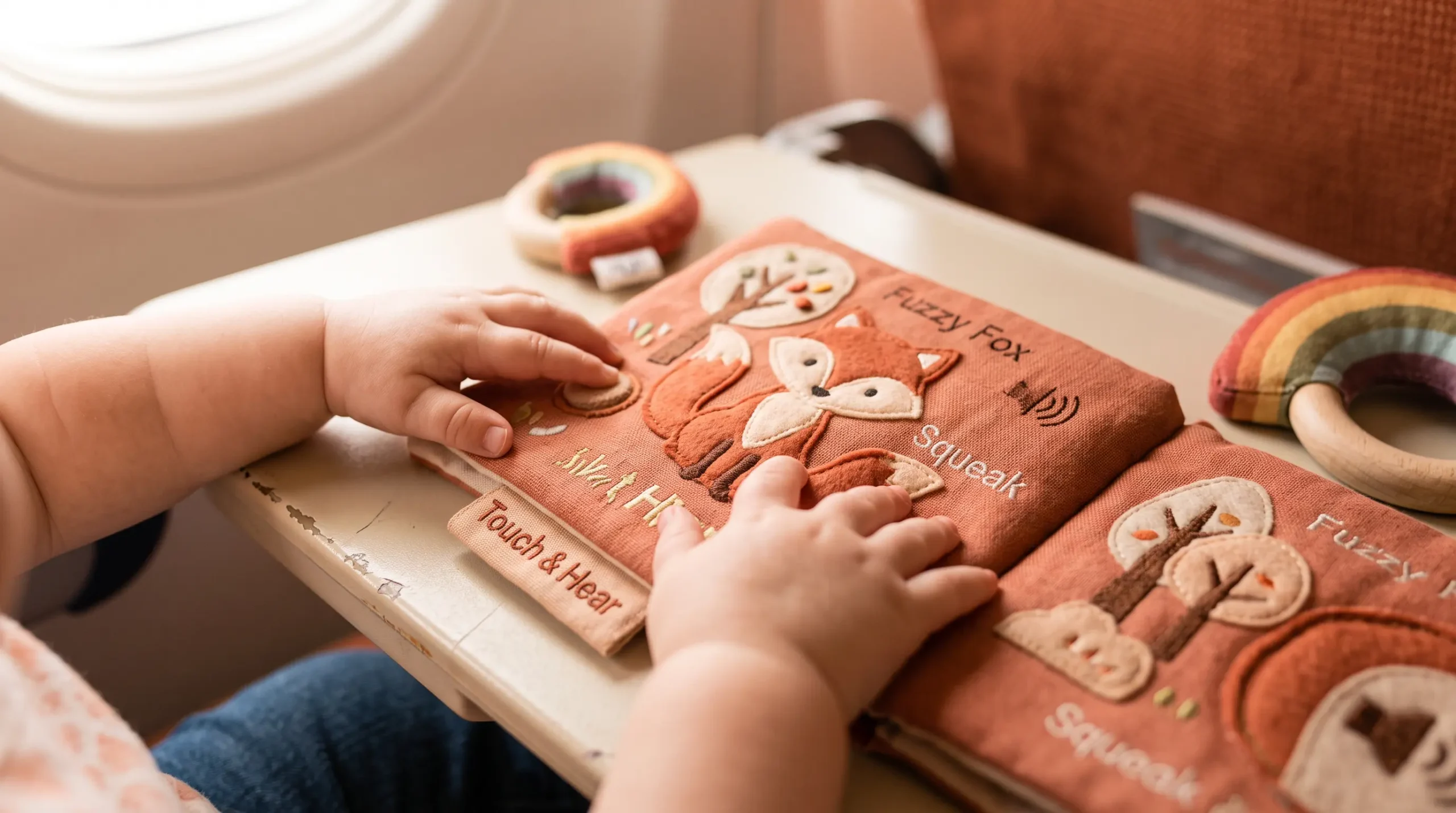
Skip the hard plastic musical books that beep on a loop. A soft, non-rigid sound book gives just enough sensory feedback (crinkle, texture, a gentle sound built into the fabric) without the sharp electronic noise that annoys a whole plane row. It also survives being chewed, dropped, and sat on, which a hardcover book never does.
2. A Toy Phone ☎️
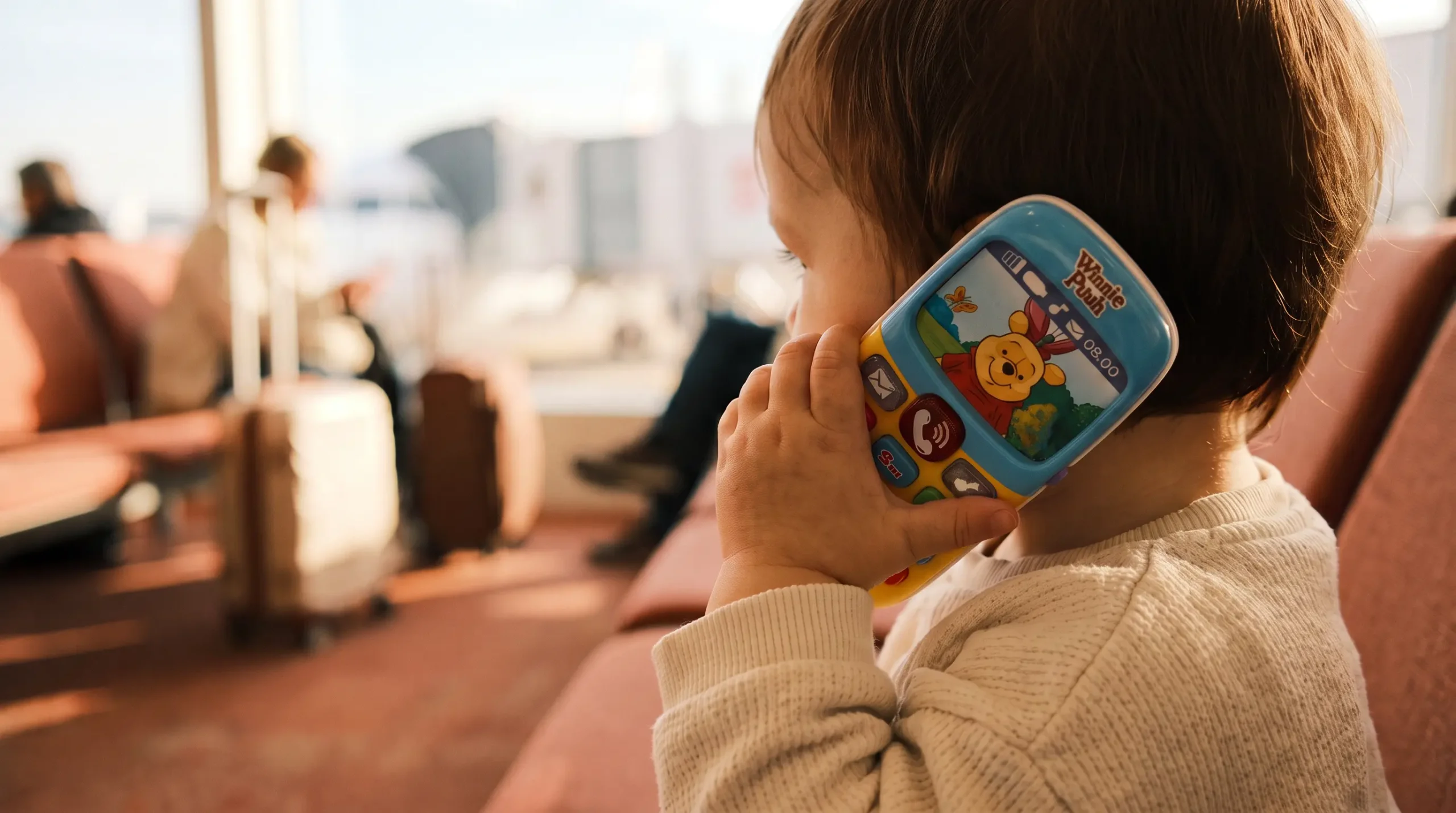
Around 10 months our daughter started pretending to call someone, holding anything phone-shaped up to her ear, and that phase genuinely lasted until 18 months. A small toy phone taps into that pretend-play stage perfectly, it is silent, light, and keeps her occupied for stretches a rattle never could.
3. A Round Sensory Toy with Textured Strings 🪢
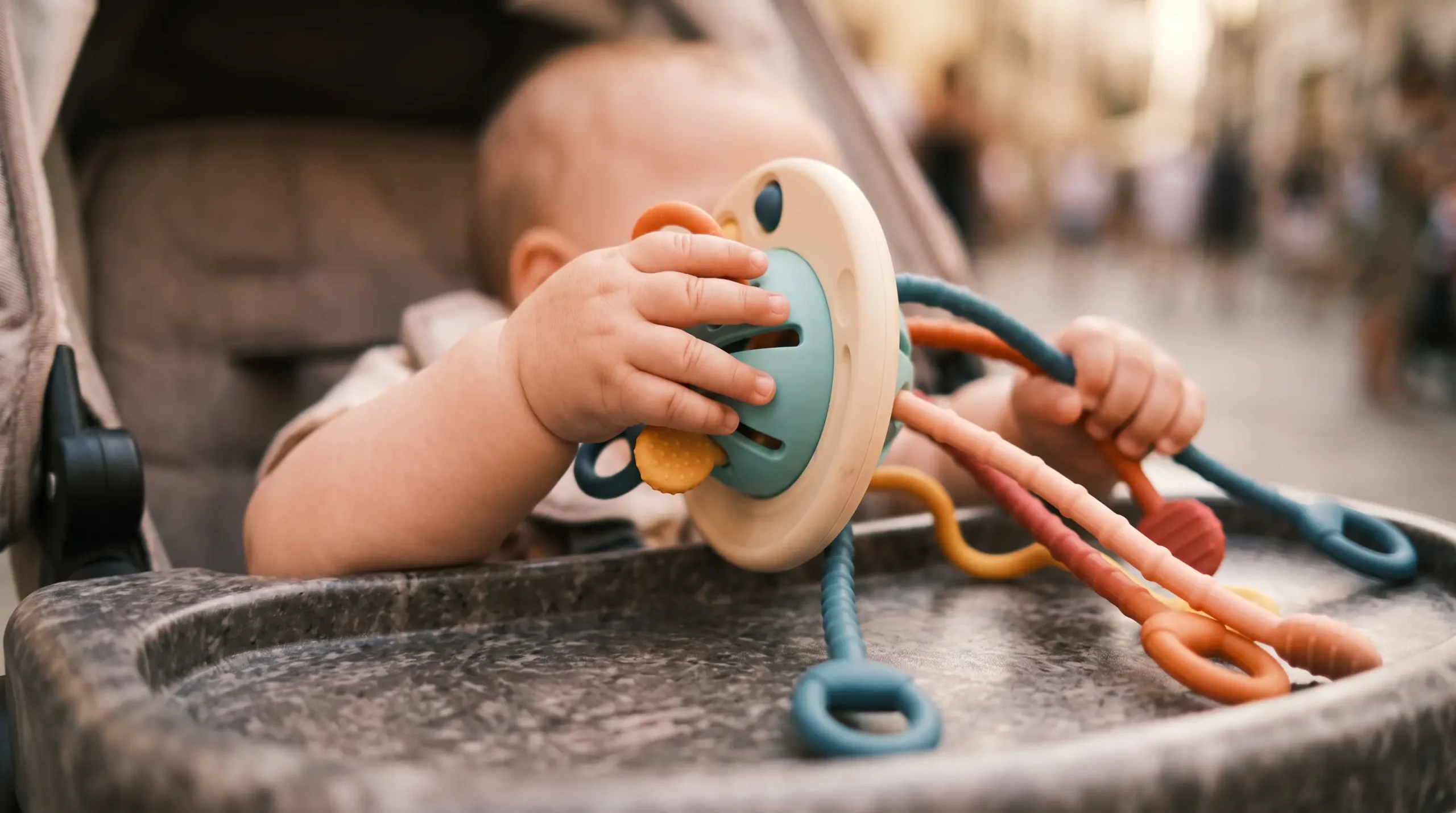
This one is easy to underestimate. A soft, rounded toy with cords or strings to pull and grip gives a 1 year old something to explore with both hands at once, which matters once the pincer grip kicks in. It is quiet, has no small detachable pieces, and travels well clipped to a bag strap.
4. Hair Clips (Attach, Remove, Repeat) 📎
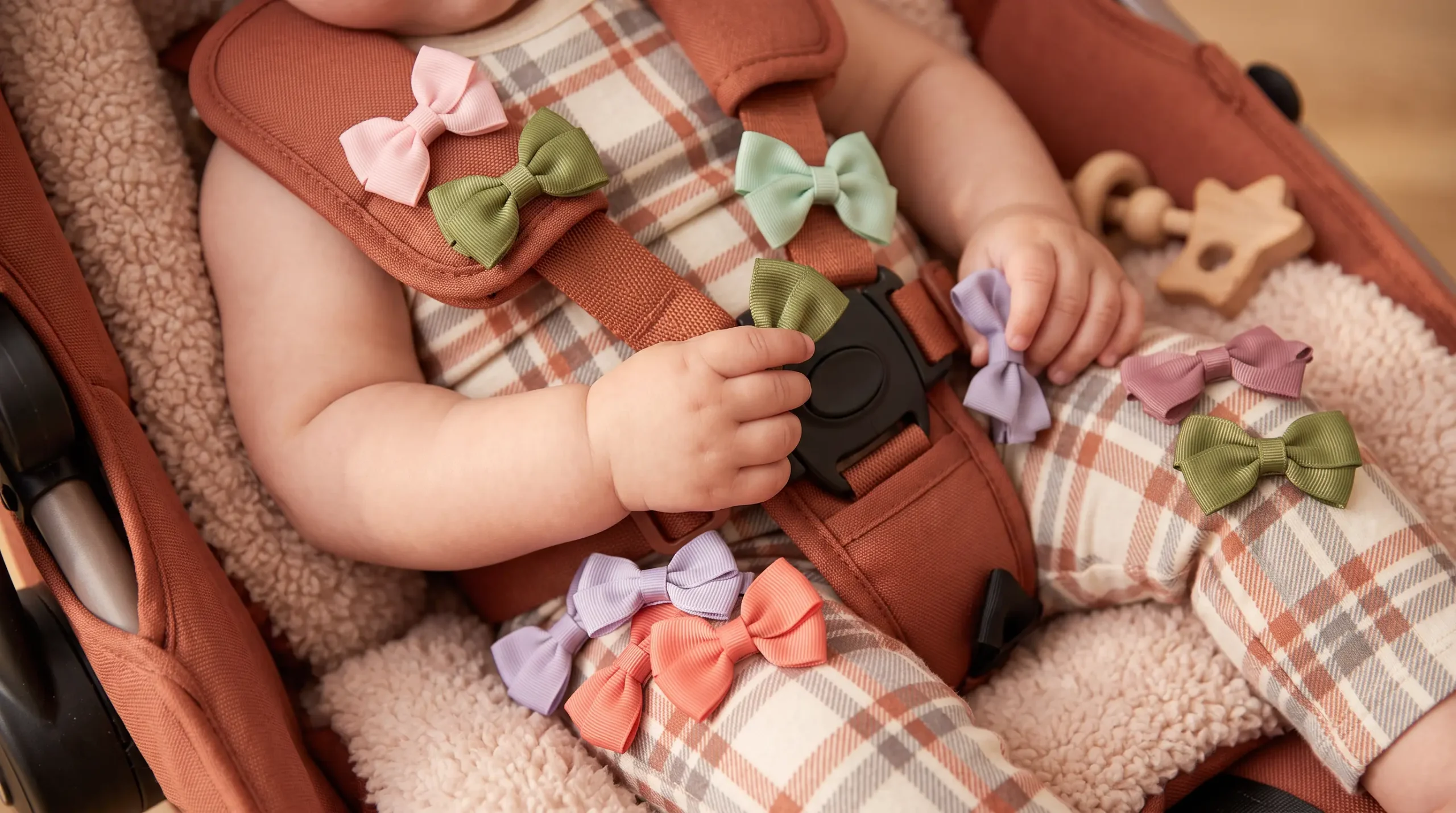
Not a toy in the traditional sense, but one of our most reliable tricks. Around 10 to 14 months, clipping a few colorful hair clips onto a strap or the edge of a bag gave her a simple task on repeat: pulling them off one by one. Once she got too good at removing them (around 14 months), the game lost its challenge, but for that window it was free entertainment we already had in our bag.
5. Tape or Sticky Notes to Peel Off 🩹
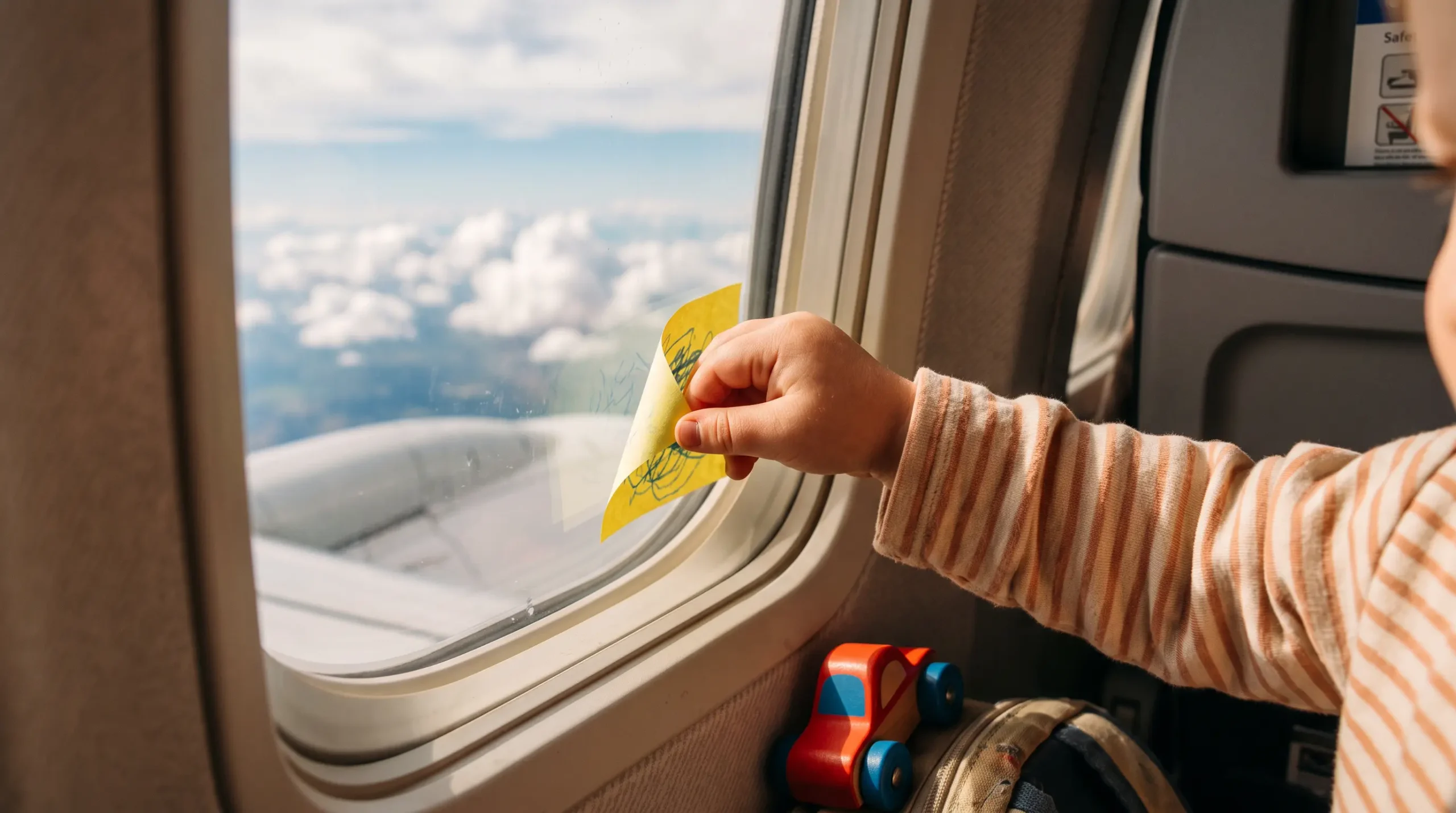
A strip of low-tack tape or a sticky note pressed onto a tray table or window works the same way as the hair clips: something to grab, pull, and peel off, then hand back to stick again. It costs nothing, takes zero space to pack, and the peeling motion is genuinely good fine motor practice at this age.
Travel Toys to Avoid at This Age
At 1 year old, the stakes on toy safety are genuinely different than they were even three months ago. Some of what to leave home is a real safety issue, some is just a practical headache waiting to happen. Worth knowing the difference.
A lot of toddler travel toy lists mix in items built for 2 to 3 year olds, like small magnetic tiles or mini figurines. They’re fun toys, just not safe ones yet for a 1 year old who’s still testing everything by mouth.
🚫 Actual safety risks, non-negotiable
- Toys with any small or detachable part. If it fits inside a toilet paper tube, it’s a choking hazard for this age.
- Mini magnetic tiles, small plastic animal figurines, and die-cast toy cars. These are genuinely great toys, just not yet, they’re built for the 2 to 3 year age range once a child has outgrown mouthing everything. At 1 year old the pincer grip is sharp enough to pick these up and put them straight in the mouth.
- Strings or cords longer than about 7 inches, a real strangulation risk in a confined car seat or plane seat.
- Toys with a loose or unscrewed battery compartment. Button batteries are a medical emergency if swallowed.
- Balloons, inflated or not, a well-known choking hazard for children under 8.
😩 Not dangerous, just a headache you don’t need
- Anything electronic with music or sound effects. Even “quiet” ones are rarely quiet enough for a full flight.
- Anything that rolls. A dropped ball or marble-shaped toy on a plane is genuinely gone until landing.
- A brand-new, untested toy. Test anything unfamiliar at home first so you’re not troubleshooting it mid-flight.
Quick safety check before you pack: if you don’t have a proper choke tube on hand, a standard toilet paper roll works the same way. If a toy or any of its parts fits entirely inside the tube, it’s not safe for a child under 3, no exceptions, regardless of what the packaging says.
Free and Budget-Friendly Alternatives That Work Just as Well
You don’t need to spend anything to keep a 1 year old entertained on a trip. Some of the most effective travel toys aren’t toys at all, they’re everyday objects your baby hasn’t been allowed to play with yet, which at this age is most of the entertainment value right there.
🥤
An empty cup with a lid
Genuinely one of the most requested “toys” by babies on flights. Ask the flight attendant for a spare cup, it costs nothing and holds attention for a surprising stretch.
🧦
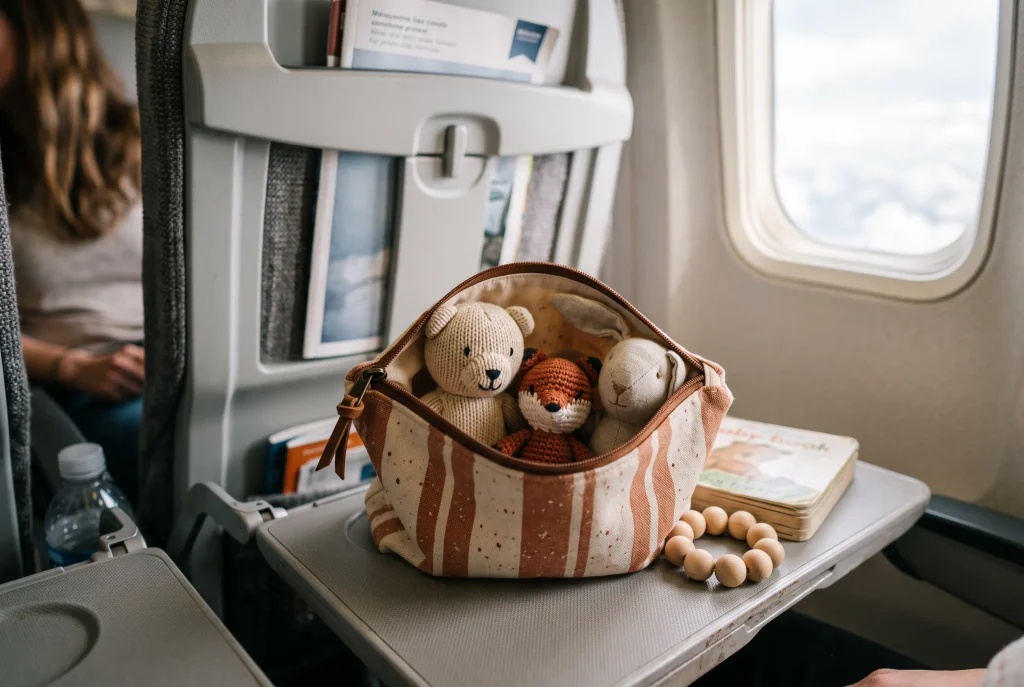
A small pouch with a zipper
Zip it, unzip it, repeat. The fine motor challenge alone is entertaining at this age, and it costs you nothing you don’t already have in your bag.
🧻
Painter’s tape
A short strip stuck to the tray table or a car window for peeling and re-sticking. Low-tack tape won’t damage surfaces and it’s endlessly re-usable.
🥛
Snacks in a lidded snack cup
Fishing individual puffs or cereal out of a small opening is a real fine motor task at this age, and it doubles as an actual snack, not just a distraction.
My honest take: the novelty of “you’re not usually allowed to play with this” often outperforms an actual toy at this age. Save one household object you know your baby is curious about, a set of keys, a small unbreakable mirror, a clean spoon, specifically for the trip. It doesn’t cost anything, and it works because it’s new, not because it’s expensive.
Frequently Asked Questions
What toys should I bring for a 1 year old on a plane?
Stick to silent, self-contained toys: a suction spinner for the window, a soft felt busy board, a lift-the-flap board book, and a familiar teether for takeoff and landing. Anything with sound, small parts, or loose pieces is best left at home.
How many travel toys does a 1 year old actually need?
5 to 7 toys is plenty for most trips. Rotate through them one at a time roughly every 15 to 20 minutes rather than handing everything over at once.
What car toys are safe for a 1 year old in a car seat?
Linking rings clipped to the headrest bar, soft pull-back cars, busy boards, and cloth crinkle books all work well. Never attach a toy directly to the car seat’s harness, straps, or handle.
Do 1 year olds need screen-free toys for long trips?
They don’t need a screen to stay entertained. A well-timed toy rotation, snack-based activities, and a couple of household object surprises can cover a 2 to 3 hour trip without a tablet.
What household items work as travel toys for a 1 year old?
An empty cup with a lid, a small zippered pouch, painter’s tape, and a lidded snack cup filled with puffs are all free, effective options that cost nothing extra to pack.
How do I keep a 1 year old entertained on a road trip?
Keep 2 to 3 tethered toys within reach at all times, store the rest in a soft pouch beside them, and rotate every 15 to 20 minutes. Plan stops so your baby gets real time out of the seat too.
What toys should I avoid bringing on a flight with a 1 year old?
Avoid anything with small detachable parts, loud sound effects, strings longer than 7 inches, loose battery compartments, or balloons. Test unfamiliar toys with a toilet paper tube before packing.
Should travel toys for a 1 year old be new or familiar?
A mix works best. Keep one or two familiar comfort items for settling in, and save one or two new or novel objects, even household ones, as surprises for the harder stretches of the trip.
Sources
- U.S. Consumer Product Safety Commission (CPSC), small parts and choking hazard regulations for children under 3
- American Academy of Pediatrics (AAP), toy safety and age-appropriate play guidelines
- Nemours KidsHealth, Choosing Safe Toys for Babies and for Toddlers and Preschoolers
- Safe in the Seat, car seat toy attachment safety guidance
- Seattle Children’s Hospital, button battery and toy safety resources
My Verdict
Five quiet, safe toys and a rotation plan will get you further than a bag full of everything your baby owns.
The 12-24 month window is narrower and more specific than most travel toy lists admit. Your baby’s pincer grip means the small-parts rule matters more than it did six months ago, and their attention span means a good rotation plan matters more than the toys themselves. Keep it simple: a handful of safe, silent, drop-tolerant toys, a loose 15 to 20 minute swap rhythm, and a couple of free household surprises in your back pocket for the hardest stretch of the trip. That’s genuinely enough.